How to Identify Breakout and Breakdown in Stocks

Traders use various strategies while trading and one of the most popular and widely used strategies are breakout and breakdown. Identifying breakout and breakdown gives traders an edge as they can use these strategies to make informed decisions.
Though there are a variety of techniques in technical analysis from straightforward price action to more advanced setups, these two concepts work by capturing big moves in the market. These two concepts are based on past price action and can act as powerful indicators to buy or sell a security. In this blog, we will look at how to identify breakout and breakdown patterns that traders actually use to take a trade.
What is breakout?
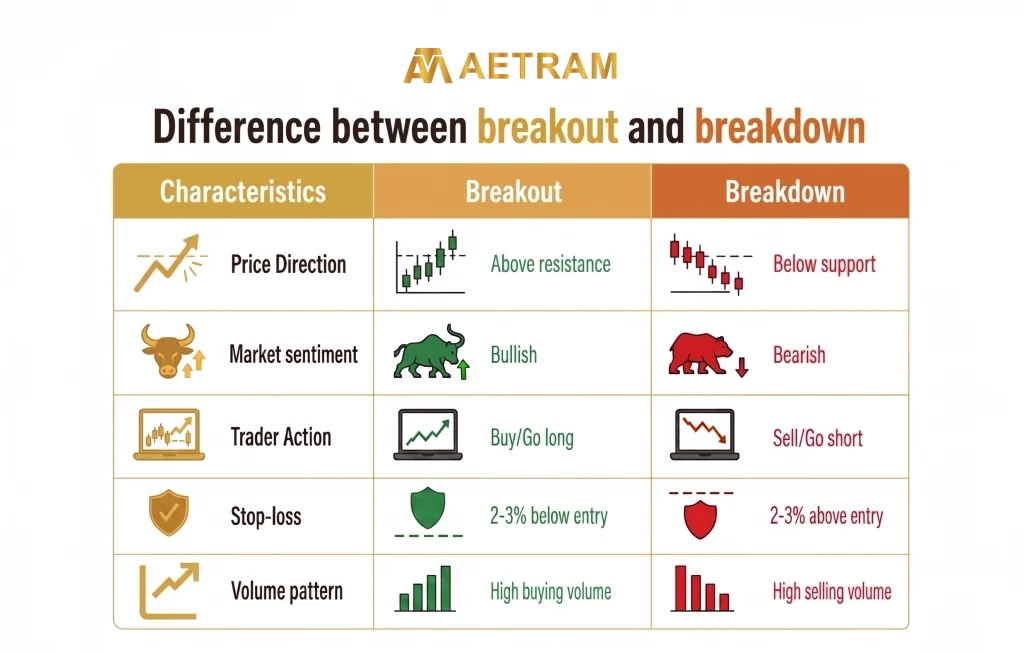
A breakout is an event which occurs when there is a sudden price rise of a security along high trading volumes crossing above key resistance area. This means that the number of buyers have outnumbered the number of sellers in that resistance area.
Earlier it would not have been the case because the price had a resistance around that price level as traders used to sell when the price of a stock reached that level. It also means that there is more supply around this price level.
However, buyers become more confident and optimistic now than before when price reaches the resistance level and start pushing the price higher breaching the resistance level.
When the resistance ceiling is broken then it means that the momentum of a stock or security has turned bullish. This resistance can also act as support after the price moves higher.
What is breakdown?
A breakdown happens when the price of a stock or security drops below a key support level. This might happen when the number of sellers has outnumbered the number of buyers.
A support level is formed when buyers start buying a stock or security in large numbers around a price level. It also means that there is a lot of demand around that price level which led to the formation of support levels.
However, when buyers stop buying around the support level and sellers become dominant, the price starts moving downward to a new lower range.
When there is a breakdown, the price drop is not temporary and it signals a new downtrend and the price can fall further. It is a clear sign that selling pressure has taken over buying pressure.
How to identify breakouts and breakdowns
Technical analysis is not 100% guaranteed and it works only in probabilities. So traders who frequently use breakdown and breakout to take a trade should not solely depend on them. They must use other technical indicators for confirmation and also to distinguish between genuine price movement from false breakouts or breakdowns. It will also improve the likelihood of the event happening and provide a better picture. Let us take a look at other technical analysis tools which can be used for confirming breakout and breakdowns.
Trendlines
Trendline is a simple but very useful technical tool which can be used to determine the trend as well as identify breakout and breakdown. A trendline can be drawn by connecting the higher highs and higher lows or lower highs and lower lows.
When you can draw a trendline by connecting higher highs and higher lows, then the price is in an uptrend. So when the price drops and breaches below an ascending trendline, then it is a breakdown.
Similarly, when you can draw a trendline by connecting lower highs and lower lows, the price is in a downtrend. So when the price rises and breaches above a descending trendline, then the price has seen a breakout.
You can also draw a horizontal line which represents resistance and support. And when the price breaches a resistance line with strong volumes, then it is a breakout and when the price breaches a support line with strong volumes, then it is a breakdown.
Analysing volume data
Volume data plays a very important role in technical analysis as it offers valuable insights into market sentiments and the strength behind any price movement. Analyzing the volume data will tell you how many shares were bought and sold over a specific period. This period can be 1 second or 1 minute or 30 minutes1 hour or 1 month, etc.
Volume can be used to interpret how active the market is and it also tells you about the liquidity available related to a stock or security. If the volume is higher than the average volume in the last one month or any duration for that matter, then there is a renewed interest among market participants. However, if a price moves up or down drastically with low volumes, it may indicate that the price movement is weak and may return to earlier price levels.
Moving Average
Moving average technical indicators can be used to identify breakout and breakdowns. A moving average is an indicator that smoothens out the price of a stock or a security to help identify the overall trend. If the price is trading below the key moving average like the 50-day or the 200-day line and breaks above the lines then it can be considered as breakout.
In contrast, if a price is trending above these lines and falls below these lines then is is considered breakdown and it indicates a trend reversal where the price is expected to fall further. These moving average lines can act as a dynamic resistance or support lines also.
Further, market participants also keenly follow crossovers between shorter-term and longer-term averages, such as the 20-day, 50-day, 100-day or 200-day lines. When the shorter-term lines like the 50-day line crosses above the longer-term lines like the 200-day , it is often seen as a bullish sign, confirming a breakout. On the other hand, when the short-term line crosses below the long-term one, it may indicate a trend reversal and a bearish sign.
Conclusion
Breakouts and breakdowns do not happen suddenly but it is preceded by accumulation or distribution. They develop gradually, often over a few days or weeks. Whenever a breakout or breakdown happens, it normally reveals whether buyers or sellers are in control of the prices. As a trader or investor, you can track these price movements to make informed decisions to buy or sell a security or even stay on the sidelines.