How to Analyse Debt Levels Before Investing in a Company

Investing in a company is a risky proposition as the company can go bust at any time due to many factors and among them rising debt levels is a big red flag. It is important for an investor to analyze the company’s debt situation before investing because if the company cannot repay its debt, it would be forced to file for bankruptcy and liquidate its assets.
Taking loans or raising capital through debt can be a useful method to meet any urgent financial requirement or for business expansion and improve shareholders’ returns. But if the debt is not paid promptly and it is unchecked, it can start to weigh on the company. If a company takes on too much debt or manages it poorly, it can severely hurt shareholder value and in some extreme cases. It can lead to financial collapse. Let us take a look at how to analyze debt as an investor in this blog.
What is debt?
A debt can be taken by an individual or a company for many reasons including buying property, equipment, machinery, land, business expansion, paying off existing loans, etc. We are going to focus on company debt and why they take debt.
A company takes debt for business operation or for business expansion. A debt is borrowed money from banks or financial institutions for a fixed tenure and it must be repaid to the lender with interest. This borrowed money is shown on the liabilities side of the balance sheet.
Difference between debt and equity
Companies often choose to borrow money rather than sell shares because raising funds through debt is generally less expensive than through equity. Further, when you take debt, the ownership of the company does not change among shareholders and the present owners can retain full control.
Another reason is a company can access funds quickly through loans or bonds without going through lengthy approval processes. The promoters of the company also need not dilute their stake in the company.
Any interest payments on debt can be deducted from taxable income and this will reduce the company’s overall tax burden and save on taxes.
Different types of debt
There are different types of debt which a company takes based on its requirements and payment capacity. Let’s take a look at them.
Short-term debt
This type of debt is taken by a company to meet its short-term financial obligations. It is usually for less than a year or up to one year and they have to service their debt within one year. The company will use these funds to meet their working capital needs. In other words, the money will be used for everyday business needs like managing cash flow, paying daily expenses or monthly expenses, supporting operations, etc.
For instance, the requirements would be accounts payable (like trade credit), short-term loans from banks, revolving credit lines, overdrafts, commercial paper, and unpaid bills such as employee salaries or taxes, etc.
Long-term debt
Long-term debt is a type of financial obligation which a company can repay even after one year. This type of debt is important for a company’s long-term growth and capital structure. The capital raised through long-term debt can be used for significant investments such as purchasing new equipment or land or machinery, starting a new project or funding research and development projects. These funds can be used for its capex requirements.
Some examples of long-term debt can be term loans from banks or corporate bonds. Long-term debt often comes with lower interest rates and longer repayment schedules compared to short-term debt and this helps companies to finance large long-term projects.
Long-term debt is advantageous to companies because of operational flexibility and the leeway to focus on long-term opportunities for growth. But it also comes with risks, including the potential for increased financial burden if the company’s revenues fail to meet expectations, if a project completion time gets extended or mismanagement of raw material costs. Properly managing long-term debt is important for a company by balancing the benefits of accessing capital with the responsibilities of paying back interest and principal amount.
Convertible debt
Convertible debt is a type of debt which is used by early-stage startups or fast-growing companies to get the required funds at a cost-effective rate. The advantage with this type of debt is that they can convert the debt into equity at a later stage. This gives the company flexibility to meet their urgent fund requirements as well as formal fundraising. Once the debt is converted to equity, the company need not pay interest on it.
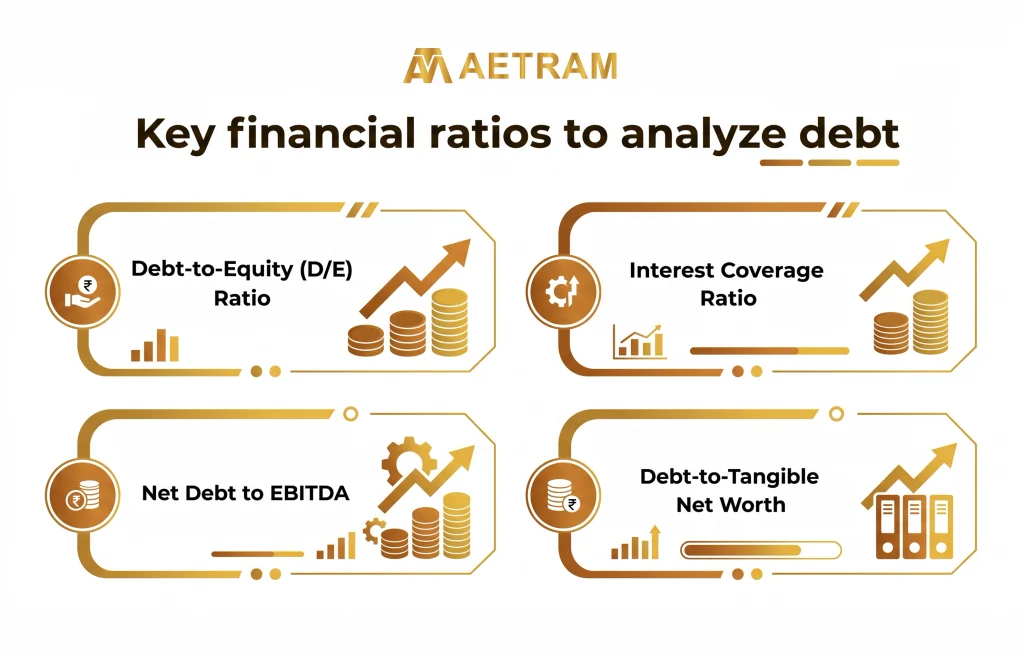
Important financial ratios to analyze debt
Before you start investing in a company, you must do the due diligence on the financial health of the company. And part of the due diligence is analyzing how much debt a company has on its books.
For checking this you should look at the balance sheet and the liabilities side of the balance sheet over a period of at least 3 years and check if there is an upward trend in overall debt. You can calculate the debt levels using financial ratios like like debt-to-equity or interest coverage, etc.
A- anything under 1 is usually good) and measuring interest coverage to make sure its earnings are enough to meet interest payments. A low debt-to-tangible net worth ratio is good, as the lower it is the lower the risk of the company defaulting. Ratios can also be compared to other companies in the same sector in order to determine appropriate levels of debt.
Debt-to-Equity (D/E) Ratio
This ratio can be calculated by dividing total liabilities by the company’s shareholders’ equity. If a company has a D/E ratio less than one, then it is a fairly safe company. If the ratio is greater than 2 or 3 then it indicates significant risk. However this may differ between industries because manufacturing or infrastructure may have higher debt levels due to its capital intensive nature.
Interest Coverage Ratio
The formula for this ratio is EBIT divided by interest expense where EBIT stands for earnings before interest and taxes. The ratio measures the company’s ability to pay the interest on its debt with its own earnings. A high interest coverage ratio like 2 or more is a positive sign for the company as they can pay their interest comfortably when it is due. .
Net Debt to EBITDA
The ratio is basically used to determine how long it will take for a company to pay off its debt using its operating earnings. If this ratio is low, it suggests that the company is in decent shape financially. But if it starts to increase and surpasses four or five, then it indicates that the company might be in some sort of a financial distress and it would be a risk for the investors.
The formula is net debt divided by EBITDA where net debt is equal to the total debt minus cash and its equivalents. EBITDA stands for earnings before interest, taxes, depreciation, and amortization.
Debt-to-Tangible Net Worth
This ratio is useful to find if a company can pay their debt with their tangible assets. The ratio is calculated by dividing its debt by its tangible net worth (net worth less intangible assets). A ratio of less than 1 means the company is in a safe situation to cover its debt by selling its tangible assets.
Impact of debt
A company that takes out a loan or debt, must regularly pay interest which will eat into their profits. These interest and principal payments are fixed costs and must be paid even if there is not enough revenue or other operating costs increases. If the debt rises and the company is unable to service them then it will increase the financial burden on the company.
When you take debt then you have to pay both interest and principal mandatorily on the said date. If a company’s cash flow reduces and the company fails to make the mandatory payments then there is a risk of defaulting. This would lead to severe consequences like the company filing for bankruptcy, selling their valuable assets and moreover shareholders may lose all of their investments in the company.
Markets tend to treat companies with high debt less favorably as the risk of default is higher and there is uncertainty if the company will be able to survive in the long run. If the company is unable to service the debt promptly, it increases the cost of borrowing for the company which would lead to less profits and less money for reinvestment, innovation or dividends.
Companies with high debt levels will have less financial flexibility, making it hard to adapt to competition and sudden economic changes or business needs. As a result, investors demand higher returns to compensate for the added risk, which ultimately pressures stock prices down because the market values these companies lower when uncertainty increases.
Even credit rating companies like Crisil, Icra, etc. will give lower ratings to companies with higher debt levels and lower repaying capacity. This will weigh on the company and make it difficult for them to raise funds with favourable interest rates.
Conclusion
Debt can be a powerful tool for companies as it can help the company to drive expansion and fuel growth. As long as the company is able to create assets for the company using the debt, the company is managing debt fairly well. Having said that, if the debt is not paid off promptly, the interest will start to compound and it would become a major liability and weigh on the companies’ financial health. So it is important for an investor to thoroughly analyze the debt levels of the company before investing.