NSE Vs BSE
When people embark on investments in the stock market, they find two names often used together which are NSE and BSE. Both refer to India’s prominent market where stocks and securities are traded for purchase and sale. Even as they perform the same duty, they have their own history and traits. Learning about the functioning of NSE and BSE can help an investor by giving more confidence in them when they trade or make an investment.
What Are NSE and BSE?
The Bombay Stock Exchange or BSE is the oldest stock exchange in the country of India and it is one of the oldest stock exchanges in Asia. It was established more than one century ago and it played an important part in developing stock exchanges in India. It is now an enormous stock market with thousands of registered companies.
The National Stock Exchange also known as NSE started much later in a more modern way. Right from inception, NSE has been an electronic stock exchange and this has been a factor that brought pace and efficiency to stock dealings in India. Even today, both stock exchanges operate in a highly computerized way.
Similarities Between NSE and BSE
Although NSE and BSE have distinct origins, they share a number of commonalities. Both are controlled by the Securities and Exchange Board of India also known as SEBI which ensures that they provide a safe and sound environment for the traders.
Both of the exchanges enable trade in diverse financial instruments like stocks, derivatives, exchange traded funds and bonds. Traders can trade on both exchanges using their trading accounts and Demat accounts to buy and sell stock. Real-time pricing and electronic order execution facilities are provided on both exchanges.
Differences Between NSE and BSE
One of the key points that distinguish NSE from BSE is trading volume. It is observed that NSE is a highly traded market meaning that stocks are more liquid. The result is that it becomes easy for investors to purchase and sell stocks without creating a considerable impact on their prices.
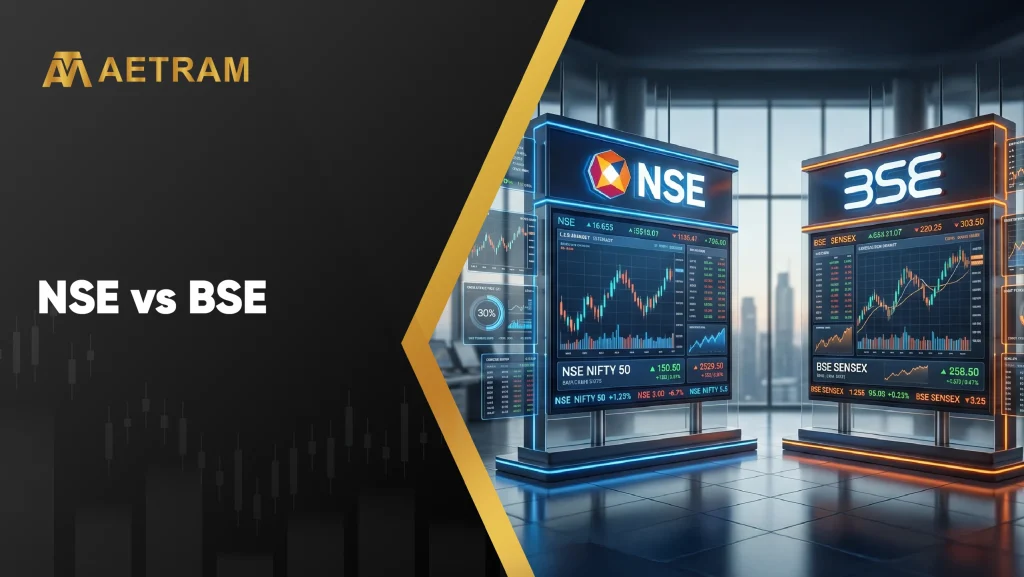
There are also some differences in their benchmark indices. BSE’s main index is known as Sensex. Sensex consists of the top 30 large and well-established firms. The main index for the National Stock Exchange (NSE) is known as the Nifty 50. The Nifty 50 consists of the top 50 large firms. Though both display the same stock markets’ performances, the former gives an overview of the markets.
Technology also distinguishes them apart. NSE introduced online trading right from the onset which made it quite appealing to many traders. BSE started with a traditional method before shifting to an online platform. Currently, both exchanges have incorporated advanced technology, although NSE had an upper hand due to its online presence right from the onset.

Which Exchange Should Investors Choose?
For an average investor, NSE vs BSE is not a big concern. Several companies are listed on both stock exchanges and most stock brokers also offer trading services on both stock exchanges. Day traders usually prefer NSE stock exchange due to greater liquidity whereas other people use NSE or BSE stock exchange depending on convenience or availability of stock.
Two Pillars of India’s Stock Market
Both NSE and BSE contribute significantly to the stock market in India. Though both stock exchanges have differences in their past, size and level of trade activity, both enable an effective marketplace with efficiency and transparency. Being aware of the differences between both helps investors trade in the stock markets effectively. No matter whether it is an NSE trade or a BSE trade, success always requires patience and planning.
Explore Aetram, a SEBI-registered stock broker offering transparent and reliable market access for informed trading across NSE and BSE.