What Are Brokerage Charges, STT and Other Stock Market Trading Costs in India?
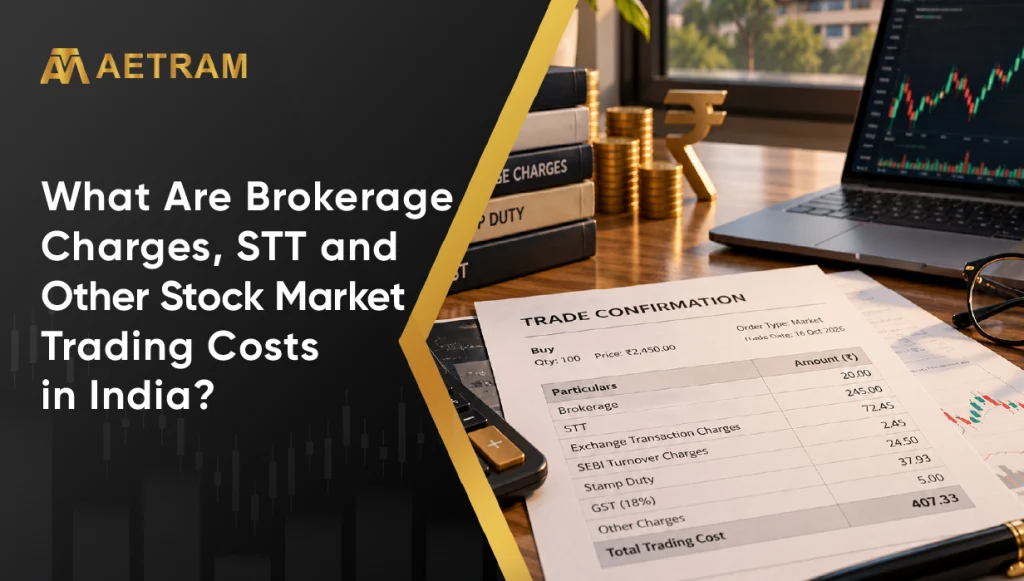
The price at which you buy or sell stocks is not the sole criterion to keep in mind when participating in the stock market. Each transaction incurs brokerage, tax, exchange charge, among others. These charges might reduce your profits or raise the cost of your investments, particularly when trading often. Knowing stock market trading charges in India would help you calculate your expenses, compare brokers and make better trading decisions.
In this blog, let us take a look at the important stock market trading charges, how it is calculated and what one must know before executing a trade.
What are Stock Market Trading Charges?
Stock market trading charges include fees and taxes incurred from the buying and selling of securities via stockbrokers. Some of the charges are charged by the broker for his/her service while some are levied by the government, stock exchanges or other regulating authorities. The charges you incur will depend on the following aspects, amongst others,
- Whether the stocks bought or sold are for delivery or for intraday trading
- Futures and Options (F&O) trades
- The value of the trades
- Brokerage plans
- Exchange charges, etc.
Even if the broker promises no brokerage for the selected kind of transaction, there might be other statutory charges.
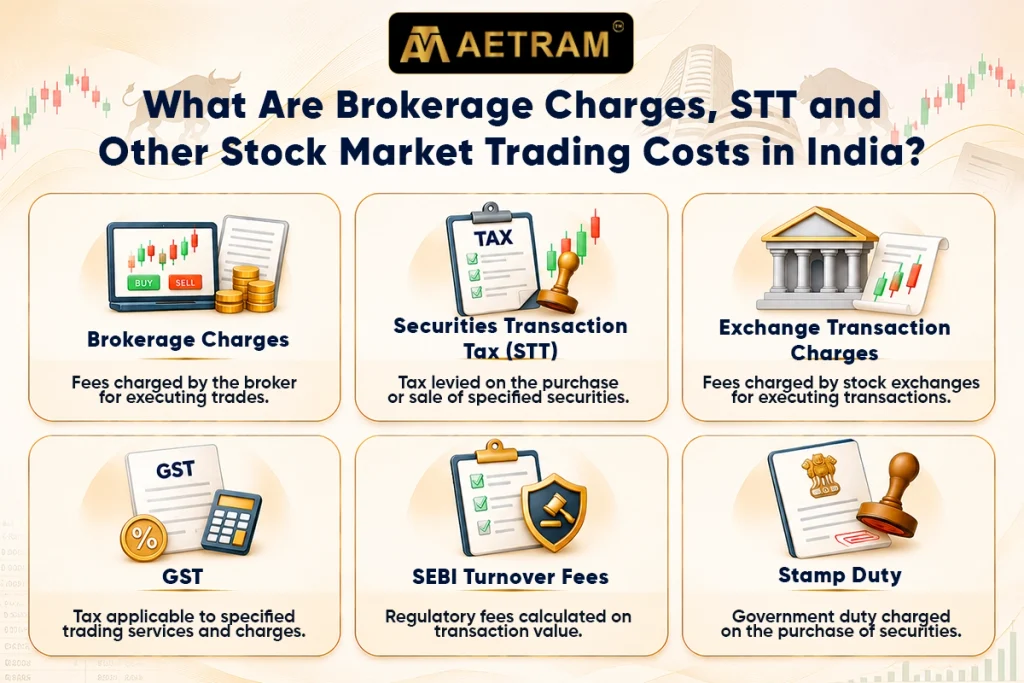
1. Brokerage Charges
Brokerage refers to the cost charged by the stock broker for executing your order. This is one of the trading charges that investors have to verify before starting their account. The brokerage charge varies from broker to broker depending upon their charging pattern.
How Are the Brokerage Charges Determined?
The brokers can charge the brokerage in the following manner:
- Percentage of brokerage: A percentage of the transaction value.
- Fixed brokerage: A pre-determined charge on each executed order.
- Zero brokerage: Zero brokerage for some specific transactions eligible.
For instance, let us take an example that a broker charges ₹20 for each executed order. If you place two orders to buy and sell the shares, then the total brokerage will be ₹40, taking into consideration that both the orders get executed at the same charge per order. However, this does not mean that your total trading charge is ₹40 only. There are other charges and tax also applicable. Before selecting a broker, verify the brokerage charge for equity delivery, intraday trading and futures & options.
2. Securities Transaction Tax (STT)
Securities Transaction Tax or STT is the tax charged by the government on certain types of securities transactions made through recognized stock markets. STT is charged via the process of trading. The tax rate charged varies according to the nature of the transaction made.
Commonly Traded Equity Instruments STT Rates
| Transaction type | STT rate | Who pays? |
| Equity delivery purchase | 0.10% | Buyer |
| Equity delivery sale | 0.10% | Seller |
| Equity intraday sale | 0.025% | Seller |
| Sale of equity futures | 0.05% | Seller |
| Sale of equity options | 0.15% of option premium | Seller |
| Exercised equity options | 0.15% of intrinsic value | Purchaser |
As of November 2026, the most relevant STT rates for commonly traded equity instruments are:
The above rates are based on the STT rate schedule applicable from April 1, 2026. STT will be charged based on different schedules for other types of transactions.
Example of Calculation of STT
Let us assume that you buy shares worth ₹50,000 for delivery and later sell them for ₹55,000.
STT on Purchase: ₹50,000 × 0.10% = ₹50
STT on Sale: ₹55,000 × 0.10% = ₹55
Total STT: ₹105
This is the STT part of the transaction. You also need to factor in brokerage and other applicable charges while calculating your costs of trading.
3. Exchange Transaction Charges
Stock exchanges charge transaction fees for handling trades on their platform. The transaction fee charged by stock exchanges is called exchange transaction charges. It depends on the applicable rate and exchange on which the trade is executed. There can be different applicable rates for equity trades and derivatives trades, among others. The amount for a single trade may not seem much but it can pile up if you place many orders. Check the applicable exchange transaction charges from your broker’s pricing schedule/brokerage calculator.
4. Goods and Services Tax (GST)
Goods and Services Tax (GST) is charged on brokerage and other specified service charges. The GST rate applicable for the services provided by stock brokers is 18%. GST is calculated on the charges related to the taxable service, like brokerage, exchange transaction charges and SEBI turnover charges.
Example:
Assume that the charges applicable in the case of a particular transaction are:
- Brokerage charge: ₹20
- Exchange transaction charge: ₹5
- SEBI turnover charge: ₹0.10
Total of above charges will come out to be ₹25.10. At 18% GST, the tax would be approximately ₹4.52.
The above illustration is just for understanding purpose only. You will have to pay GST based on the charges applicable to your transaction and broker. GST and STT are different from each other. STT is a securities transaction tax, but GST is applicable to the specified service charges.
5. Stamp Duty
The stamp duty is a tax imposed by the government on security transactions. In case of exchange transactions, it is normally charged to the buyer, depending on the nature of the instrument or transaction involved. These are common rates:
| Transaction type | Stamp duty rate |
| Equity delivery purchase | 0.015% |
| Equity intraday purchase | 0.003% |
| Equity futures purchase | 0.002% |
| Equity options purchase | 0.003% |
Such percentages apply to the price of the transaction as specified in the cases. Stamp Duty applies on the buy side of such transactions. So, when buying stocks worth ₹50,000 for delivery, then the stamp duty will be 0.015%, which equates to ₹7.50. The computation basis varies depending on the instrument, derivatives, etc; hence, it will be better if you referred to the rules for your particular segment.
6. SEBI Turnover Charges
Securities and Exchange Board of India (SEBI) regulates the securities markets in India. SEBI turnover charges are used for funding its regulatory activities. SEBI turnover charges amount to ₹10 per crore of the value of the transaction, i.e. 0.0001% for normal securities transactions. Therefore, if the value of your transaction is ₹1,00,000, then the SEBI turnover charge will be ₹0.10. The amount is very small when looking at an individual transaction.
7. Depository Participant (DP) Fees
The DP fees are the fees associated with the debiting of the shares from the demat account. In normal stock delivery trading, the DP fee will apply in case you have to sell the stocks which are debited to your demat account. The DP fee is calculated according to the cost structure of the depository and fees that are levied by the broker. It can be charged per share or per debit. There is no DP fee in normal intraday trading, wherein the shares are sold on the same day and are not delivered to the demat account.
8. Some Other Charges You Need to Know About
Besides those mentioned above, there may be some other charges applicable in some transactions. Account Maintenance Charges (AMC): Some brokers or demat account providers might charge AMC annually or periodically in relation to the maintenance of your account. This depends upon the service provider as well as the nature of the account.
Call & Trade Charges: Some brokers might impose some other charges for placing your order through call trade with the help of the broker/dealer and not the trading application. Auto Square Off Charges: Some brokers might impose some extra charges in case of auto square off of intraday position according to their policy.
Interest for MTF: In case you avail yourself of MTF for borrowing money for purchasing eligible securities, then some interest or other charges might be applicable. Charges related to penalty and delay in payment: Some other charges might be applicable depending upon some defaults.
All these charges are not applicable to all investors and all transactions.
How Much Does It Cost to Buy and Sell Shares?
Consider this example to understand how different charges can affect a delivery trade. Suppose you buy shares worth ₹50,000 and later sell them for ₹55,000.
| Particulars | Amount |
| Purchase value | ₹50,000 |
| Sale value | ₹55,000 |
| Difference before charges | ₹5,000 |
| STT on purchase | ₹50 |
| STT on sale | ₹55 |
| Stamp duty on purchase | ₹7.50 |
| SEBI turnover charges on both sides | Approximately ₹0.11 |
All the above costs amount to roughly ₹112.61 without taking into consideration the brokerage, exchange fee, GST on applicable service, DP fee or any other applicable cost. Thus, the balance from the ₹5,000 difference will be lesser once all the costs have been deducted from it.
The above example is purely demonstrative and may not give you the entire cost in every case of a broker or exchange. This cost will depend on your applicable rates. Moreover, the difference between the value at which you have bought and sold cannot always be the final profit that you can make.
How Can You Reduce Cost of Stock Market Trading?
While some costs are fixed by regulatory authorities, there are certain measures that you can consider for managing the overall trading cost.
1. Comparison of the Brokers
Make sure you compare the brokers that suit you in terms of segments you often trade. The brokerage structure of one may not suit another due to different trading pattern.
2. Consider Other Costs Apart from Brokerage
The lower the brokerage doesn’t necessarily make it the lowest cost structure. Make sure you compare the statutory charges, the demat charges, account maintenance charges, etc.
3. Don’t Trade for the Sake of It
Trading more often might increase the overall transaction cost. Make sure you don’t trade if you have no specific reason to do so and it is not your strategy.
4. Brokerage Calculation
There are brokerage calculators that will help you in calculating the costs that will be incurred as a result of a transaction. All that you need to do is enter the details of your transaction.
5. Read Your Contract Note
After each transaction, make sure you read the contract note and the statement of your transaction made by your broker.
Know Your Fees for Each Transaction
Fees for services like brokerage, STT and others that involve trading in the stock market may appear insignificant if looked at individually. Having this knowledge will help you gauge how much you’ll have to pay for the service. You need to find out how much the charge is per trade and then consider whether it will be beneficial to make the trade or not. Always look into the rates provided by the latest official exchange data and those by your broker.
Explore market screeners, watchlists andmake informed trading decisions with Aetram.
Frequently Asked Questions
1. What is the difference between brokerage and STT?
Brokerage is the fee charged by a stockbroker for executing orders. STT is a government tax levied on specified securities transactions. Both may contribute to the total cost of buying or selling shares.
2. Is STT charged on both buying and selling shares?
For equity delivery transactions, STT is generally charged on both the purchase and sale sides. For equity intraday transactions and equity derivatives, the applicable rules and rates differ.
3. Is GST charged on STT?
GST is generally applied to specified taxable service charges, including brokerage and applicable exchange and SEBI charges. STT itself is a separate tax and is not included in that GST calculation.
4. Are stock market charges the same for every broker?
No. Statutory charges follow the applicable rules, but brokerage, DP charges, account maintenance fees and other broker-specific fees may vary. Exchange transaction charges can also differ by exchange and segment.
5. How can I calculate the total cost of a trade?
You can use your broker’s brokerage calculator to estimate the charges before placing an order. For an accurate calculation, include the applicable brokerage, STT, exchange transaction charges, GST, stamp duty, SEBI turnover charges and DP charges, where relevant.