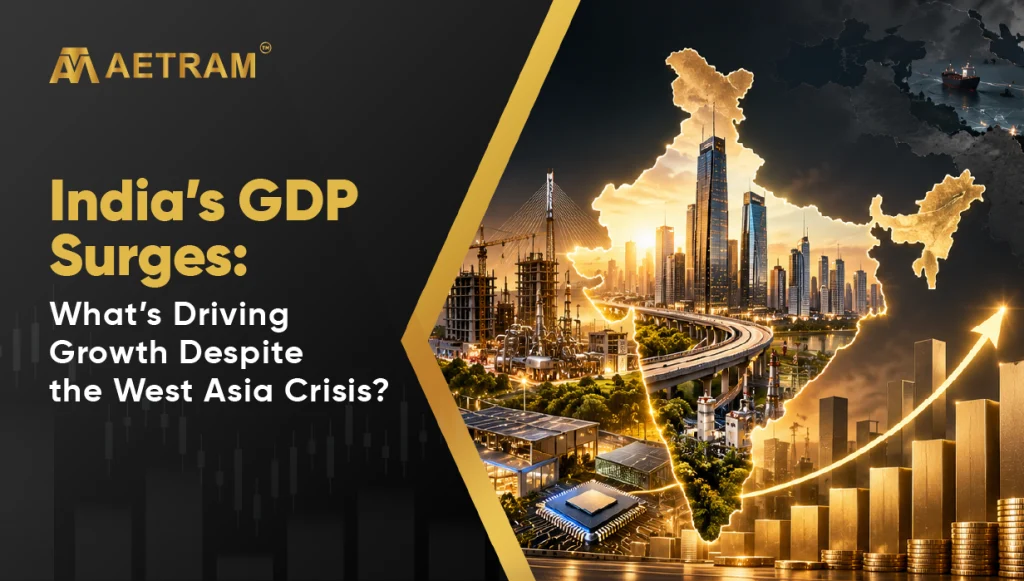
India’s GDP Surges: What’s Driving Growth Despite the West Asia Crisis?
The global economy is going through a structural shift which is threatening the idea of globalization. Sanctions, trade tariffs, geopolitical tensions, West Asia wars, oil price hike are all affecting many countries and India is not alone.
Though India is one of the big economies in the world, the fact that it imports more than 80% of crude oil makes the country vulnerable to any oil price shocks. Added to this, AI development is also weighing on the country’s IT sector. As a result, many global institutions and credit rating agencies reduced their forecast for the calendar year 2026.
But when the data arrived, many economists, analysts, observers, etc., were surprised. The country reported a real GDP growth of 7.8% during the period April-June 2026. This number was the fastest among major economies and it was above even India’s central bank RBI’s projection of 7%.
So how did India manage to grow faster than many economies even during such global tensions? In this blog, we will see the important economic indicators, the five reasons beyond the country’s growth, the policy cushions, and the risks that still matter in the coming months.
India’s GDP Growth in Q1 and Q2 FY27
The Ministry of Statistics and Programme Implementation released the Q1 FY27 data in August where real GDP stood at Rs 81.36 lakh crore, up 7.8% against 6.9% a year earlier. Real gross value added (GVA) rose 8.2%. Nominal GDP grew 10.3%, compared with 8.1% in Q1 FY26.
The reported numbers were better than expectations. The RBI predicted 7%, a Reuters poll estimated 7.1% and 7.3% by Bloomberg consensus. However, there was one caveat for anyone comparing years because this is the first release on the new GDP series, which uses 2022–23 as the base year and replaces the 2011–12 base.
Though there are no official figures for Q2FY27 from the government, the Finance Ministry has released a nowcast which uses high frequency data rather than final accounts. This puts the growth at 7.35%.
This number is likely backed by strong economic indicators like the gross GST collections which increased by around 15%, compared to around 8.4% in the previous quarter. The industrial output also increased by 8% in August.
Energy usage, port traffic and car sales numbers indicate positive growth and support the government’s calculations. The finance ministry also said that momentum is picking up but not as fast as Q1. The official Q2 estimate will be published by the MoSPI on November 30.
How the West Asia Crisis Hit India
India is exposed to four channels and vulnerable to any instability in these areas.
Energy: According to JPMorgan, India likely imports 58% of India’s oil needs from the gulf. Similarly the country also likely imports 57% of gas imports from the Middle East. Crude touched $126 on April 30 and hovered near $115 in late April, according to the Finance Ministry’s own review.
The RBI’s rule of thumb is that a 10% rise in oil prices trims growth by about 15 basis points. SBI estimated that crude at $100 would pull growth down to 6.6%, and at $130 to around 6%. S&P and Crisil also pencilled in 6.6%.
Pressure on Indian rupee: Whenever the price of oil increases in the international markets, the rise will widen India’s current account deficit. This will put a lot of pressure on the rupee and it will depreciate rapidly. This was evident when the Indian rupee hit a record low of 96.96 against the US dollar in May. Moreover, Bank of Baroda expects the current account deficit to widen to 1.8–2.0% of GDP in FY27 from 0.6% in FY26.
Prices and public finances: India’s central bank, the RBI, now projects FY27 CPI inflation at 5.2%. On the fiscal side, excise duty cuts and higher fertiliser subsidies could cost the Centre around 0.5% of GDP.
Trade and remittances: The Gulf Cooperation Council and West Asia account for about 14% of India’s exports. Moreover, many Indians have a lot of businesses established in that region and many Indians work in those countries and the region is a major source of remittances.
Five Reasons For India’s Economic Growth
We will look at the different factors that are acting as a tailwind for India’s sustainable economic growth.
Infrastructure Spending
India has been spending heavily on infrastructure and the centre’s capital expenditure reached roughly Rs 3.40 lakh crore in April–June. Gross fixed capital formation (GFCF) grew 11.9% in real terms, more than double the 5.8% of a year earlier.
The investment ratio rose to 34.4% of real GDP from 33.1% a year ago. Capital-goods production accelerated across different categories, suggesting that investment is leading to real activity and growth of the economy. Moreover, public spending is clearly leading and private firms are following.
Manufacturing sector is expanding
Manufacturing GVA grew 9.2% in Q1. Generally, whenever there is a strong investment cycle it will boost factory output as machinery, cement, steel and electricals all benefit from increased capex rises.
Moreover, according to S&P global, HSBC India Manufacturing Purchasing Managers’ Index (PMI) stood at 54.7 in October. The sector continued to register expansion due to strong domestic and international demand and also price pressure eased during the month. The numbers also suggest that it is expanding and the momentum is likely to be carried in the coming quarters.
Robust service sector
India’s economy is driven by the service sector. It is the biggest sector and also important among the three because it contributes about 55% to India’s GDP. The other two being manufacturing and agriculture.
Financial, real estate, IT and professional services grew 12.1%. The services sector is also less affected by commodity price swings and earns a lot of foreign exchange. Strong services exports also help the external balance, which matters when crude inflates the import bill.
Further, India’s services sector activity expanded at its fastest pace in four months in October, according to data released by S&P Global. Its HSBC India Services Purchasing Managers’ Index (PMI) stood at 55.8 in October, driven by stronger domestic demand and new business growth. As the number stood above the 50-point mark, it suggests that the sector is expanding.
Increase in household demand
Private final consumption expenditure makes up more than half of nominal GDP and it grew slightly faster at 7.1% compared to 6.8% a year earlier.
Consumption supported growth amid higher inflation as it normally puts pressure on household spending. This was due to higher credit growth and the government’s decision to shield consumers from higher pump prices.
Rise in exports
India’s total exports, which is a combination of merchandise and services for September 2026 registered a positive growth of 10.99% compared to September 2025. Major drivers of merchandise export growth in September 2026 include electronic goods, petroleum products, organic & inorganic chemicals, engineering goods, cotton yarn/fabs./made-ups, handloom products etc. Further, India’s total exports during April-September 2026-27 is estimated at US$ 476.20 billion registering a positive growth of 13.84%.
How government policy helped Indian consumers
The Indian government has been taking a lot of efforts during any geopolitical tensions and stepped in whenever the international crude oil price increased. They took a lot of measures to keep the domestic petrol, diesel and LPG prices stable.
They were able to achieve it by lowering excise duties and boost in public capex. This helped support consumption as household budgets were protected and the government continued to spend on capex.
The RBI also took a gradual approach to raising interest rates. Repo rate remained unchanged at 5.25% until the August meeting. But downward revisions were observed as data came in. In October, a 25 bps increase in repo rate to 5.5% happened and it was a shift towards a measured tightening policy by the Monetary Policy Committee. This was because the RBI estimated inflation would increase to 5.2%.
Risks to watch in H2 FY27
Strong headline growth comes with risks which investors and market participants must be aware of. Let us look at the looming risk for Indian companies in this section.
Crude oil:
If there is any escalation in geopolitical tensions, crude prices may stay elevated. It is also likely that it will remain elevated even if the conflict ends because of disrupted logistics and damaged infrastructure.
Current account deficit:
Though there are instances where the current account deficit is narrowing, imports remain elevated. This is likely to weigh on the current account and a widening deficit leaves India more dependent on foreign capital flows that too during a time when there is more uncertainty in the global economy and tighter global financial conditions.
Inflation:
Inflation is a silent killer of your savings and an invisible tax. If the government passes on any fuel price hikes to the consumers, then it might lead to higher inflation as transportation and other related costs will increase. If the situation persists and if it becomes difficult to manage, a price increase at a retail store will become inevitable.
Monsoon and El Niño:
The planet is going through a climate change and every year there is some kind of a natural calamity. A weak monsoon would hit farm output and food inflation will increase. In India, almost half of the net cultivated or sown area remains un-irrigated. It is entirely dependent on timely monsoon rains, leaving crops highly exposed to climate change. Already, agriculture production slowed in the first quarter of this year. So investors and commodities traders must closely watch this space.
What This Means for Investors and Businesses
Investors prefer investing in countries and economies which have favourable investment climate and are also growing steadily. Investment-led expansion tends to benefit capital goods, infrastructure, banking and manufacturing more than sectors that depend on discretionary consumption. A strong bank credit growth is good sign for the economy and when the banking sector is strong and growing, then it means the overall economy is thriving. However, higher rates and elevated crude argue for watching margins at companies exposed to input costs.
Whilst demand conditions are positive, businesses may still be sensitive to input costs and currency volatility. So businesses must be cautious about it. Companies which have import-heavy supply chains or large rxposure to foreign-currency borrowing must stress-test their plans if the Indian rupee falls further and crude rises above $100.
Further, we must wait for three dates and data points which will give us a better picture about the economy. Those are the official Q2 GDP will be release on November 30, the RBI’s next policy decision, and where the crude prices are headed.
Conclusion
Though global economy has been uncertain, India’s growth story has surprised many. Despite crude oil prices hitting a 4-year high due to wars and the rupee hitting record lows, the economy has managed to grow at 7.8% in Q1 and it is likely to grow well above 7% in Q2.
The reasons are structural as much as cyclical. Investment picked up, manufacturing and services remained strong, household consumption remained steady and exports outperformed imports. We also saw supportive policies, including flat pump prices and lots of public capex.
The next couple of quarters will test how much of that momentum is durable. Market participants must watch out for oil, the rupee and fiscal position. If the GDP print comes out around the 7.35% as per government’s forecast, it shows that India has got the domestic drivers in place to sustain the economy during an external shock.
Frequently Asked Questions (FAQs)
1. What was India’s GDP growth in Q1 FY27?
India’s real GDP grew 7.8% in April–June 2026, up from 6.9% a year earlier. The figure beat the RBI’s 7% projection and made India the fastest-growing major economy that quarter.
2. How has the West Asia crisis affected India’s economy?
The conflict pushed crude to $126 a barrel, weakened the rupee to a record low and raised inflation risks. India imports over 80% of its crude, so higher oil prices widen the current account deficit.
3. What is driving India’s GDP growth?
Investment leads, with strong fixed capital formation. Manufacturing grew, while services expanded strongly. Private consumption also rose and exports gained. Government capital expenditure supported the broader investment cycle.
4. What is the RBI’s FY27 GDP growth forecast?
On October 7, the RBI raised its FY27 growth forecast to 7.1% from 6.7%. It also hiked the repo rate by 25 basis points to 5.5% and projects 7.2% growth for Q2.
5. When will official Q2 FY27 GDP data be released?
MoSPI will publish official Q2 FY27 estimates on November 30, 2026. The Finance Ministry’s nowcast of 7.35% is only an early indicator, so the final figure could differ from it.