What Is Market Depth and How Does It Affect Trading?

Market depth is a measure on how well a market can handle big orders without resulting in any big price swings. It is determined by the number of buy and sell orders listed in the order book at any given time.
This market depth affects trading because if the market depth is shallow, then the orders would not be executed at the desired price. The market is considered to be deeper only when the bid and ask price is closer to the current price and they are balanced.
The market depth is a key indicator of liquidity and how easily buyers and sellers can enter or exit positions without disrupting the market and moving the price drastically.
How market depth affects trading
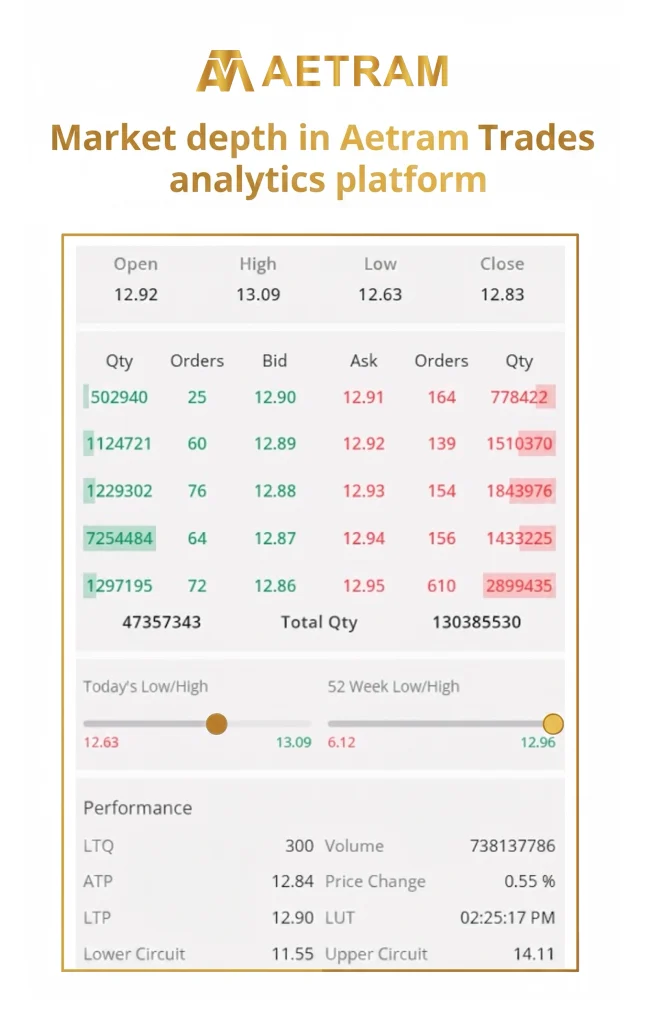
Though market depth gives information about liquidity , it does not mean a stock has high daily volume if it has strong market depth. To understand market depth, you must look at the order book and analyze the real-time list of buy and sell orders placed at different price levels.
Even on days with high trading volumes, imbalances in these orders can lead to sudden price swings, showing that depth isn’t just about volume, but about the balance and availability of orders at various prices.
Market depth essentially reflects the total volume of pending orders available at different price points. It’s about how much a limit order can be executed at a specific price without being affected by market changes, or how much a market order can be filled at a certain price, even if it’s limited by size.
Market depth is all about stability and if a stock has deep market depth, then there are plenty of buyers and sellers at various price levels which means big orders will not cause the fluctuation in sudden prices.
If a stock is highly liquid, then it means there is constant activity from both buyers and sellers. The more balanced the order book, the more resilient the price remains, even when big trades happen. So, market depth is not just about how trade happens but how smoothly and predictably that trade happens without disrupting the price without causing any volatility.
Disadvantages of low market depth
Low market depth means low liquidity. When a market is shallow, there are fewer orders stacked at each price level. This makes it harder for the market to absorb large buy or sell orders without changing the price.
When there is low market depth, there is a chance for price slippage, If you place a large market order (e.g., to buy) in a shallow market, the order will quickly consume all available selling orders at the best price and be forced to fill at progressively higher, less favorable prices. This difference between your desired price and the average execution price is known as slippage.
Shallow markets can experience high volatility, where even small trades can trigger significant price swings, because there is not enough “depth” to act as a buffer.
A shallow market depth reduces liquidity, leading to price slippage which means your order often gets executed at an undesired price compared to the price you saw when placing it.
Institutional traders and market depth
Institutional traders are those traders who can place huge buy or sell orders, and will be able to literally move the price of a security. For big institutional traders, it is important to know and understand market depth because when they place large orders, they need to know if the market can absorb those orders without pushing prices up or down sharply. If there are not enough market participants to absorb the orders, then even a modest trade could result in significant price movements.
But here’s something important, i.e., market depth does not always mean high trading volumes. A market can have deep order books with lots of buy and sell offers, even if it is not seeing a lot of daily trading activity. So, depth tells you about the structure and stability of the market, not just how busy it is.
Conclusion
Market depth is one of the important pieces of information for traders and for those who are analyzing the markets because it gives a clear snapshot of current buy and sell orders at different price levels for a particular security. This information helps you to understand demand and supply at various prices and also at which price point there is high and low liquidity. It also gives you indication about possible short-term price movements that allows traders to expect any shifts before they happen. With this insight, they can make smarter and more informed decisions about when and how to enter or exit positions.