Understanding Put Options With Examples
A put option is a derivatives contract which is bought by traders who expect the price of the underlying asset to fall. This asset can be indices, stocks, commodities, ETFs, etc. This is the opposite of call option because the buyer will buy a call option contract when he or she expects the price of the underlying asset to rise.
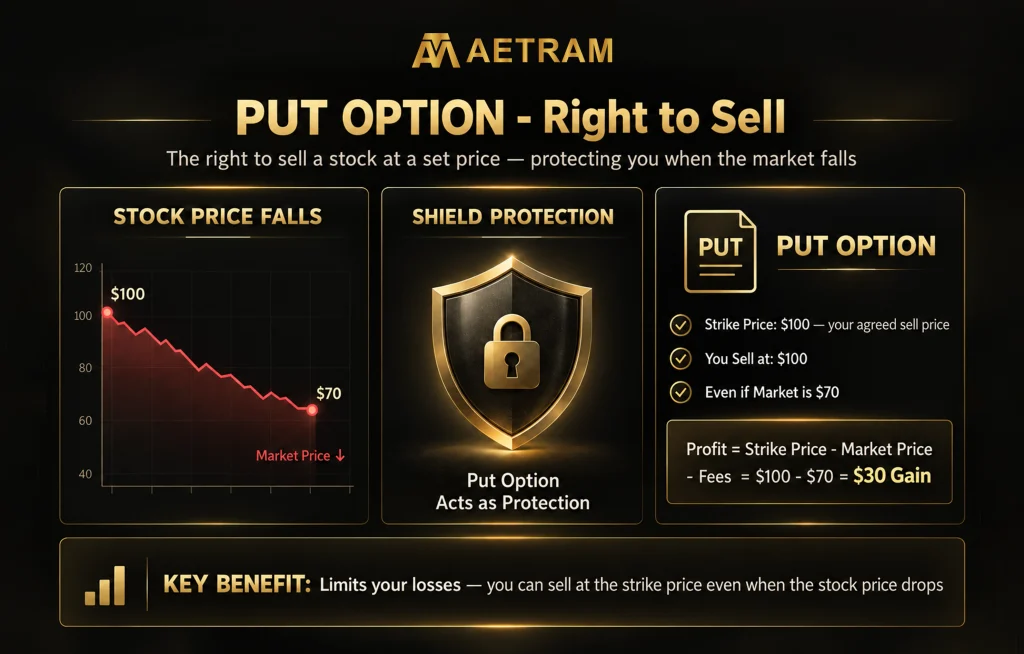
A put option contract will give the buyer the right to sell the underlying asset at a predetermined price at an expiry date in the future but the buyer does not have any obligation to sell the underlying asset. The buyer will pay a premium to buy the put option contract from the seller who is also known as the writer. The predetermined price is also known as the strike price.
Let us understand how put options based on different scenarios like in the money, at the money and out of the money.
In-The-Money (ITM) Put Option
Let us assume the current price (also known as spot price) of a company ABC Limited is already below strike price
Assume ABC is trading at 21,800 and you buy a monthly put option with:
Strike Price: 22,000 (ITM)
Premium: ₹120 per unit
Lot Size: 50 units
Total Premium Paid: ₹120 × 50 = ₹6,000
Break-even: 22,000 – 120 = 21,880
Expiry Scenarios
ABC is at 21,500: Profit = (22,000 – 21,500 – 120) × 50 = ₹19,000 return and that is an investment gain of 217% gain on premium.
When ABC is at 21,880, you break-even and you recover the premium paid. If ABC is at 22,100, the options contract expires worthless. You lose the premium of ₹6,000 which will be the maximum loss for the buyer.
At-The-Money (ATM) Put Option
Imagine a company called Mango Enterprises has a strike price equal to current market price (also known as spot price)
Setup: The company is trading at 48,000. You buy a weekly put:
Strike Price: 48,000 (ATM)
Premium: ₹180 per unit
Lot Size: 15 units
Total Premium Paid: ₹180 × 15 = ₹2,700
Break-even: 48,000 – 180 = 47,820
Expiry Scenarios
If Mango Enterprise is trading at 47,000, then you will have a profit of ₹12,300 ((48,000 – 47,000 – 180) × 15). This is a significant return of 356% on the premium.
If Mango Enterprise is trading at 47,820 which will be the break-even. If Mango Enterprise at 48,200 or above, then the buyer will lose the full premium of ₹2,700.
Out-of-The-Money (OTM) Put Option
Let us assume a company DCS Limited’s strike price is below the spot price which is also known as the current market price
Setup: DCS is trading at ₹2,850. You buy a monthly put:
Strike Price: ₹2,700 (OTM)
Premium: ₹20 per share
Lot Size: 250 shares
Total Premium Paid: ₹20 × 250 = ₹5,000
Break-even: 2,700 – 20 = ₹2,680 (requires 6% drop)
Expiry Scenarios
If DCS is trading at ₹2,500 on expiry, then you can make a profit of ₹45,000. (2,700 – 2,500 – 20) × 250. A massive return of 800% on premium.
If DCS is trading at ₹2,680, then you will break-even and you will make neither profit nor loss.
If DCS is trading at ₹2,720, you as a put option buyer will lose the entire premium of ₹5,000. The option will expire worthless.
How To Trade Put Options?
To trade put options, you need to have a trading and demat account which you can open for free with SEBI-registered stock broker Aetram Trades. You have to click the link and follow the instructions to complete the KYC procedure.
You can easily place and execute orders with respect to buying and selling put options through Aetram’s next-gen trading platform. While placing the orders, it is mandatory to mention the strike price, number of contracts, and expiration date. After the order is executed, you must monitor your positions and manage them based on market movements and your trading strategy. Aetram also provides a lot of pre-built trading (nearly 40) strategies based on different market conditions. You can also create your personalized strategies.
Conclusion
Put options are sophisticated financial instruments which can be traded to make profit as well as used to hedge risks. But these are risky instruments and your choice must depend on your market view and risk tolerance. You should also have a good understanding about the moneyness that will help you optimize your cost, probability of successful trade, and leverage based on your market view. Make sure you factor in STT, GST, physical delivery risks, and SEBI’s margin rules.
Frequently Asked Questions
1. When should you buy put options?
You can buy put options when you have a bearish market outlook or when you expect the price of the underlying asset to fall in the coming weeks or months.
2. What is a put option?
A put option is a financial contract or agreement between two parties where the buyer of the contract has the right to sell the underlying asset to the seller but does not have the obligation to sell.
3. Can I trade put options in Aetram’s trading platform?
Yes. You can buy and sell put option contracts at different strike prices using basket order. We have a state-of-the-art analytics tool to gauge the market and decide at which strike price to buy.
4. Can I sell a put option contract before expiry date?
Yes. You can sell the contract in the market before expiration without waiting till the expiry date.
4. When will the premium for a put option contract rise?
The premium for a put option contract will rise when bearish condition increases or the spot price falls drastically. Higher volatility and more time for expiry will also help the premium to increase.