Explained: What is Moneyness in Options Trading?
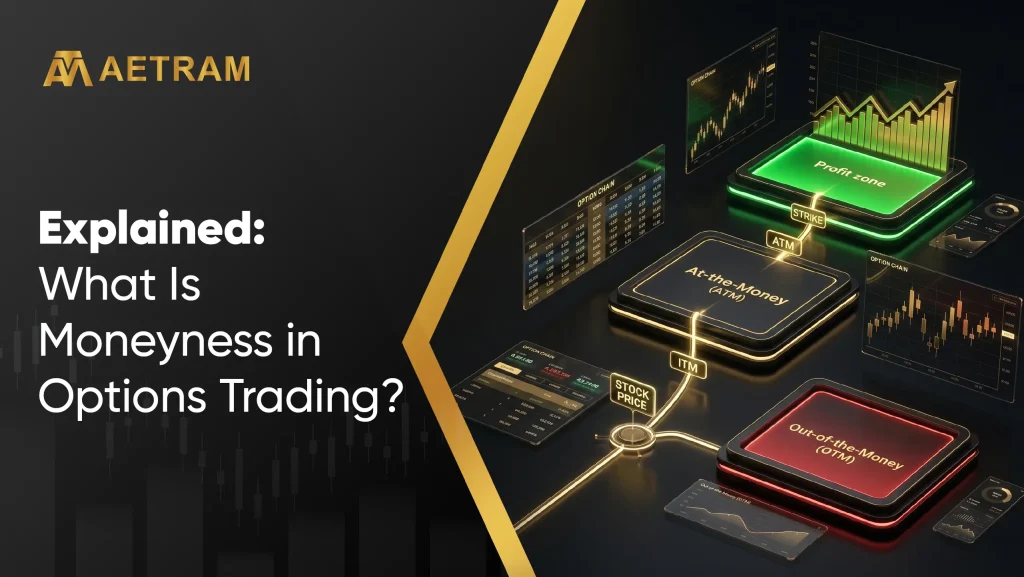
Moneyness is an important concept in options trading and it tells the trader about the correlation between the strike price of the options contract and the spot price of the underlying asset.
Understanding moneyness concept helps you to evaluate whether an options contract has the potential to be profitable or not, if that contract is exercised. When it is about moneyness of an options contract, the options contract are defined in three ways. They are In the money (ITM), At the money (ATM), or Out of the money (OTM) option. This will help the trader to select the correct strike price based on the market condition. This moneyness describes about the intrinsic value of an options contract at present.
Without understanding moneyness, a trader will have a difficult time understanding different options strategies and the trader will get confused when trading options contract. So let us understand this concept in this blog.
Intrinsic value
The intrinsic value of an options contract is different from the intrinsic value of a share. In options contract, the intrinsic value is the money that an options buyer is likely to make if the buyer decides to exercise the right. Therefore the intrinsic value can never be zero and it can only be either positive or zero.
For calculating the intrinsic value of call options contract and put options contract slightly differs. The formula to calculate the intrinsic value of the call option contract is: spot price – strike price.
Whereas, the formula to calculate the intrinsic value of the put option contract is: strike price – spot price
Intrinsic value is different from extrinsic value associated with an options contract and extrinsic value takes the following into account — time value and implied volatility. So you need both, intrinsic and extrinsic value, to calculate the total value of options contract.
In the money (ITM)
Options contracts which are in the money are those contracts which have intrinsic value and time value. A call options contract is said to be in the money when the spot price of the underlying asset is higher than the strike price of the contract. A put options contract is said to be in the money when the strike price of the contract is higher than the spot price of the underlying asset.
At the money (ATM)
An options contract is said to be at the money when the strike price is very close or equal to the spot price of the underlying asset. This means that the options contract may not have intrinsic value or very low intrinsic value, and the premium will have only time value. This time value of the contract will continue to decay as the contract approaches the expiry date.
Options that are at the money (ATM) are more likely to be expensive than out of the money (OTM) options. But they are less expensive than In The Money (ITM) options. Here, the moneyness of calls and puts are affected by volatility and time decay.
ATM options are mainly impacted by time value and have very little or no intrinsic value. Due to this, they are sensitive to changes in volatility and time decay. So, options contracts that is at the money are frequently used by traders anticipating substantial short-term price movements.
Out of the money (OTM)
Options contract that is out of the money is said to have no intrinsic value and has only extrinsic value which is a combination of implied volatility and time value. Out of the money is the opposite of in the money.
A call options contract is said to be out of the money when the strike price is higher than the spot price. A put options contract is said to be out of the money when the strike price is lower than the spot price of the underlying asset.
Options that are out of the money are less expensive with respect to premiums that must be paid to buy the contract and this attracts some traders. However, for the buyer to be profitable, the underlying asset must make a significant move in favour of the buyer, otherwise, the contract will expire worthless. This makes buying an option contract that is out of the money highly risky.
Conclusion
If you plan to actively trade options in the FnO market , then it becomes imperative for you to under the concept of moneyness. Without understanding this concept, there is a high probability for you to face heavy losses trading options. Among the three types of options discussed above, you must select the more suitable type of options based on the market condition, price outlook, risk tolerance, and time horizon.
Frequently Asked Questions
1. What is the primary function of moneyness in options trading?
Moneyness tells the trader about the correlation between the options contract’s strike price and the underlying asset’s spot price. Understanding it helps evaluate whether an options contract could potentially be profitable if exercised.
2. What are the three definitions used to describe the moneyness of an options contract?
The three definitions are In the money (ITM), At the money (ATM), or Out of the money (OTM) option.
3. How is the intrinsic value calculated for a call option contract?
The formula to calculate the intrinsic value of the call option contract is: spot price – strike price.
4. When is a call options contract considered “In the money” (ITM)?
A call option is said to be ITM when the spot price of the underlying asset is higher than the strike price of the contract.
5. What is the characteristic value of an Out of the Money (OTM) option contract?
Options contracts that are OTM have no intrinsic value. They only have extrinsic value, which is a combination of implied volatility and time value. Buying an OTM contract is considered highly risky.