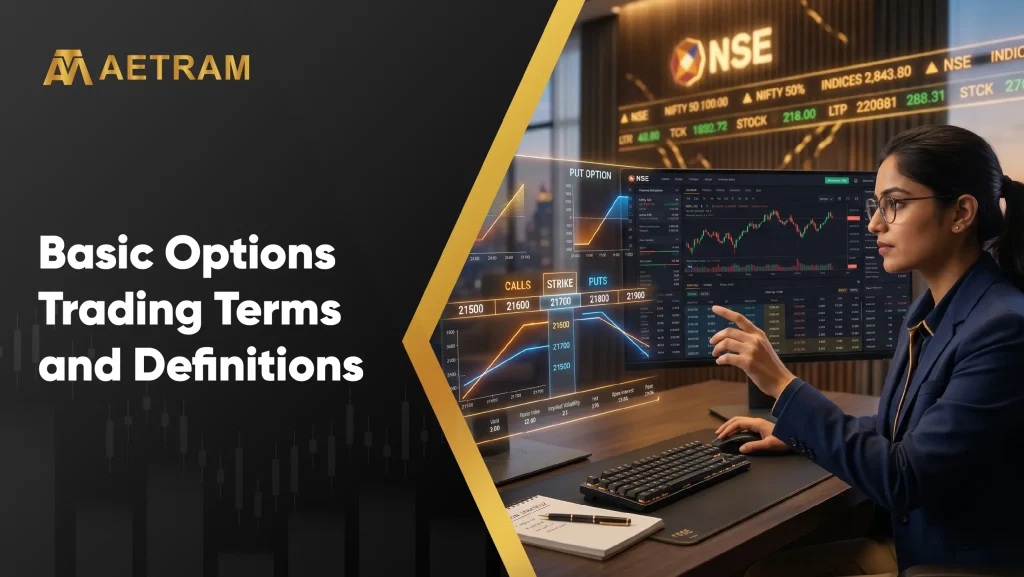
Basic Options Trading Terms and Definitions
Derivatives is a financial product and a financial contract where the value of the derivatives is derived from an underlying asset. This underlying asset can be a stock, index, commodity, interest rate, etc. There are many derivatives products like futures, options and swaps. Among them, options is the most popular derivatives product and it attracts huge amount of capital.
To trade in options segment, you need a demat account and it can be opened with Aetram Trades. It is also imperative for a trader to understand options and for that you have to know the important terminologies associated with options trading. We will be discussing these terms in this blog, so that you become familiar with options trading, at least theoretically.
Options
Options are a type of derivatives product and it is a contract between two parties, buyer and seller, where the buyer has the right and not the obligation to buy or sell the underlying asset at a particular price at a future date. However, the seller of the option have the obligation to buy or sell the underlying asset if the buyer decides to exercise his or her right.
Lots
Options contract are traded in lots and one lot represent the minimum quantity of underlying asset that one must buy or sell as per terms of the contracts.
Call Option
A call option is a type of options contract where the buyer has the right to buy the underlying asset at the strike price at the specified date and there is no obligation to buy the underlying asset. A buyer of a call option is bullish about the underlying asset.
Put Option
A put option is a type of options contract where the buyer of the contract has the right to sell the underlying asset at the strike price at a particular date and the buyer of a put option is bearish about the underlying asset. The buyer of the contract has no obligation to sell the underlying asset.
Spot Price
The current market price of the underlying asset which can be a stock, commodity, index, etc.
Strike price: A strike price is also known as exercise price, which is a predetermined price at which a buyer of a options contract is ready to buy or sell an underlying asset.
Expiration date
It is the last day of the options contract after which the contract expires and becomes worthless. It cannot be bought or sold after this date. The expiration date is important for both option buyer and seller because it is linked to time decay concept in options. As a contract approaches expiration date, the value of the contract falls.
Option Buyer
An option buyer is a person who buys either a call option contract and/or put option contract from a seller by paying a premium. The buyer has the right and not the obligation to exercise the contract. The option buyer is also known as an options holder. The maximum risk for an option buyer is the premium paid for buying the options contract. If the buyer does not exercise his or her right, the contract becomes worthless on the expiry date.
Option Seller
An option seller is a person who sells an option contract to a buyer. The seller is also known as an option writer who collects a premium upfront from the buyer. When a buyer exercises an option contract, the seller has the obligation to fulfil the contract. Options selling is very risky compared to option buying as the losses are very high and they have to fulfil the contract terms and that is why they have to pay a heavy margin. This margin is used as a collateral by the exchange and the broker to cover potential losses and prevent default due to significant adverse price movements.
Premium
A premium is an amount paid by a buyer to buy the contract from a seller and the premium is calculated based on factors like intrinsic value, time value, and volatility.
Exercise
The act of an option buyer invoking their right to buy (for call options contract) or sell (for put options contract) the underlying asset at the strike price.
Option Assignment
It is a process when an option seller is assigned to buy or sell the underlying asset at the strike price, when an option buyer exercises his or her right. Option seller is obligated to buy or sell the underlying asset as per the options contract.
Frequently Asked Questions
1. What are derivatives?
Derivatives are financial contracts and its value is derived from an underlying asset like stocks, indices, commodities, etc. Derivatives are used for hedging purposes, speculation, portfolio diversification and minimizing risks.
2. What is a call option?
A call option is a contract that gives the buyer the right but not the obligation to buy the underlying asset at the strike price. The underlying asset must be bought on or before the expiration date. Broadly speaking, the buyer of a call option is bullish.
3. What is a put option?
A put option is a contract that gives the buyer the right but not the obligation to sell the underlying asset at the strike price on or before the expiration date. Generally, buyers of put options expect the price of the underlying asset to fall.
4. What are spot price and strike price in options trading?
A spot price is the current market price of the underlying asset and a strike price (also known as exercise price) is the predetermined price at which the option buyer will buy or sell the underlying asset.
5. What happens on the expiry date of an options contract?
An expiry date is the last date of the options contract and its validity expires after this date. The contract becomes worthless and cannot be traded after the expiration date.