Iron Condor Strategy Explained for Beginners
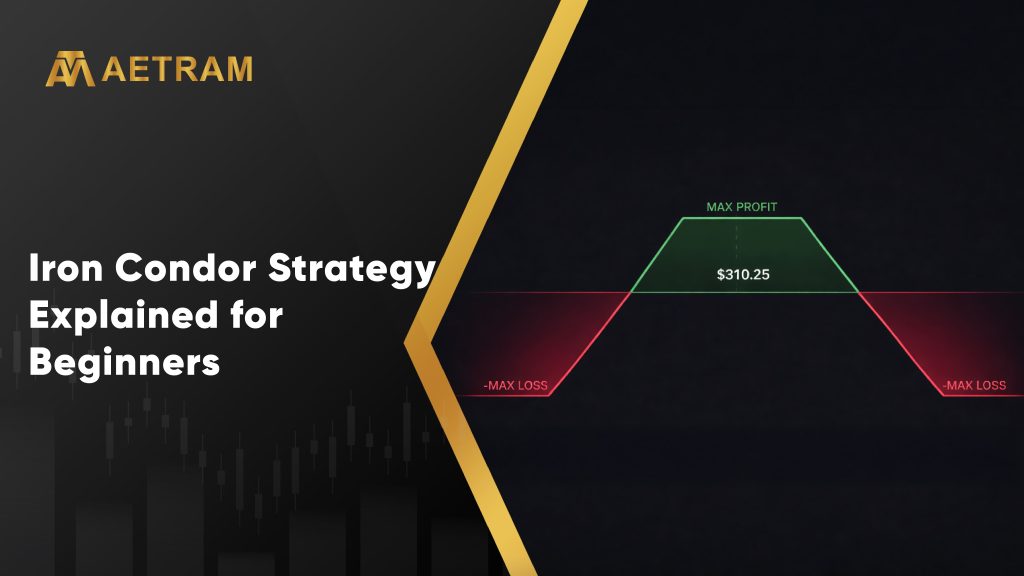
Iron condor is a direction neutral options strategy which is used by options traders when the market is moving sideways. The strategy can be used by traders who are risk averse and want to take advantage of low volatility in the market. Let’s decode the strategy in this blog.
Understanding Iron Condor
Iron condor strategy is applied by traders when they think the market is neither bullish nor bearish and it is going to move sideways.
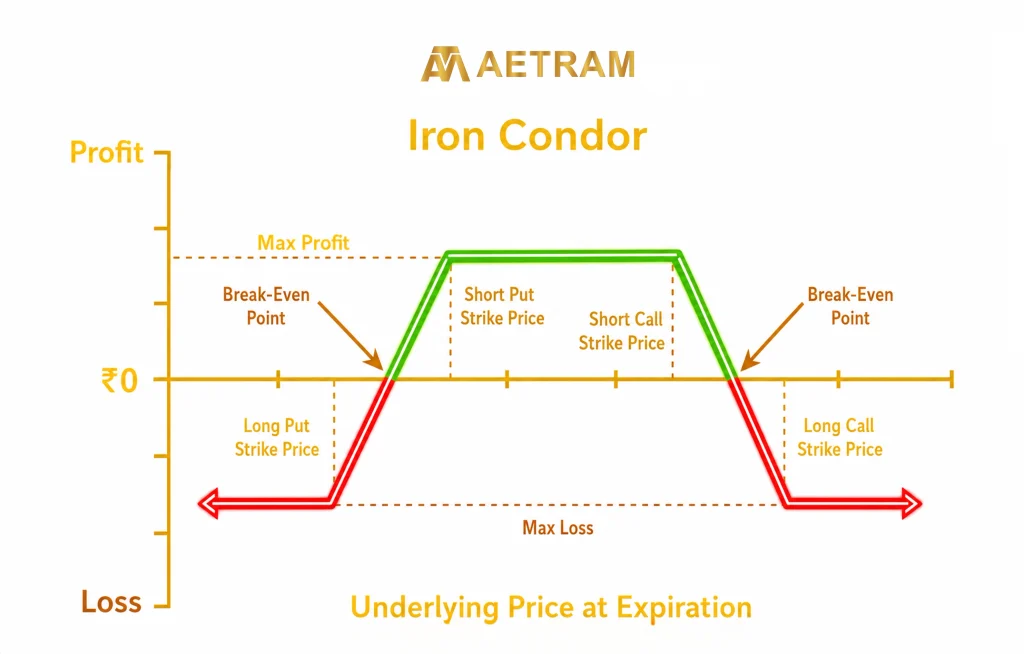
The strategy has four legs or in other words it has four contracts. It is a combination of two vertical spreads which means two call options contracts and two put options contracts with the same expiry day but different strike prices are bought and sold. We can also say that this iron condor strategy is a combination of bear call spread strategy and bull put spread strategy. Let us understand this separately with an example.
What is bear call spread?
Bear call spread is also known as call credit spread is an option strategy where the trader has a bearish-to-neutral view on the price of a security. The trader thinks the underlying asset will remain flat or fall slightly and will not rise.
To execute this strategy, you must do two things. Buy and sell a call option of the same underlying asset with different strike prices but the same expiry date.
Example
Assume a stock (underlying asset) is trading at Rs 100. To enter this strategy you have to sell a call option with strike Rs 105 and buy a call option with strike price of Rs 110.
When you sell a call option contract you will receive a premium, let’s say, Rs 4 and when you buy a call option contract you will pay a premium, let’s say, Rs 1.
Pay close attention to the premium because the call option with the strike price of Rs 105 which is closer to the spot price of Rs 100 commands a higher premium. In contrast, the call option with a strike price of Rs 110 which is farther out-of -the money has lower premium.
Premium is the money paid by the buyer of an options contract to the seller of the contract. Buyer has the right but not the obligation to exercise the option contract.
When do you make profit in bear call spread?
If the stock stays below Rs 105 at expiry, then both calls expire worthless and you get to keep the full profit of Rs 3 (Rs 4- Rs 1).
However, if the stock stays between Rs 105 and Rs 110, then you make partial profit.
If the stock goes above Rs110, then you make losses but the losses are limited. The loss can be calculated by knowing the difference between the two strike prices minus the net credit.
Difference between the two strike prices is Rs 110- Rs 105 = Rs 5.
Net credit = Rs 4 – Rs 1 = Rs 3 and Loss = Rs 3 – Rs 5 = Rs 2 per share.
What is bull put spread?
A bull put spread is also known as put credit spread and this option strategy is used when the traders expect the underlying asset to be mildly bullish or remain flat and not fall drastically. It is the opposite of bear call spread.
This strategy has two legs where you must sell a put option at a higher strike price and buy a put option at a lower strike price. Let us understand this with a an example.
Example
Suppose a stock is trading at Rs 100, to execute this strategy, you must sell a put option with strike price Rs 95 and buy a put option with Rs 90. When you sell, let’s assume, you receive a premium of Rs 4 and when you buy a put option, you pay ₹1 premium. S the net premium credit would be Rs 3 (Rs 4 – Rs 1).
When do you make profit in bull put spread?
If the stock stays above Rs 95 at expiry, both the put contract will expire worthless and you get to keep the full net premium credit of Rs 3 which will be your maximum profit per share.
But, if the stock price stays between Rs 90 and Rs 95, then you make partial profit and if the stock falls below Rs 90, you loss is limited to the difference between two strike prices minus the net premium. So the loss would be Rs 2 (Rs 95 -Rs 90 – Rs 3)
Things to remember while using iron condor strategy
When you plan to trade the iron condor strategy, selecting the right strike price is important. If the spot price of the stock stays between the two sold strike prices, then you as a trader will reap the maximum profit. This is because all the four contracts will expire worthless.
So you must select the strike prices in such a way that the sell options strike price to be close enough, but far enough apart so that there is a good chance the stock will end up between the two strike prices and to generate a positive net credit. If the strike prices are too close, then the chances of you generating a positive net premium will decrease. On the other hand, increasing the strike prices further apart, will increase the likelihood of the stock price staying within that range at expiration.
One helpful tool for estimating this probability is delta. For example, a short option with a delta of 0.05 is two standard deviations away approximately. This means that there is about a 95% chance that the contracts will expire out of the money. However, higher the probability of success means smaller net premium credit.
So if you want to increase the amount of profit, you might have to lower the probability of success. Having said that, your outlook on volatility plays an important role and if you believe markets will stay calm with low volatility, iron condors is a good low-risk strategy with predictable outcomes.
Conclusion
Among the many options strategies available, iron condor is a direction neutral strategy with limited profit potential and loss potential. It is designed for market situations where the price of the underlying stock or index will stay relatively stable in the short term which is nothing but with lower volatility and conservative traders can use this strategy when the market is expected to move sideways.