NSE Extends F&O Trading. Do you get to gain?
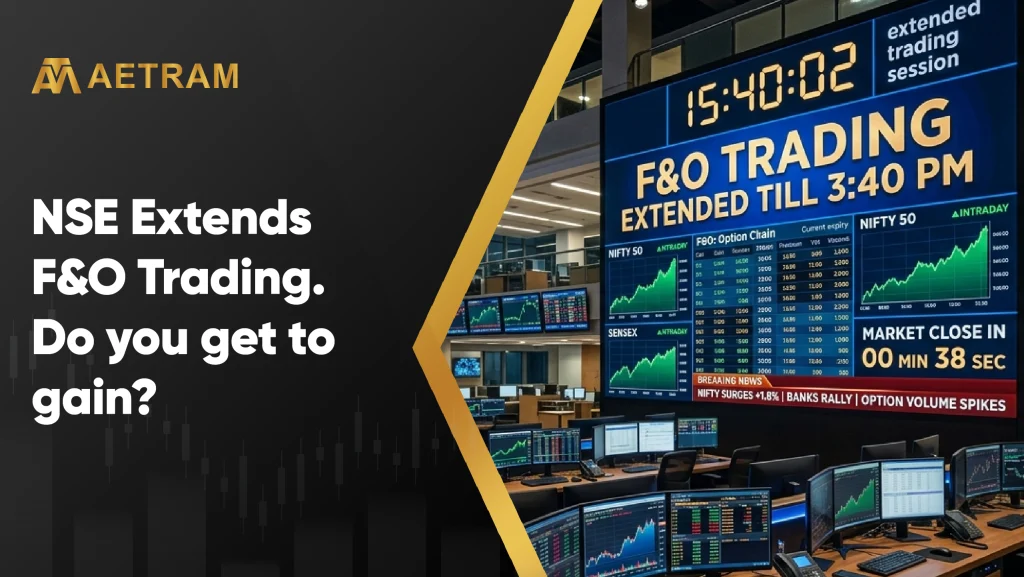
For as long as most Indian traders can remember, the derivatives market closes at 3:30 PM. But this is going to change from August. Starting August 3, 2026, India’s biggest exchange the National Stock Exchange will keep the Futures & Options segment open for an extra 10 minutes, pushing the closing time to 3:40 PM.
Theoretically speaking, it sounds like a minor tweak with respect to timing. In practice, it touches everything from how closing prices are discovered to how algo strategies will be coded in the future and even how your mutual fund‘s NAV gets calculated at the end of the day. But the real question every trader should be asking is will this extra 10 minutes actually work in their favour or is it just more screen time with the same old risks? Let’s break it down in this blog.
What Exactly Has Changed
The core change is straightforward. The normal market closing time for equity derivatives, covering index futures, index options, stock futures, and stock options, moves from 3:30 PM to 3:40 PM. Everything else around it stays put. However, the opening time of the stock market will still open at 9:15 AM, while the pre-open session will be from 9:00 AM to 9:15 AM. The trade modification window will continue until 4:15 PM.
As a result, this is not a complete overhaul of trading hours but a targeted extension and there is a specific reason for this change.
Understanding the Closing Auction Session
The trigger for this change is the introduction of a Closing Auction Session, or CAS, in the equity cash segment. This is a structured 20-minute window from 3:15 PM to 3:35 PM where the official closing price of a stock gets determined through an auction mechanism rather than the older volume-weighted average price approach alone.
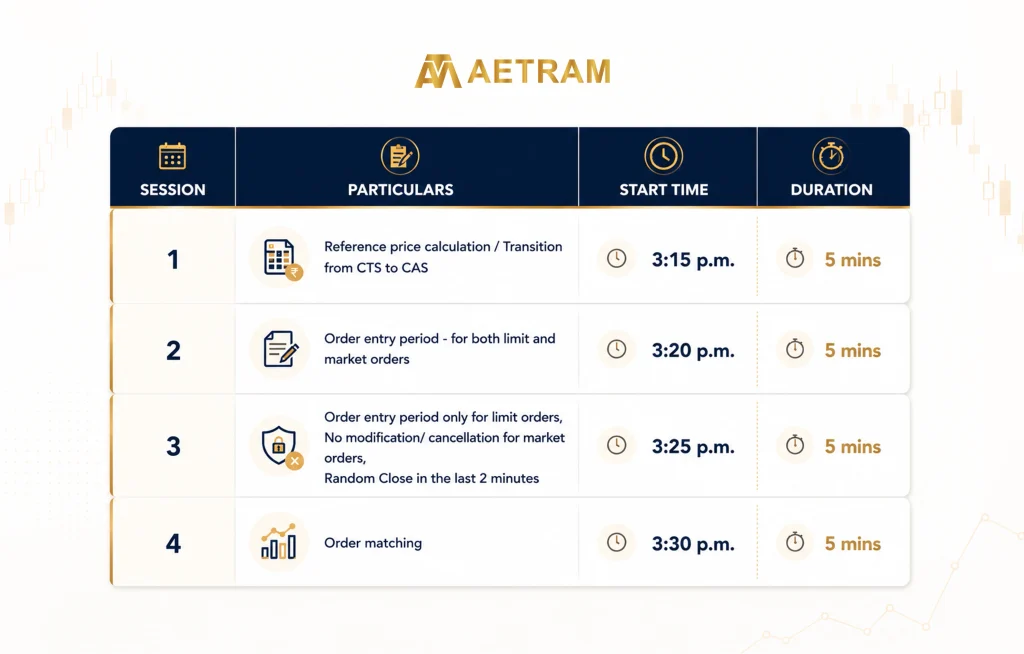
This is designed to stop any kind of last-minute, high-volume trades that can distort a stock’s closing price, something that has been a long-standing concern, especially around index rebalancing dates and derivative expiries.
Why Did NSE Make This Change
Since F&O contracts derive their value from the underlying cash market, keeping derivatives trading open only until 3:30 PM, while the cash market’s price discovery process runs until 3:35 PM created a mismatch. Traders holding futures or options positions would essentially be locked out of adjusting their trades based on the final, auction-determined price of the underlying stock.
The extra 10 minutes closes that gap. It gives F&O participants a window to react to the cash market’s final price before their own segment shuts down, which is meant to keep the two markets moving in sync rather than working off different reference points.
Notably, this rollout is happening in phases. The first phase, effective August 3, 2026, covers CAS and the revised F&O timing, but only for stocks that already have active derivative contracts. The second phase, expected September 7, 2026, will extend the framework further with a new morning pre-open auction session.
Do Traders Actually Gain?
This is the part worth sitting with, because the honest answer is: it depends on what kind of trader you are.
Where the gain is real:
For traders who actively manage positions around market close, especially on expiry days, the extra 10 minutes may be useful. It gives you a chance to see how the cash market’s auction settles a stock’s price and then react in the derivatives segment, rather than being forced to exit or adjust positions before that information is even available. That’s a meaningful improvement in decision-making, not just a cosmetic change.
There’s also a broader market-quality argument. If the closing price is more reliable and less prone to last-minute manipulation, then the derivative contracts priced off that cash market are, by extension, fairer too. Traders who rely on accurate settlement prices, whether for hedging, arbitrage, or simply closing out positions, benefit from that improved reliability even if they never notice the mechanism working in the background.
Where the gain is less obvious:
For high-frequency and algorithmic traders, this isn’t necessarily a free win. Every system that was calibrated to the old 3:30 PM close and the 3:00-3:30 VWAP window now needs to be re-coded and tested. Get it wrong, and you risk missed executions or, worse, positions that stay open longer than intended because a system didn’t account for the new closing time.
Retail traders who habitually square off positions close to market close should also be careful not to assume the extension is purely a buffer. The operating price bands for stock futures will be reset just before the CAS begins, calculated fresh at plus or minus 3% of a newly determined reference price. Orders sitting outside that revised band can get cancelled automatically. If you’re not tracking this, you could find your resting orders wiped out without warning.
So the extension isn’t a blanket advantage. It rewards traders who adapt their process and exposes gaps in those who don’t.
Impact on Options Traders
Options traders, in particular, should pay attention to the expiry-day dynamics. The last 30 minutes of an expiry session already tend to see a spike in activity as traders roll over positions, square off, or let contracts lapse. With the closing window now extended, that scramble gets an extra 10 minutes to play out, spread across a period where the cash market itself is going through a structured auction rather than free-flowing trade.
This could mean somewhat smoother price behaviour into the close on expiry days, since the auction curbs erratic last-second cash market moves. But it also means options premiums close to the money may keep shifting a little longer than traders are used to, so any strategy that relies on a hard 3:30 PM cutoff for decision-making needs a fresh look.
What About Mutual Fund NAVs
This change isn’t confined to F&O desks. Since mutual fund NAVs are calculated using the closing prices of the underlying stocks and those closing prices will now come from a structured auction rather than a simple last-traded-price or VWAP snapshot, NAV calculations get indirectly affected too.
In theory, this should be a positive development for retail mutual fund investors. An auction-based closing price is expected to be less susceptible to being skewed by a single large trade placed deliberately near the market close, something that has occasionally distorted NAVs in the past. More reliable closing prices mean more accurate valuations for anyone holding equity mutual funds, even if they’ve never placed an F&O trade in their life.
Phase 2: What’s Coming Next
August 3, 2026, is only the first step. From September 7, 2026, NSE plans to roll out the second phase of this framework, which brings in a new morning Pre-Open Auction Session alongside the revised afternoon structure. Details of exactly how the morning session will function are still emerging, but the direction is clear: NSE is moving toward auction-based price discovery at both ends of the trading day, not just at the close.
For now, phase one is limited to stocks with active derivative contracts. Everything else continues to use the existing VWAP-based closing price method, at least until the framework widens further.
How Traders Should Prepare
There are a few practical steps you can take as a trader. If you have set any time-based alerts, order triggers or system checks at 3:30 PM closing time then you have to update it to align with the new closing time.
You have to review your algorithmic strategies that rely on end-of-day timing to ensure they consider the new 3:40 PM deadline instead of triggering early or missing the window totally.
Keep an eye on the updated pricing bands established right before the Closing Auction Session starts if you often keep orders close to the market close since orders outside of that range could be automatically cancelled.
NSE has said that it will conduct mock sessions before the actual release, so try to attend the mock session through the platform which your broker provides and get familiar with it.
Conclusion
NSE’s decision to extend F&O trading hours to 3:40 PM is significant because it aligns the derivatives market with a basically more structured way of determining closing prices in the cash sector.
For traders willing to adjust their systems, alerts, and expiry-day habits, this works in their favour due to better price discovery, more informed exits and fairer settlement prices. For those who don’t update their processes in time, the same 10 minutes could just as easily become a source of confusion or missed execution. In that sense, the gain isn’t automatic. It’s earned by preparation.
Frequently Asked Questions
When does the new NSE F&O closing time take effect?
The revised closing time of 3:40 PM applies from August 3, 2026, alongside the introduction of the Closing Auction Session in the cash market for stocks with active derivative contracts.
Will the derivatives closing price calculation method change?
Yes, NSE will be changing the closing price calculation method from Volume-Weighted Average Price (VWAP) method with a market-wide Closing Auction Session (CAS).
Does this affect mutual fund investors?
Yes, indirectly. Since NAVs are based on closing prices and those prices will now come from a structured auction, NAV calculations for eligible stocks are affected too.
Is the pre-open session timing changing as well?
No, the pre-open session continues from 9:00 AM to 9:15 AM, and normal market open remains at 9:15 AM. Only the closing time is extended.
Is this change applicable to all stocks?
Not yet. Phase one, from August 3, 2026, applies only to stocks with active derivative contracts.