Why Indians Buy Bikes Which They Cannot Afford
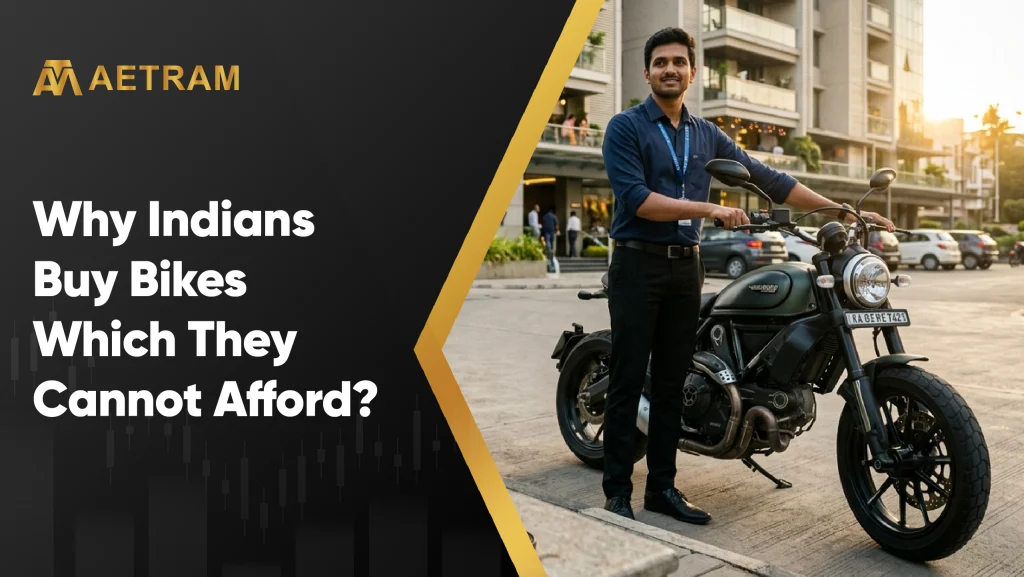
India has become aspirational or maybe that’s what the marketers say to sell their product. In this scenario, many college students and 20 year olds are buying bikes that they cannot afford. Let us look at the reasons behind buying such expensive bikes and the repercussions with respect to it in this blog.
The Great Indian Bike Obsession
In today’s two-wheeler showrooms, you will see something strange (compared to the previous generation) and common at the same time. A 22-year-old who has landed his first job with a starting salary of Rs 25,000 per month is signing loan papers for a bike that costs more than Rs 1 lakh or Rs 1.5 lakh. This is more than four or six months of his monthly take-home pay.
And if you ask him why, he will not mention about good mileage for which he is paying such a huge price or engine displacement. He will talk about how it feels and how people look at him when he is riding the bike.
This is a paradox at the heart of India’s two-wheeler market because people are not thinking twice regarding buying a bike that is costing a bomb. These days youth wants to own bikes purely from a status standpoint. Bikes have stopped being just a mode of transport a long time ago. They have become identity markers and manufacturers also have started to produce bikes that are too expensive rather than affordable. And this is evident from the monthly sales and quarterly sales as Indians are buying bikes they genuinely cannot afford and doing it in growing numbers.
Social Status Over Practicality
In the earlier generation, a bike or a scooter was bought for practical purposes. But now a two-wheeler is bought to make a statement. The bike you drive can tell others about your taste and even your personality. This is why so many buyers gravitate toward performance bikes that turn heads. And when they decide to buy they do not think about the huge price they will be paying because loans are available easily which facilitate owning an expensive bike easily.
Many Indians have this social anxiety of “log kya kahenge” (what will people say) which plays a very big role in pushing people to buy expensive bikes. A commuter bike that does the job perfectly well is often seen as settling and the person is not ambitious. A more expensive, more powerful, more aspirational bike, on the other hand, will give the impression to others that you have “made it” even if you are not financially well-off.
Further, social media like Instagram, Snapchat, etc. has only amplified this. A bike is not just for riding anymore. It is being photographed in various angles, filmed, filters are added, shared and promoted. Reels of highway rides, engine sounds and modification videos have turned certain bike brands into cultural symbols. Some bike owners have even become influencers. Even if you own a bike through a bank loan which you can barely service, it feels like buying entry into a new rich lifestyle rather than buying a vehicle to commute.
EMI Culture Fuels Impulse Buys
If social pressure is the spark, then easy financing is the fuel. This easy financing is both a boon and a bane as India’s new-found EMI (Equated Monthly Instalment) culture has fundamentally changed how people think about purchasing and consuming. India has started to buy almost everything on EMI. From smartphones to big TVs, bikes, cars, furniture, everything is bought on EMIs. When a bike costs Rs 1.5 lakh but the EMI is advertised as “just Rs 4,999 a month,” the actual price tag stops mattering. The monthly number feels manageable, even when the total cost which includes the principal and the interest is a different story altogether.
Bike showrooms, manufacturers and finance companies are aware of the current consumer psychology and they lean into it heavily. Low down payments, “zero cost EMI” schemes, and instant loan approvals remove almost every friction point that used to make people pause and reconsider buying something expensive. What once required months of saving can now be walked out of a showroom with, on the same day, with simple paperwork.
The issue with EMIs is that it gives this sense of feeling where costly purchases look affordable on a monthly basis when they are not financially reasonable. Once processing costs, insurance cost and interest are taken into account, a bike purchased on EMI usually ends up costing more than its stated price. Few consumers figure this out before signing on the dotted line and instead of thinking about whether the total cost fits their financial objectives, they are concentrating on whether the monthly amount matches their budget.
Marketing That Sells Dreams, Not Bikes
No industry understands aspiration marketing better than the automobile industry in India. Advertisements rarely talk about specifications first. They talk about freedom, about empowerment, achieving your dreams, your personality, taste, attitude towards life, personality, etc.
These days an advertisement is produced in such a way that it evokes emotions in you first before it engages with your intellect or tells you how it is useful or whether you need it.
This style of marketing is effective because it avoids logical decision-making and taps into your emotions. No one purchases a high-end motorcycle following a spreadsheet analysis of fuel economy and resale value. They get it because an advertisement, a movie scene, or an influencer made them see themselves on that highway with the engine roaring and it feels cinematic for the aspirational viewer.
As a leverage, companies also utilize exclusivity like waiting lists or limited editions and “book now, pay later” campaigns that generate urgency and appeal at the same time. When a product is advertised as being exclusively owned by a certain type of person, consumers will go above and beyond their budgets just to feel like they belong in that group.
Aspiration vs Affordability
It is very difficult for an aspirational consumer to go for something which is affordable because the math does not add up. Prices of two-wheelers in India have increased due to higher raw material costs, stricter emission norms, rising labour costs and premiumisation across the industry. Meanwhile, income growth for a large section of the young population, especially those in their first few years of employment, has not kept pace with this increase in vehicles.
This has led to a widening gap between what people want to buy and what they honestly can afford without burning their pocket. More often than not this gap is bridged by taking a loan from a bank or NBFC or some other financial institutions at higher interest rates.
So if you are young, a general rule of thumb in personal finance is that the two-wheeler you are planning to buy should not go beyond 3-6 months of your net income. More importantly, EMIs across all loans combined shouldn’t cross 40% or 50% of your monthly take-home pay. In practice, many young buyers exceed both benchmarks comfortably. This is not because they do not know better, but aspiration has a way of overriding arithmetic or making you risk averse.
Peer Influence and College Culture
As Facebook and Instagram became popular among youths, there has been an urge among young people to show-off what they own or what they are to the point of being narcissists. The desperation to seek validation has pushed them to own things at any cost even if it is for a few days or months.
Nowadays, owning a cool or popular bike is important because it acts as a social currency. It determines who is invited on highway rides, who’s seen as “cool” in a friend circle, and sometimes, even who gets noticed by whom.
Parents also in the name of showering love on their kids often end up co-signing loans or putting down payments for bikes far outside their capacity. They know they cannot afford it, but still sign the dotted line just because the child begs that “everyone else has one.”
At this point, the bike turns from a personal decision to a peer-driven pressure because not having it seems like falling behind.
This is evident in tier-2 and tier-3 cities, where the two-wheeler frequently serves as the main vehicle for the entire family. This adds another layer of pressure to buy something more capable, more premium, and inevitably, more pricier than what the household budget can really allow.
Hidden Costs Buyers Ignore
The EMI is just the beginning. Buyers rarely account for the full cost of ownership before signing up for a bike they can barely afford. Insurance premiums for premium and high-cc bikes are significantly steeper than for standard commuter models. Add to that the cost of premium fuel (many performance bikes require higher octane petrol), specialized servicing, and expensive spare parts that aren’t available at every neighbourhood mechanic.
Secondly, all vehicles are depreciating assets. So when you buy a costly two-wheeler, it will lose its value faster in the first year alone. If a young buyer has stretched his budget to cover the purchase price and has to sell quickly, maybe because of a job loss or a medical emergency, then they seldom have the financial cushion to cover this depreciation.
Add to that, if you want any modifications done like to fit an aftermarket exhausts, custom paint jobs, or upgrade some parts of the bike, it will result in continuous financial drain.
The Psychology of Instant Gratification
Behavioural economists have a term for this: present bias. It’s the well-documented human tendency to overvalue immediate rewards and undervalue future consequences. Buying a bike today feels good. The EMI burden, the insurance renewal, the depreciation — all of that belongs to “future you,” and present you is remarkably good at not thinking about that person.
This bias is especially strong with big-ticket lifestyle purchases like bikes, cars, and gadgets, where the emotional payoff is instant and visible, while the financial cost unfolds slowly, invisibly, over months and years. By the time the EMI starts feeling heavy, the excitement of the purchase has already faded — but the commitment remains.
Further, comparing yourself with others in social media platforms may aggravate this bias. Purchasing something aspirational by a friend sets off a sort of urgency that takes precedence over you being patient. Even though it would be a better option to wait for a year to accumulate money and purchase the same bike without a loan, it would be agonizing for the youngster to wait for a year.
How to Buy a Bike You Can Actually Afford
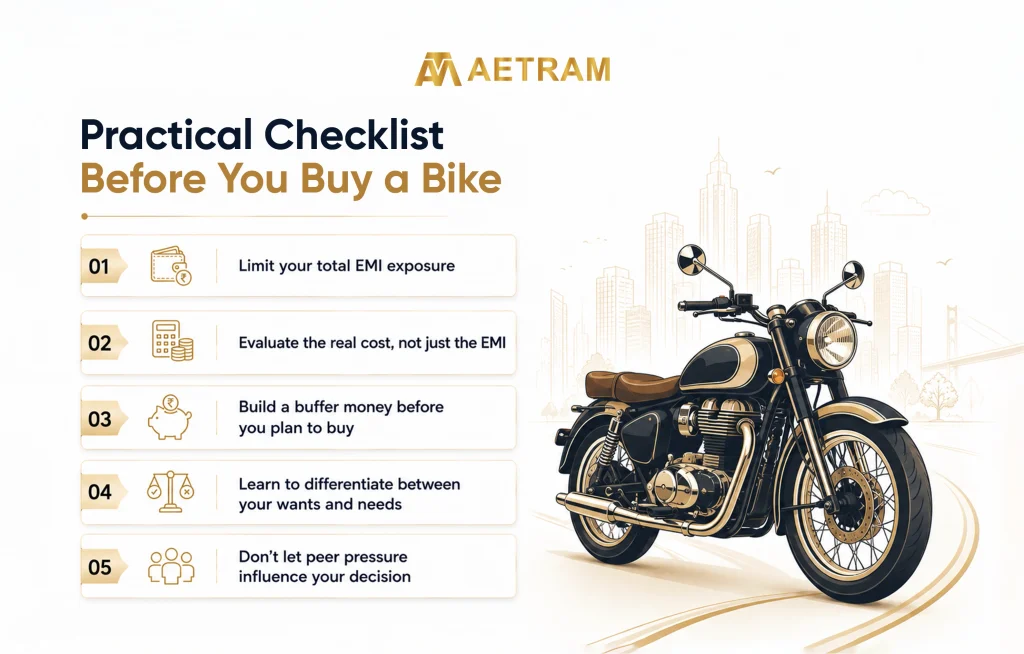
This blog is not about discouraging people not to buy the bike you want. It simply means your buying decision deserves a little more financial discipline than an EMI calculator on a dealership website. A few practical checks can help:
Follow the income-based limit where you try to maintain the on-road price of the bike within 3-6 months of your net take-home salary. If it exceeds that, it’s worth pausing and reassessing.
Cap your total EMI exposure. All your EMIs combined like bike, personal loans, credit card dues, should ideally stay under 40% of your monthly income. Anything higher starts eating into savings and emergency funds.
Calculate the real cost, not just the EMI. Add up the total interest paid over the loan tenure, insurance, and processing fees. Compare this to the cash price. The gap will often surprise you.
Build a buffer before buying. Ideally, save for a larger down payment rather than opting for the lowest possible upfront amount. A bigger down payment reduces both your EMI and your total interest outgo significantly.
You should always be able to distinguish between your wants and needs. Be honest to yourself and ask yourself if the more expensive model fulfills a practical need in your life. Or if a less expensive version would do the same job for your daily use.
Don’t let peer pressure influence your decision with respect to your budget. What your friend or colleague can afford has no bearing on what fits your income and financial goals.
Conclusion
In India, people are emotionally attached to their vehicles especially if it is a first. It goes beyond just being a useful and functional machine. There is nothing wrong with wanting a bike that makes you happy. The real problem is not your desire but when that wish is funded without a realistic assessment of affordability. This may leave the buyer tied to EMIs that strain their monthly budgets and postpone other financial objectives like saving, investing or having an emergency fund.
Understanding why this pattern exists, the status signalling, the marketing psychology, the ease of EMIs, the peer pressure is the first step toward making a more balanced decision. The next time the excitement of a showroom visit takes over, running the numbers first can be the difference between owning a bike you love and being owned by a loan you regret.
Frequently Asked Questions (FAQs)
How much should I spend on a bike based on my salary?
Keep the bike’s on-road price within 3-6 months of your net take-home salary to avoid EMI strain and financial stress later.
Why do EMIs make expensive bikes feel affordable?
EMIs break the total cost into small monthly numbers, making buyers focus on manageability rather than the real, higher total cost involved.
What percentage of income should go toward bike EMIs?
All EMIs combined, including your bike loan, should ideally stay under 40% of your monthly take-home income for financial safety.
What hidden costs do bike buyers usually ignore?
Insurance, premium fuel, servicing, spare parts, and fast depreciation are often ignored, making the actual ownership cost much higher than expected.
How can I avoid overspending on a bike due to peer pressure?
Set your budget based on personal income and goals first, before visiting a showroom, so peer influence doesn’t inflate your final decision.