How to Organise Your Stock Watchlist for Better Market Tracking?
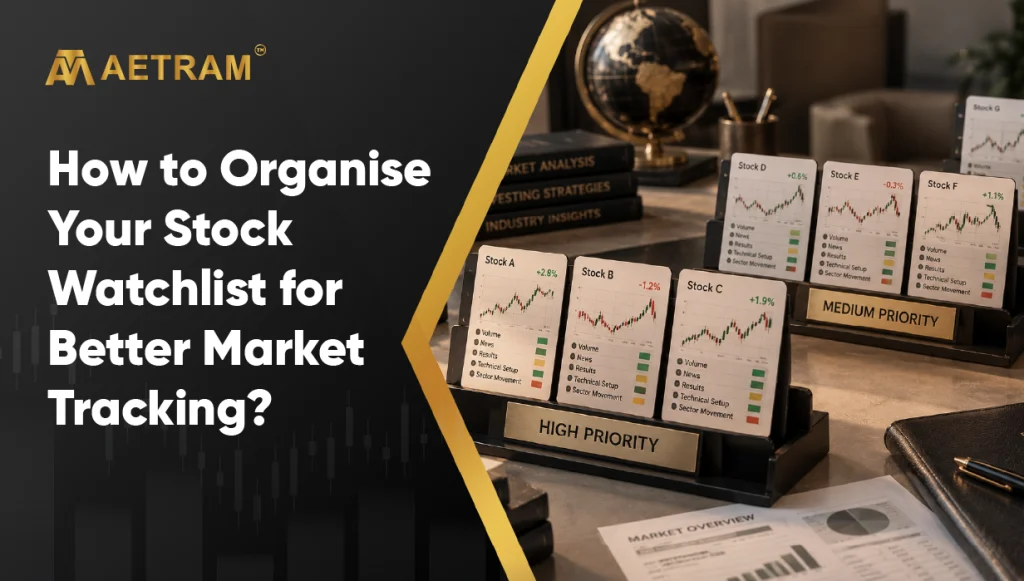
Think of opening your trading app when the market isn’t open yet and you see 50, 80 or even 100 stocks staring back at you. These stocks could be on your watchlist because they seemed interesting to you, somebody suggested them or they have been performing well lately. However, when the market moves, it suddenly becomes hard for you to decide which stocks should matter to you and why.
The purpose of a watchlist is to simplify the process of market tracking, not add to the noise. An effective stock watchlist is capable of helping you concentrate on relevant stocks, evaluate their prices, look for setups, etc. This is what an organised watchlist should look like for better market tracking.
1. Don’t Put All Stocks in One Watchlist
A very common mistake among traders is using a single watchlist and putting all the stocks on it which catch the eye. The point here is that a lengthy list doesn’t allow you to pick up the points which really matter. Instead of having all your stocks in one list, classify them according to their use like:
• Long Term investment Stocks
• Short term trading stocks
• Research Stocks
• Sector Wise stocks
• Technical setup stocks
• Earnings/other event-based stocks
This way, you will be able to switch between your market strategies without messing things up.
2. Create Sector Wise Watchlists
Having sector wise lists can give you an idea of where the market activity lies. You can create lists like:
• Banking/Financial services
• IT
• Pharma
• Auto
• FMCG
• Energy
• Metals
• Realty
Suppose a number of banking stocks have seen some sharp movements on the same day. It will become easy for you to analyze whether the trend has occurred because of one particular company or due to the sector itself. But it should be noted that just because of sector wise activity, all the stocks of that sector don’t show similar behavior.
3. Separate Investment Stocks From Trading Stocks
A stock you want to hold for several years does not necessarily need to be monitored in the same way as a stock you are considering for a short-term trade. For long-term holdings, you may be more interested in:
• Revenue and profit growth
• Debt levels
• Cash flows
• Business developments
• Valuation
• Corporate announcements
For trading stocks, you may pay more attention to:
• Price movement
• Volume
• Volatility
• Support and resistance levels
• Technical indicators
• Breakouts or other setups
Keeping these categories separate prevents your watchlist from becoming confusing.
4. Include Stocks with an Intention
Before including any stock on your list, just ask yourself one simple question, “Why am I watching this stock?”
The reasons for including this stock could be:
• The earnings are coming soon
• The stock has recently broken out of a range
• You are conducting research about the company
• The stock is from the sector you would like to track
• The stock’s valuation appeals to you
• You are waiting for certain price levels
Understanding the reason behind each inclusion will make your watchlist more valuable. You can keep notes beside the stock to understand what you are looking for.
5. Include Valuable Market Data Columns
A watchlist becomes highly valuable if it includes market data columns that help you track stocks. Based on your purpose, these columns may include:
| Information | Why It Matters |
| Last Traded Price | Tracks the current market price |
| % Change | Shows daily movement |
| Volume | Helps understand trading activity |
| Open | Shows where the stock started the session |
| Previous Close | Provides a reference point |
| 52-Week High/Low | Gives broader price context |
| Market Cap | Helps understand company size |
| P/E Ratio | Useful for valuation comparison |
It is not necessary to show all metrics available. The same amount of information overload will come from excessive numbers as from too many stocks. Pick the information which helps you follow the market the way you do.
6. “Today’s Focus” List
It is not necessary to follow your full portfolio during the day of trading. You should compile a shorter watch list which includes only those stocks which have to be followed on that day. Here are some examples of such stocks:
• Stocks which have important news
• Unusual volume stocks
• Stocks which have upcoming results
• Stocks which are approaching the price which is on your radar
• Stocks which are making important moves against the market.
7. Review and Clean Your Watchlist Periodically
A watchlist shouldn’t be something permanent. A stock may look like a good candidate at first; but after doing some research, you may come to a conclusion that it is no longer worth watching. Remove stocks if:
• Your initial interest is gone
• The event which made you interested in a particular stock is now over
• You finished with all the necessary research
• The stock doesn’t fit your strategy anymore
• You stopped following the company
You can clean up your watchlist on a monthly or quarterly basis, which will help you avoid overcrowding it with too many stocks.
8. Avoid Mistaking Your Watchlist for Your Buy List
It is essential to differentiate between them. Adding a stock to your watchlist does not mean that you made your decision about buying the company’s stock. It is just a convenient way to track those companies which are interesting to you. However, before investing or trading a particular stock, you still need to assess the fundamentals, valuation, the current market situation, possible risks and suitability for your goals.
9. Alerts rather than Price Watching
There is no need to spend your whole day watching your list constantly. If your platform offers such an opportunity, you can use alerts to be notified about price points of other parameters that are significant to your technical analysis. For instance, if you monitor a certain stock close to a certain level, then this level will notify you about it reaching this zone.
10. Do Not Overdo With Your Watch List
In the end, it is not necessary to make the most complicated watch list you could imagine. Rather, it is important that your list answers some simple questions:
• Which stocks do I watch?
• Why do I watch them?
• Which stocks require my special attention today?
• What has happened since the last time I reviewed my watch list?
• Is there something that requires me to conduct further research?
Simple Approach to Creating Your Watchlists
As an example of how you might approach structuring your watchlist, consider the following framework:
Watchlist 1 – Long Term
List of stocks under research and/or that you own.
Watchlist 2 – Short Term
List of stocks under observation for any trade setup.
Watchlist 3 – Sectors
List of stocks categorized by sectors, e.g. banking, IT, pharmaceuticals and automotive.
Watchlist 4 – Events
List of stocks with upcoming events, e.g. earning reports or corporate announcements.
Watchlist 5 – Stocks for Today
List of stocks needing your attention for the day.
This approach separates your more general research from market observation.
Create a Workable Stock Watchlist
It’s not the number of stocks you can follow but rather the quality of following them that really counts when it comes to making an effective stock watchlist. Rather than trying to follow all interesting stocks on one list organize companies according to the objective, sector, time period or reason for following them. Stick to a manageable number of stocks, show only relevant data, delete irrelevant stocks and set up alerts if needed. The most important thing is to understand that watchlists should be used as a tool for tracking and not for avoiding decisions.
For more ways to monitor stocks, analyse market movements and stay updated, explore Aetram.
FAQs
1. How many stocks should I keep in a watchlist?
There is no fixed number. The ideal size depends on how actively you track the market, but keeping separate, focused lists can make monitoring easier.
2. Should I create separate watchlists for investing and trading?
Yes. Long-term investing and short-term trading involve different objectives and may require different information, so separating them can reduce confusion.
3. Should I organise my watchlist by sector?
Sector-wise lists can be useful for comparing companies within the same industry and observing broader sector movements.
4. How often should I clean my stock watchlist?
Review it periodically such as monthly or quarterly and remove stocks that no longer have a clear reason for being tracked.
5. Does adding a stock to a watchlist mean I should buy it?
No. A watchlist only helps you monitor stocks. Before investing or trading, you should conduct appropriate research and consider the risks involved.