Things to Know If You Have Missed Your ITR Deadline (AY 2026-27)
The months of June and July are busy months for a lot of Indians who are income earners because that is when a lot of them would file their income tax returns. And yet, there are quite a few individuals who have missed submitting their income tax return this year.
Though the Income Tax Department has reported that more than 7.8 crore returns have been filed for AY 2026-27 till the end of August, there could still be people who failed to meet the deadline. This could be because some may have been away on a business trip, whereas others may have received their Form 16 late or a few could have forgotten to file their return.
Nevertheless, the good part is individuals who have missed filing the returns by the deadline can still file the return but they have to pay some penalty for missing the deadline and filing it late.
The Income-tax Act, 1961 lays out specific procedures that one must follow to file their return, provided that one does so before the relevant due dates. In this blog, we will discuss what will happen if you miss your ITR deadline and the process of how you can rectify that issue.
Check if you have missed the deadline
The first thing you must do if you are earning is check when the deadline for your ITR filing is. There are different types of ITR like ITR-1, ITR-2, ITR-3, ITR-4, etc. and each of these ITRs have different deadlines. So you must not get worked up and check which ITR you are supposed to file and the corresponding deadline.
For FY 2025-26 (AY 2026-27), the due date for salaried individuals and other taxpayers filing ITR-1 or ITR-2 was 31st July 2026. Those filing ITR-3 or ITR-4 without a tax audit requirement had until 31st August 2026.
Businesses and professionals subject to a tax audit under Section 44AB got a longer runway, with their deadline falling on 31st October 2026. If your applicable date has passed and you have not filed yet, you can still file a belated income tax return.
Understanding belated ITR
An individual can file his or her income tax return after the due date under Under 139(4) of the Income-tax Act, 1961, and this is called a belated income tax return. A belated return is subject to the same reporting requirements as a regular ITR but is accompanied by a fee, interest, and some loss of benefits.
Filing a return late is not advisable, but it is significantly better than not filing at all. The due date for filing a belated return for AY 2026-27 is the 31st December 2026. Even when this date is missed, the available options for taxfilers become limited. So it is better advised to file before this date, especially for those who are reading this article in September or October.
Cost of filing ITR late
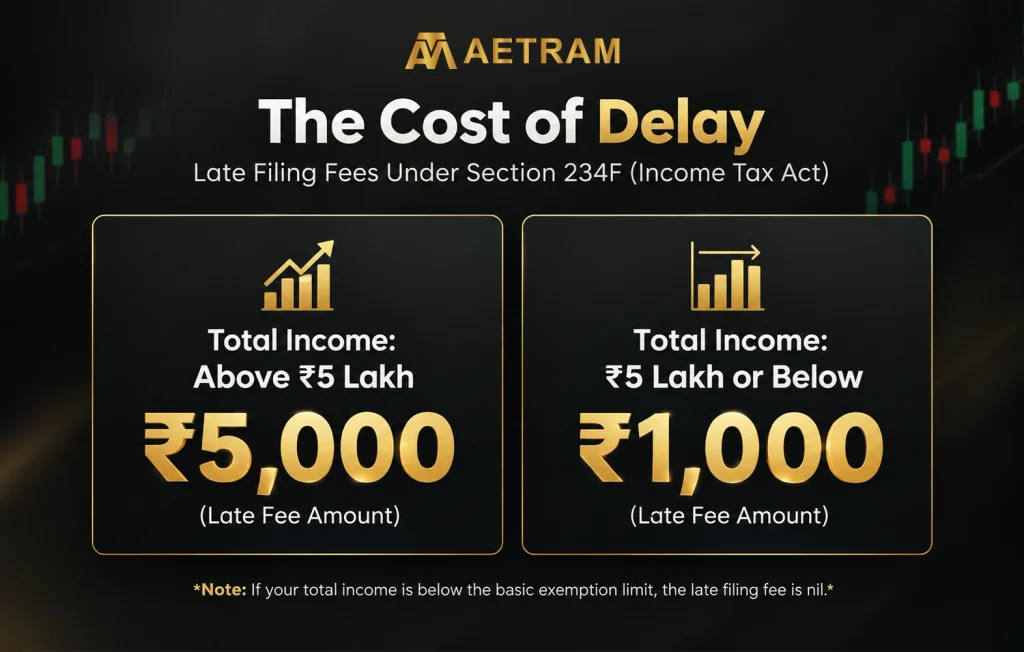
Even if an individual can file income tax returns late, it will actually cost him or her. If your total income exceeds Rs 5 lakh, you have to pay a late filing fee of Rs 5,000. If your income is Rs 5 lakh or below, the fee drops to Rs 1,000. And if your total income falls below the basic exemption limit, no fee applies at all. This penalty rule kicks in the moment you file after the original due date, regardless of whether you owe any additional tax or not.
The fine amount is the same whether you are late by one week or 3 months. It does not matter once you have crossed the original deadline. Having said that, interest will keep accumulating separately if you keep delaying filing the ITR.
The cost of not filing the ITR will start to increase when interest is calculated under section 234A. The income tax department charges interest at 1% per month or part of a month on any unpaid tax liability. The interest calculation will start from the original due date and it will be calculated until you actually file your return.
Even if you are only a few days into a new month, it counts as a full month for this calculation. So if you owe Rs 50,000 in tax and you’re three months late, you’re looking at ₹1,500 in interest alone, on top of the late fee. The longer you wait, the more this adds up. This is why you must file ITR promptly or at least seek professional help from chartered accountants so that you can avoid these unnecessary fines.
Other disadvantages of late ITR filing
Beyond the fee and interest, a belated return quietly costs you certain benefits that timely filers get to keep.
Unable to carry forward losses
One major issue is the loss carry-forward rule. When you have business losses or capital losses, except for losses from house property, you usually can’t carry them forward to future years if you file your return late.
This means that losses that could have been used to offset future profits will simply go to waste, unused. For people who trade or own businesses, this can be a big problem. It’s like losing out on a chance to reduce your future tax bill.
If you could have used those losses to offset profits in later years, it would have made a big difference. But if you don’t file on time, you’ll miss out on that opportunity.
You might also have to wait a while to get your money back. If taxes were taken out when you got paid and you’re supposed to get some of that back, it usually takes longer to get your refund if you filed your tax return late.
Also, you might not be able to claim some deductions and exemptions that you would have gotten if you had filed on time. These are only available if you file your taxes when you’re supposed to, so if you’re late, you could miss out on them.
When applying for loans
The consequences of not filing your taxes can be substantial and it can affect other areas of your financial life which you may not be aware of.
When applying for loans, banks and other financial institutions will ask for your last three years of ITR. If you have a history of not filing your returns, the bank will consider you a high-risk client and the bank might not be comfortable in considering your loan application.
If you are planning to travel and need to submit your visa application to a country such as the United States, the United Kingdom, Canada or any of the Schengen countries, you may have to provide them with your ITR to prove that you are financially stable. Failing to file your ITR can prevent you from traveling and rejection of your visa.
Not filing your ITR can even have legal consequences. If you have a large amount of taxable income and consistently do not file your ITR, the tax authorities can prosecute you. This is very unlikely to happen to a person who earns an average income, but there is a possibility that they may also be subjected to prosecution.
Belated ITR date also missed?
Let us say you missed 31st December also for filing your IT returns, then the government of India has given an option to still file your ITR.
You can still file an Updated Return under Section 139(8A) of the Income Tax Act. It is commonly known as ITR-U. This provision was introduced in 2022 and expanded by Budget 2025 and it gives you a filing window of 48 months from the end of the relevant assessment year. For AY 2026-27, that pushes your absolute outer limit to 31st March 2031.
This isn’t a free pass, though. ITR-U comes with additional tax on top of your regular liability, and the rate rises the longer you wait.
File within 12 months of the assessment year’s end, and you’ll pay 25% additional tax on the tax and interest due. Wait 13 to 24 months, and it climbs to 50%. Between 25 and 36 months, it’s 60%. Beyond that, up to 70%.
But there is a catch regarding ITR-U, which is, it cannot be used to claim a refund and generally cannot reduce your previously declared income or increase reported losses.
It exists to help you disclose more income or file where you hadn’t filed at all, not to reduce what you owe. It is not a convenient extension but consider it as a last resort.
Steps to file your belated ITR
If you’re still within the December 31st window, here’s how you can file your ITR.
Start the process by determining and confirming which ITR form applies to your income profile, whether it is ITR-1 for simple salaried income or ITR-3/4 for business and professional income.
Next, download your Annual Information Statement (AIS) and Taxpayer Information Summary (TIS) from the income tax portal. Cross-check these against your own records of salary, interest, dividends, capital gains, etc. Mismatches here are one of the most common reasons returns get flagged later.
Reconcile your TDS entries in Form 26AS against what your employer or bank has actually deposited. Compute your total tax liability, factor in the interest under Section 234A, and pay any outstanding amount when submitting your return.
Once filed, you have 30 days left to verify your ITR, either through Aadhaar OTP, net banking, or by posting a signed ITR-V to the CPC in Bangalore. An unverified return is treated as though it was never filed, so do not skip this final important step of ITR filing.
If your finances are even mildly complex, involving capital gains, foreign income or multiple income sources, it’s worth having a chartered accountant review your figures and do the filing on behalf of you.
Conclusion
There could be many reasons for missing the ITR deadline. It may be a setback but it is not a crime unless you do not file ITR at all.
Indian tax law gives you many ways to file income tax in a structured approach to be tax compliant, albeit at an extra cost. Delay always compounds the cost, both in interest and in lost benefits like carry-forward losses.
So it is important for all tax payers to understand the fee and interest you will be bearing for late filing of ITR and act before it is too late or get a notice from the income tax department.
Frequently Asked Questions (FAQs)
1. What is the last date to file a belated ITR for AY 2026-27?
The last date to file a belated return under Section 139(4) is 31st December 2026. It is better to file as soon as possible to limit interest costs.
2. How much penalty will I pay for filing my ITR late?
Under Section 234F, taxpayers with income above Rs 5 lakh pay Rs 5,000. Those with income up to Rs 5 lakh pay Rs 1,000. No fee is applicable if income is below the exemption limit.
3. Can I still claim a refund if I file a belated ITR?
Yes, you can claim a refund through a belated return. However, processing may take longer than it would for a return filed within the original due date.
4. Will I lose the ability to carry forward losses if I file late?
Most business and capital losses cannot be carried forward if filed belatedly, except for loss from house property, which remains an exception under the law.
5. Does filing a belated ITR affect my loan or visa applications?
Banks and visa authorities often review ITR filing history for the last two to three years, and gaps or delays may raise questions during processing and even lead to visa rejection.