What Is Tracking Error in ETFs?
In recent years, the number of demat accounts have increased and more people have started to invest in the Indian stock market and one of the products that have gained traction is ETFs which track indices.
ETFs are financial products which track a portfolio of stocks, commodities or bonds and they can be traded on the stock exchanges like NSE or BSE. There are different kinds of ETFs namely index ETFs, sector ETFs , commodity ETFs and bond ETFs. Many ETFs in India track different indices like NIFTY 50, Sensex, NIFTY 100, sectoral indices, etc., or commodities like silver ETF or gold ETF. ETFs have become a popular choice for investing due to its characteristics which has attracted a lot of retail investors and you as an investor have a simple and cost-effective way to gain exposure to a broader market.
With more asset management companies entering the space and offering a variety of ETF products, it is high time you understood a few important terms like tracking error and tracking difference. Let us understand these two important terms in this blog.
What is tracking error?
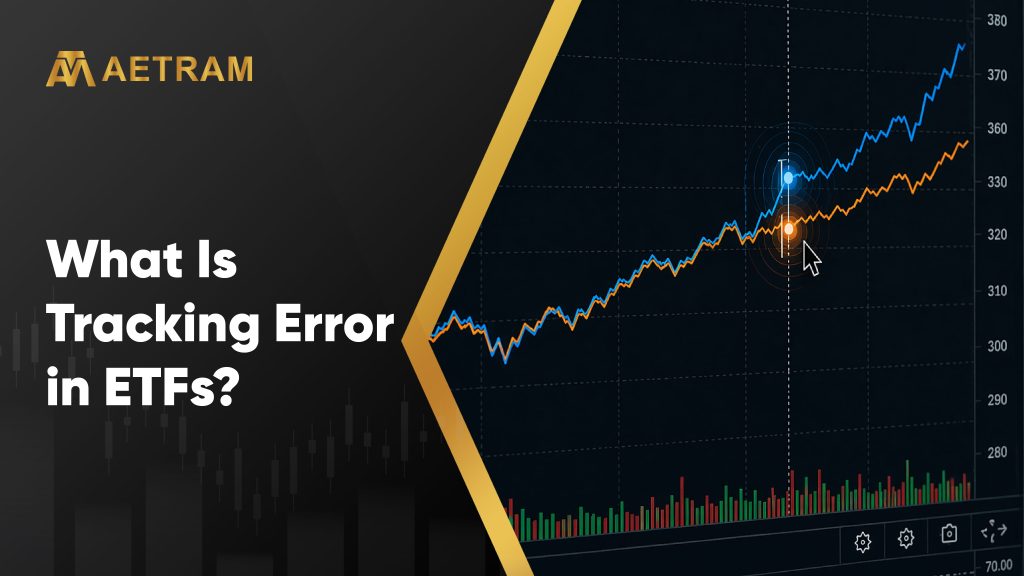
When you are exploring different ETFs, you must make sure to check the tracking error of the ETFs because it tells you how much the annualized standard deviation of the difference between the performance of the ETF and the performance of the index which the ETF is tracking. If you are a beginner and new to investing and plan to invest in ETFs, it is important to understand tracking error and how it could affect your investment returns.
ETFs are financial products which are designed to imitate the performance of a specific index, so returns of an ETF must be close to the returns of the index. In most cases, the difference is negligible, but sometimes there are small differences due to various reasons. These minor differences do not make a big impact but certain factors like management fees, transaction costs, market volatility, timing of the investment, etc. may weigh down on the difference over a long period of time.
Tracking error also arises due to differences in selection of stock, cost of trading or the timing of investments. Sometimes, the fund may tweak the portfolio by buying or selling a security so that it can manage risk or improve returns. This might lead to small deviations and though these deviations are small initially, over time they can increase in absolute terms.
A low tracking error means the fund closely mirrors the index, while a higher tracking error means that it has deviated more from the returns given by the index or the underlying asset.

Key reasons for tracking errors
Expenses
When you invest in ETFs, there are some expenses like management fees that are involved. These fees are also known as expense ratio and it is a measure that is denoted as a percentage of the asset under management. These expenses are subtracted from the ETFs returns before they are passed on to investors, which means the actual returns you receive might be slightly lower than the performance of the underlying asset.
Cash holding
The money you invest through ETFs is not invested entirely in the underlying asset or index funds. Some part of that money could be held in cash to cover potential redemptions, meet operational expenses and also to handle corporate events like dividend payments which related to the securities in the index.
Delay during taking trades
There can be delays in buying or selling shares due to lower market liquidity and this will lead to a longer time to settle transactions and realize sale proceeds. Further, there can be delays in dividends which can affect when those funds can be reinvested.
Certain trades may not be executed because the fund would not have been able to buy the required number of shares at the right price and closely follow the index. Moreover, any income earned without crediting the investor or the funds held in cash form without investing could affect returns as well as liquidity.
When you invest in ETFs, the fund is not restricted to buying or selling only at closing but it can be traded during the trading hours at market price. But the underlying index is based on the closing prices of securities at the end of the trading day that may lead to the difference.
Rounding off error
While ETFs try to mirror the underlying index, there may be rounding off done for the number of shares it holds and though this rounding off is small, it can result in slight differences in the total value of returns of the ETF compared to the benchmark.
Uses of understanding tracking error
When you know the tracking error, you will be in a better position to measure the performance of how well a fund is keeping up with its benchmark and also comparing between various kinds of ETFs offered by different AMCs.
It also helps in risk evaluation because it will help the investors to understand the level of volatility or uncertainty the ETF is exposed to compared with the underlying index.
You as an investor can also check how consistently the ETF has delivered over a period of time and also determine if the fund has outperformed or underperformed during which periods.
If the tracking error is higher then there is active intervention by fund managers and it means that the fund is trying a different strategy to beat the benchmark and hence the difference between the fund and the underlying index or assets.
Conclusion
For investors, understanding tracking error is essential because it helps them assess how accurately a fund reflects the performance of its benchmark. A fund with consistently low tracking error is generally a better choice for those who want to stay close to the market’s performance without taking on any unwanted extra risk.
So, investors should look beyond the fund’s name or its expense ratio when choosing an index fund and they should look at the tracking error which can provide valuable insights on the performance of the ETF.