Debt ETFs vs Liquid Funds

As far as the safest investments are concerned, the Indian investors prefer debt ETFs and liquid funds. These two investment tools target fixed income securities but fulfill various functions. To know how these investments function, let us first learn about liquid funds.
Understanding Liquid Funds
The liquid funds are basically mutual funds that invest in short-term money market securities such as Treasury Bills, Commercial Papers and Certificate of Deposits with maturity of up to 91 days. The purpose of liquid funds is to generate liquidity and capital preservation. Generally, an investor gets his/her money back in just one business day. Hence, liquid funds are regarded as one of the safest mutual funds in the market.
What Are Debt ETFs?
They involve the buying of fixed income investments such as government and corporate bonds and other types of debts. In contrast to other ETFs, debt ETFs can buy investments whose maturity is relatively longer. Hence, they have the ability to give slightly higher profits but due to the nature of such ETFs, they are subjected to market fluctuations just like any other asset.
Difference in Fundamentals
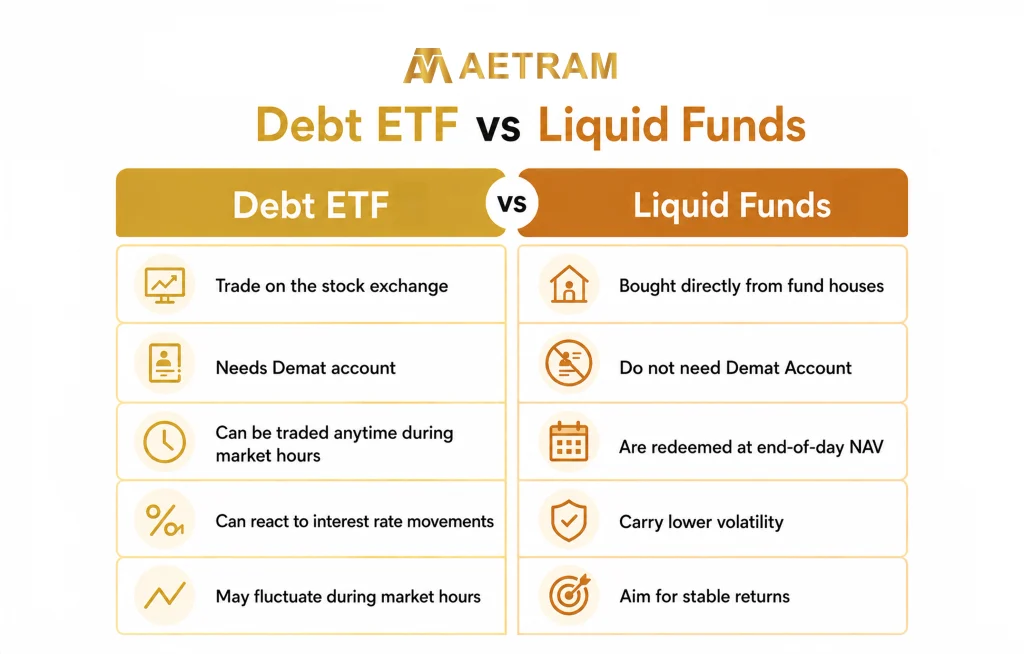
The major distinguishing factor is in their period of investment and liquidity. The liquidity fund aims at providing the investor with immediate access to cash and also provides stable returns. However, in the case of the debt ETF, its goal is not only stability but providing higher returns within a reasonable period.
Comparing Risk and Returns
In comparison, the liquid fund comes with a significantly lower risk profile because the underlying investments are short-term and of high quality. However, they offer lower returns as compared to debt ETFs which have higher return potential albeit with slightly higher risks.
Liquidity and Accessibility
Liquid mutual funds are extremely liquid and hence give instant liquidity. Money can be redeemed from these funds very fast, typically within one day. Thus, these funds suit short-term financial planning purposes such as emergency situations. Also, Debt ETFs have liquidity because they can be traded at any time within trading hours. On the other hand, the prices of debt ETFs might change through the trading days, unlike liquid mutual funds whose prices tend to be constant.
Investment Horizon
The choice of investing in either liquid funds or debt ETFs depends on one’s investment horizon. Liquid mutual funds are perfect for investors with a short-term investment horizon since their returns are not market linked. Hence, their price stability is guaranteed. In contrast, Debt ETFs are suitable for individuals with a long-term investment horizon and can afford price volatility for higher profits.
Which One to Opt For?
In case your main concern is security and easy access to funds, then liquid funds are the right option for you. Both of them have advantages in their own ways, but they also come with some disadvantages. When you opt for liquid funds, you gain stability, convenience and security without taking risks. In the same manner, when you decide to invest in debt ETFs, you must be ready for market-related ups and downs.
Use the Correct Tool for Stability and Profit
Whether you are investing in debt ETFs or liquid funds, both options can serve well for conservative investors. If you choose liquid funds, then you can expect security and convenience without any risk. On the other hand, you can enjoy profits through debt ETFs, but you need to have patience for it.
Connect with Aetram if you are looking to build a balanced investment portfolio with the right mix of low-risk options.
FAQs
1. What is the main difference between debt ETFs and liquid funds?
Liquid funds are for short-term investments with high liquidity, while debt ETFs are market-traded and suited for longer-term investing.
2. Which is safer: debt ETFs or liquid funds?
Liquid funds are generally safer because they invest in short-term instruments with lower risk.
3. Can I withdraw money anytime from liquid funds?
Yes, liquid funds offer quick redemption, usually within one working day.
4. Do debt ETFs give higher returns than liquid funds?
Debt ETFs may offer slightly higher returns, but they also come with more market risk.
5. Which is better for beginners?
Liquid funds are better for beginners due to their simplicity, stability and easy access to funds.