What Are Life Cycle Funds? Can Retail Investors in India Invest in Them?

Mutual funds have become a popular investment avenue for investors in India because of its ease of use and simplicity. Most retail investors, at least in cities and urban centres, now have some knowledge of mutual funds, thanks to the ‘Mutual Funds Sahi Hai’ campaign.
However, retail investors do not know when to shift from high-growth, high-risk assets to safer, capital-preserving assets. To address this situation, the market regulator SEBI has come out with a new mutual fund category called Life Cycle Funds. And, if you are an investor looking for any new scheme that is for the long term, this is good news. This new MF scheme is built to do the asset allocation thinking for you, automatically becoming more conservative as you approach a defined target year.
In this blog, we will discuss these life cycle funds, how they are different from existing fund categories, and most importantly, whether retail investors like you should consider investing in them.
Understanding Life Cycle Funds
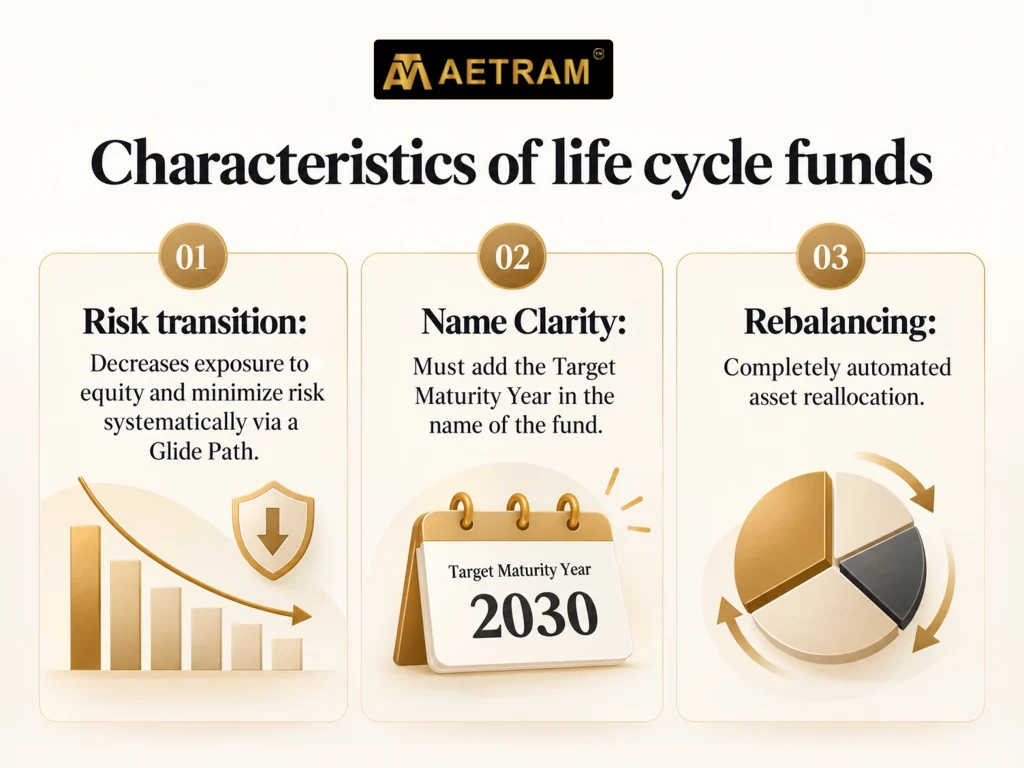
Life cycle funds are open-ended MF schemes which have a pre-defined maturity date and follow a glide path method to investing. Glide path means the scheme automatically adjusts the asset mix where it reduces equity exposure and increases debt and other lower-risk assets as the fund approaches its target year.
In simpler words, when the target date is in the future, say maybe 25 or 30 years, the fund holds a large part of the clients’ money in equities. As the years pass and the target date draws closer, the fund manager will systematically shift the portfolio money toward debt instruments, gold, silver, and other capital-preservation assets, reducing volatility.
Life cycle funds are similar to Target Date Funds (TDFs) which have been popular in the US and other developed markets for decades. India’s market regulator SEBI has essentially brought a structured, India-specific version of this concept into the domestic mutual fund industry.
So Life Cycle Funds have replaced the earlier “solution-oriented” fund category which included retirement funds and children’s funds. It may be because SEBI felt it had not scaled well, partly due to rigid lock-in structures that discouraged investors.
How Do Life Cycle Funds Work?
The mechanics of a life cycle fund are built around a few key rules.
1. Defined Maturity Periods
Any AMC can launch Life Cycle Funds with maturities ranging from a minimum of 5 years to a maximum of 30 years. It should be in increments of five, i.e., 5, 10, 15, 20, 25, or 30 years. So you will be able to see funds named “Life Cycle Fund 2036” or “Life Cycle Fund 2056,” with the number indicating the target maturity year.
2. Mandatory Naming Convention
According to SEBI, any Life Cycle Funds scheme must compulsorily carry its maturity year in the scheme name. This will help investors and also remove any confusion or guessing. It will also prevent mis-selling by any AMC. Earlier there were risks due to vague or marketing-driven fund names, letting investors instantly identify which fund matches their goal horizon.
3. The Glide Path – Asset Allocation That Changes Over Time
SEBI has prescribed a different asset mix across different stages of a fund’s life. The asset mix will be a mix of equity, debt, and precious metals.
During the initial years, equity allocation can be as high as 70–90%, since the long horizon can absorb short-term market volatility and also the investor can take risks.
After a few years, when the fund reaches its mid-life, equity allocation moderates to roughly 40–60% and a higher share of the money will be parked in debt.
At the final stage of the fund, equity exposure will be reduced to 10–25% and the bulk of the portfolio will be invested in debt instruments to protect the corpus which has been accumulated.
So as per the scheme, investors need not manually track and rebalance their portfolio every few years. The scheme will do it for them, based on SEBI-mandated rules which every AMC should strictly follow.
4. Diversification Across Multiple Asset Classes
Life Cycle Funds are different compared to traditional balanced or hybrid funds because the latter invest in equity and debt mostly. But life cycle funds are permitted to invest across a wider asset class like equity, debt, InvITs, exchange-traded commodity derivatives, and gold and silver ETFs. This flexibility of investing in different asset classes gives the fund managers more room to manage risk and generate returns across different market cycles.
5. Credit Quality of Debt Funds
To keep the debt portion of these funds relatively safe, SEBI has laid down rules so that the fund will invest in debt instruments rated AA and above. These ratings are given by credit rating agencies like CRISIL, ICRA, etc. This measure is taken for capital preservation and it becomes vital as the fund nears maturity.
6. Open-Ended Structure With Exit Loads
Though the scheme has a fixed maturity year, life cycle funds remain open-ended. This means that your money is not locked in until the target date. Therefore, you can enter or exit at any time. But SEBI has taken some steps to discourage short-term trading and encourage long-term investing through this new MF category. SEBI has mandated graded exit loads typically around 3% in the first year, 2% in the second year, and 1% in the third year, and then tapering off.
7. Limits on Number of Schemes
To protect investors and avoid product overload by AMCs, SEBI has said that each AMC to have a maximum of six life cycle funds open for subscription at any given time, i.e. one for each of the six permitted maturity buckets.
Life Cycle Funds vs Other Fund Categories
It’s worth understanding how life cycle funds differ from products you may already be familiar with:
Balanced/Hybrid Funds: A hybrid fund maintains a relatively static equity-debt ratio (say, 65:35 or 60:40) regardless of your personal timeline. A life cycle fund’s allocation changes as the target date approaches, it is dynamic, not static.
Retirement/Children’s Funds (Solution-Oriented Funds): The old solution-oriented category came with a mandatory five-year lock-in or lock-in until retirement age, which many investors found restrictive. Life cycle funds are open-ended, with only short-term exit loads instead of a rigid lock-in — a meaningfully more flexible structure. Note that some AMCs may continue to run existing retirement or children’s funds alongside the new category, subject to SEBI’s transition rules, but new fund houses are expected to gravitate toward life cycle funds going forward.
Target Maturity Funds (TMFs): Don’t confuse life cycle funds with target maturity debt funds, which are pure debt products (often index-linked, holding bonds until a specific maturity date). Life Cycle Funds invest in multiple assets across equities, debt, commodities, REITs and not just fixed income.
Investing in Life Cycle Funds by Retail Investors
Life Cycle Funds are open-ended mutual fund schemes which are accessible to retail investors through the same channels used for any other mutual fund schemes. Anyone can invest in these schemes through AMC websites, registered mutual fund distributors, RIA platforms, or apps offered by stockbroking and various other platforms. All you have to do is complete the KYC process and select your scheme. There is no special eligibility criterion like minimum net worth requirement or accredited investor status for categories like AIFs or PMS.
This category of mutual funds have been designed and introduced for retail investors who want to invest in long-dated schemes with well-defined goals like retirement, a child’s higher education, or a home purchase after 15–20 years.
That said, being eligible to invest and being the right fit for a product are two different questions. Here’s what retail investors should weigh before jumping in.
Who Can Invest In Life Cycle Funds
Investors with a clear, fixed-horizon goal. If you know you need the money only after 20 years or 30 years, a Life Cycle Fund 2056 MF scheme will remove the headache of manually rebalancing your portfolio every few years over three decades.
First-time or less hands-on investors. If asset allocation and rebalancing decisions feel overwhelming, a life cycle fund automates this process within a regulator-defined framework, which can reduce behavioural mistakes like panic-selling equity in a downturn.
Investors are prone to emotional decision-making. Since the glide path is systematic and rule-based, it removes the temptation to time the market or drastically alter allocation based on short-term news flow.
Things That Retail Investors Must Check
One-size-fits-all glide paths may not match your personal risk appetite. The SEBI-prescribed allocation bands are designed for the average investor at a given distance from maturity. If your actual risk tolerance, other investments, or liabilities differ significantly, the fund’s glide path may feel too aggressive or too conservative for your specific situation.
Product overload is a real risk. With roughly 40-odd AMCs each permitted to launch up to six life cycle funds, the market could see well over 200 such schemes. Comparing performance, expense ratios, and glide path steepness across so many near-identical-sounding products will require genuine due diligence, not just picking a fund because the maturity year matches your goal.
Track record for this newly introduced scheme is still being built. Since this is a newly introduced category, most life cycle funds will not have a long performance history. Investors should examine the fund house’s overall track record in managing multi-asset and hybrid strategies rather than relying purely on past NAV performance of the specific scheme.
Exit loads apply in early years. While there’s no hard lock-in, redeeming within the first three years attracts a graded exit load, so these funds are best approached with a genuine long-term commitment rather than as a short-term parking option.
Expense ratios need scrutiny. As with any actively managed multi-asset fund, check the total expense ratio (TER) and compare it against simpler alternatives like a low-cost equity index fund paired with your own periodic rebalancing into debt, especially if you’re a cost-conscious, hands-on investor.
A Practical Way to Evaluate a Life Cycle Fund
Before investing, retail investors should look at a few specific things beyond just the catchy maturity-year name:
Match the maturity year to your actual goal, not just the nearest available option. A mismatch of even a few years can mean the fund starts de-risking before or after you actually need liquidity.
Check the exact glide path like how steep is the equity-to-debt transition and does it align with your risk tolerance as the maturity date of the goal nears.
Look at the underlying asset mix, for instance, how much exposure does the fund have in gold, silver, or InvITs, and does that fit your existing portfolio (to avoid unintended overlap or concentration)?
Compare expense ratios across similar-maturity life cycle funds from different AMCs.
Assess the fund house’s experience in managing multi-asset and hybrid categories, since life cycle funds require broader expertise than a plain equity or debt fund.
The Bottom Line
Life cycle funds mark a meaningful evolution in India’s mutual fund landscape as they bring the discipline of automatic, goal-linked asset allocation to retail investors without requiring active portfolio management on their part. For long-term goals like retirement or a child’s education, where the biggest risk is often poor timing of the equity-to-debt shift rather than fund selection itself, life cycle funds offer a genuinely useful, easy-to-understand solution.
Yes, retail investors in India can invest in these funds, and for many, they could become a sensible core holding for long-dated financial goals. But as with any new product category, the smart approach is to look past the name and maturity year, understand the glide path and underlying costs, and choose a scheme that genuinely matches your personal risk profile and timeline, not just the one your relationship manager pushes first.
Frequently Asked Questions (FAQs)
1. What is a life cycle fund in simple terms?
A life cycle fund is a mutual fund with a fixed target year (like 2046) that automatically shifts from equity-heavy to debt-heavy allocation as that year approaches, so you don’t have to manually rebalance your portfolio.
2. Can a retail investor with a small investment amount invest in life cycle funds?
Yes. Life cycle funds are regular open-ended mutual fund schemes available via SIP or lump sum, with no special eligibility or minimum net worth criteria, unlike PMS or AIFs.
3. What is a glide path in a life cycle fund?
A glide path is the predefined formula that governs how a fund’s asset allocation shifts from higher-risk assets (equity) to lower-risk assets as the fund approaches its maturity date or year.
4. How is a life cycle fund different from a target maturity fund (TMF)?
Target maturity funds are pure debt products that hold bonds until a fixed maturity date. Life cycle funds are multi-asset products investing across equity, debt, gold, silver, and other instruments, with allocation that evolves over time.
5. How many life cycle funds can one AMC offer?
Each AMC can have a maximum of six life cycle funds open for subscription at a time, one for each permitted maturity bucket (5, 10, 15, 20, 25, and 30 years).
Disclaimer: This blog is intended for informational and educational purposes only and should not be construed as financial, investment, or legal advice. Investments in mutual funds are subject to market risks. Please consult a qualified financial advisor before making any investment decisions. Aetram Trades Pvt. Ltd. is a SEBI-registered stock broker and an AMFI-registered Mutual Fund Distributor (ARN-281894).