What is NFO in Mutual Fund?

In recent times, asset management companies are launching new mutual fund schemes as they tap into new themes and sectors to invest in. When these new mutual fund schemes are launched, they are called new fund offer (NFO) initially. These New Fund Offers are also getting good response from retail investors as there has been an increasing financial awareness and participation from them. These investors also consider mutual funds as a logical path to invest in the booming stock market and debt market, albeit indirectly. In this article, we will discuss NFO in depth.
What is a NFO?
NFO stands for New Fund Offer and it is introduced by an asset management company (AMC). Through a NFO, a mutual fund scheme is launched for the first time in the market and investors can subscribe to a new fund offer during the subscription period that is open for a few days, typically 15 days. NFO is an early opportunity for investors to invest in a mutual fund scheme which has been created by an AMC.
AMCs come out with a NFO so that they can pool money from public and potential investors and invest that pooled money in securities like stock or debt. For doing this, the AMCs also levy a commission charge on the total asset under management (AUM) for managing the investors’ money. Higher the AUM, higher is the total commission collected.
Different types of NFO
There are a couple of types of NFO that are popular based on their characteristics which we will explain in this section.
Open ended NFO
In Open ended NFO, investors can buy any number of units by subscribing to these NFOs. These NFOs are MF schemes where investors can buy units of these MF schemes even after the initial NFO subscription period is over.
Therefore, these are convenient for investors as they can start an SIP or keep investing in lumpsum as long as the MF scheme is available in the market. Here, investors can buy the units of the MF scheme and redeem the units by selling it at any time. There is no fixed period to buy or sell the units.
Close ended NFO
Close ended NFO is the opposite of Open ended NFO. Investors can buy the units of the close ended NFO during a specified time only i.e. during the subscription window only and there is a cap on the fund size.
Once the subscription window closes, investors cannot buy these units of the MF scheme. You cannot start an SIP in this type of scheme and there is also no premature withdrawal. The units of the scheme are locked till maturity which is likely to be anywhere between 3 to 7 years depending on the scheme.
However, according to the market regulator SEBI, close ended schemes must be mandatorily listed on the stock exchange. Investors can buy these schemes in the secondary market. If any investor wants to offload the units of the scheme, they can sell them on the stock exchange, but the value might differ from the fund value.
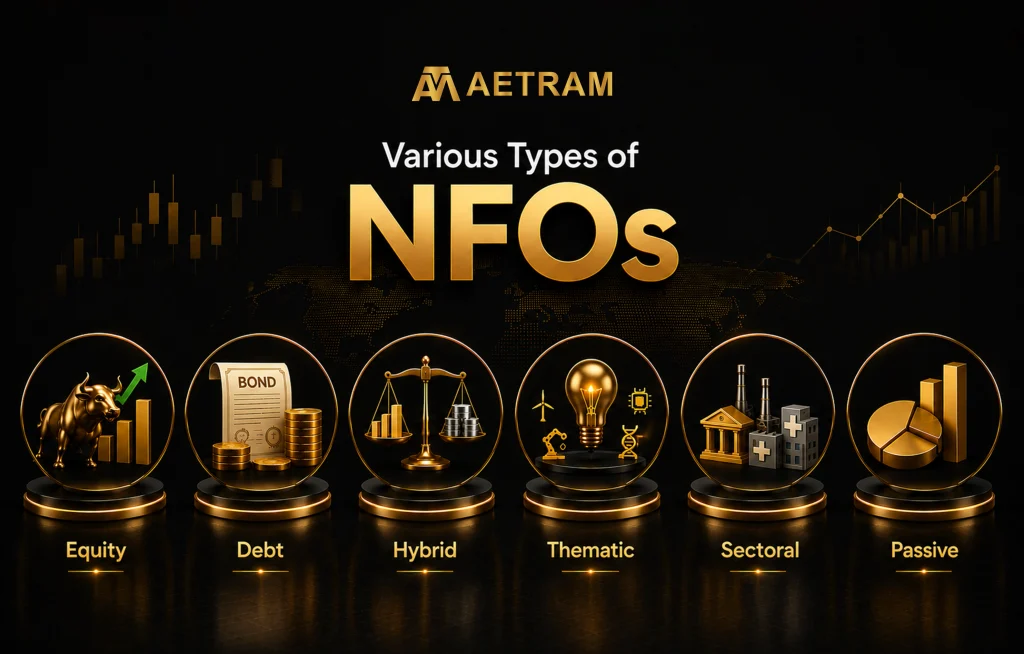
Different NFO Categories
NFOs are launched in different categories and based on the investor’s risk tolerance and time frame, they can subscribe to different NFOs. We will discuss the different categories available in this section.
Equity NFO: These NFOs focus on investing in equities across large-cap, mid-cap and small-cap stocks. These are suited for aggressive long-term investors with a high risk appetite. Investors are likely to have higher returns by subscribing to these NFOs.
Debt NFO: These NFOs invest in various types of bonds like government bonds, corporate bonds, municipal bonds and other debt funds like target maturity debt fund. These NFOs are best suited of conservative investors with a low level of risk appetite and looking for less volatile investment avenues.
Hybrid NFO: Asset Management companies launch these kinds of NFOs for investors with moderate risk appetite. These NFOs invest in securities that are a combination of equity and debt, balancing risk and returns.
Thematic or Sectoral NFO: These NFOs target a particular theme or sector and invest in companies that are present in those sectors or industries. These are launched to capitalize on new and emerging themes like green energy, AI, electric vehicles, etc. The risks are concentrated to that particular set of companies and if the sector doesn’t take off, then it would be considered a dud investment. However, these thematic or sectoral NFOs present a lot of high growth opportunities for risk-taking investors.
Passive NFO: A passive NFO is launched by an AMC to track and imitate a market index, say, Nifty 50 or Sensex, rather than beat the market index. Money invested in these NFOs will be proportionately distributed among the constituents of the market index according to the weightage and percentage calculated in the index. These are suitable for conservative investors and the returns are nearly equal to the underlying index. The management and expense ratio is low, however, investors must be careful about tracking error of the scheme.
Important things to check before you subscribe to an NFO
- Investors must do a thorough background verification of the asset management company (AMC) that has come out with an NFO and the fund manager who will be managing investments in this scheme. The AMC must be reputed and the fund manager must be experienced with the right qualification. The AMC must have a good streak in terms of generating returns for investors.
- Investors must thoroughly study the following documents: Scheme Information Document (SID), Key Information Memorandum (KIM), and Statement of Additional Information.
- By reading the above mentioned documents, it is imperative for you to understand the objective of the scheme, the strategies mentioned in the scheme, the themes and sectors the scheme will be focusing on, if the scheme is aligning with your long-term financial goals.
- Investors must check the expense ratio and exit load of the NFO. This is because a higher expense ratio is likely to weigh on the final redeemable amount.
- Based on your risk tolerance, timeframe, and financial objectives, pick the right NFO that suits you rather than subscribing to too many NFOs which may lead to over diversification.
Benefits of NFO
- NFOs have a low entry barrier and it is very beneficial for small investors as well as big investors. Most NFOs are priced at ₹10 per unit making it easier for new investors to tap the stock or debt market indirectly.
- NFOs provide investors a chance to invest across various asset classes like equities, debt, hybrid, etc., different companies based on market cap and sectors, new and emerging themes, etc.
- Investors can subscribe to NFOs to diversify their investment portfolio and mitigate risks.
- Through NFOs, investors like you can invest in a new mutual scheme from the beginning at a very low price, leading to potentially higher returns if you stay invested for a long time period. These returns can be capital appreciation or dividend payouts.
- NFOs are professionally managed by fund managers with a lot of experience and who track various sectors. As the money is professionally managed, the chances of you achieving your investment goal is potentially high.
How to invest in upcoming NFOs?
Investors like you can invest in upcoming NFOs through Aetram Trades India. Investors can raise a request with our dedicated team through [email protected] or call 044-48680008/044-49477777 to subscribe to new NFOs. Our team would assist you in completing the subscription process smoothly.
Conclusion
Investing in a New Fund Offer gives an opportunity to potential investors to build and grow their wealth over a long period of time. Investors must ensure they pick the right AMC, understand the objective of the scheme by reading the important documents, know the theme and sector in which their money will be invested in and must stay invested over a long period of time to bear the fruits of investing. As there are benefits associated with subscribing to NFO, it makes a lot of sense to invest via NFO to diversity and achieve the desired financial goal.
Frequently Asked Questions
1. What is an NFO?
NFO stands for new fund offer and by subscribing to an NFO, you have an advantage of investing early in a mutual fund scheme.
2. Which NFO is more popular – Open ended or Close ended?
Open ended NFOs are more popular compared to close ended NFOs as they are more flexible
3. If I have to start an SIP, which NFO should I select?
To start an SIP, Open ended NFOs are the best option because you can buy and sell the units at any time even after the NFO subscription time is over. Close ended NFOs do not allow you to do an SIP as subscription time is for a fixed duration.
4. How long an NFO will be open for subscription?
According to SEBI rules, a New Fund Offer (NFO) can be open for subscription for a maximum of 30 days. Having said that, the exact subscription period is determined by the Asset Management Company (AMC) and the popular timeframe is 15 days.
5. Is there a cap to invest via NFO?
If it is an open ended NFO, there is no limit on investment. But, if it is a close ended NFO, there is a cap on the investment.
Disclaimer: This blog is intended for informational and educational purposes only and should not be construed as financial, investment, or legal advice. Investments in mutual funds are subject to market risks. Please consult a qualified financial advisor before making any investment decisions. Aetram Trades Pvt. Ltd. is a SEBI-registered stock broker and an AMFI-registered Mutual Fund Distributor (ARN-281894).