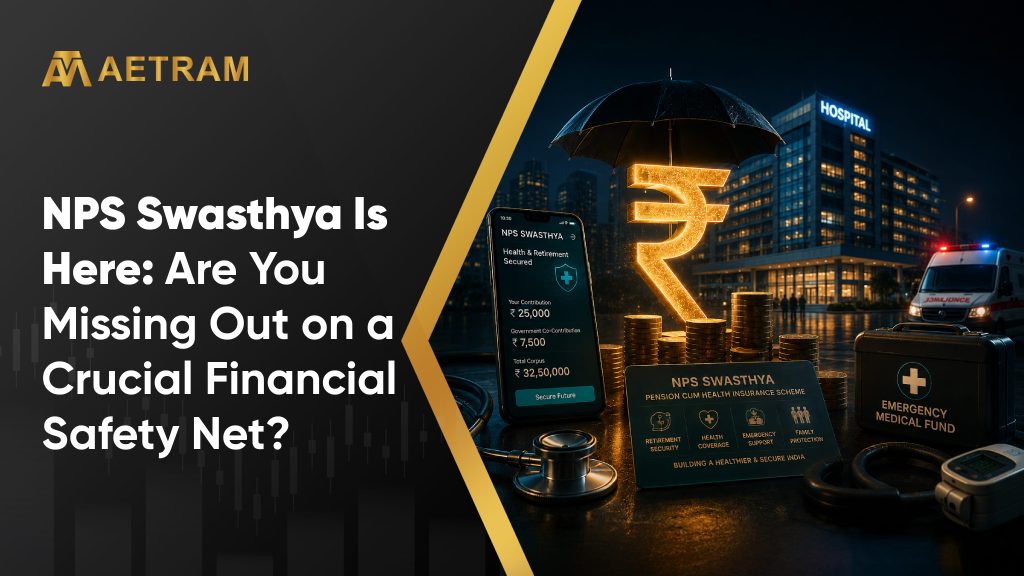
NPS Swasthya Is Here: Are You Missing Out on a Crucial Financial Safety Net?
India is the world’s most populous country which is a boon and a bane. While most of the population is young and there are talks about leveraging the demographic dividend which is a boon, there are also some negative impacts like rising healthcare costs with burgeoning population.
The Indian government is unable to meet the healthcare needs of the entire population through government institutions like AIIMS and most of the population is left to fend for themselves. However, to lessen the burden of healthcare costs on its fellow citizens, the Indian government has introduced a healthcare-linked retirement scheme called NPS Swasthya which we will discuss in this blog.
What is NPS Swasthya Pension Scheme?
Healthcare costs and retirement planning are both long-term financial obligations for each individual as the price of goods and services keep increasing and this burns a hole in their pocket. To ease this burden, PFRDA (a government institution) has launched NPS Swasthya Pension Scheme to address them together.
The scheme is being tested as a Proof of Concept under the Regulatory Sandbox Framework and the current launch is not yet full-scale. It is limited in scope and intended to evaluate the product before any wide implementation across the country.
While traditional NPS focuses solely on creating a retirement corpus, NPS Swasthya is different because it has introduced a new feature by integrating healthcare coverage into the pension scheme.
The concept is fairly simple and straightforward because as healthcare inflation is rising significantly, the government is encouraging and facilitating the subscribers to gradually build a financial corpus over time and when there is a sudden medical emergency, the subscriber is able to withdraw from this fund, provided they follow the established rules guidelines.
The initiative is being observed closely, with its effectiveness and feasibility being evaluated in real-world scenarios. Some aspects of the structure are still under review, but early signs suggest it could offer a more holistic approach to long-term financial planning.
Why was NPS Swasthya launched?
Pension Fund Regulatory and Development Authority (PFRDA) introduced this scheme which allows subscribers to use pension savings for any eligible medical expenses but still keeping the retirement-planning structure intact. This scheme can be used by the subscribers for both outpatient and inpatient medical expenses as healthcare costs can create sudden pressure on household finances, especially during emergencies or recurring treatment.
The scheme is intended to bridge the gap between retirement savings and money required for healthcare expenses, especially for people who may need quick access to funds during emergencies.
PFRDA’s objective is to check if the new vehicle for retirement savings will help people who need to access their pension fund in their lifetime to pay for healthcare expenses instead of taking loans or withdrawing from other financial assets or depending completely on their health insurance for claims.
This makes the scheme especially important and useful for individuals in an inflationary healthcare environment where cash flow matters as much as coverage and this scheme is not designed as a replacement for health insurance but a complement to someone’s health insurance.
Who can join NPS Swasthya?
NPS Swasthya scheme is not mandatory and voluntary for individuals. It is open to all Indian citizens and the subscriber must have a Common Scheme Account with NPS as this is an extension of the broader NPS scheme. It is not a distinct savings scheme.
The scheme is in the proof-of-concept phase and it is being offered only to a restricted number of subscribers. However, PFRDA is likely to frame new rules in the future, change the eligibility for subscribers, etc. after studying subscriber engagement and claims. As such, it is important to check for the latest NPS Swasthya rules before you sign up.
Contribution under NPS Swasthya
Individuals who subscribe to NPS Swasthya Pension Scheme can contribute any amount they want, as long as it follows the current rules for the non-government sector under NPS.
Contributions from the scheme are invested automatically by the pension funds according to the rules set out in the MSF.
Subscriber above 40 years old (excluding those in government jobs or government-owned companies) can transfer up to 30% of their own and employer contributions from their regular pension account to the NPS Swasthya Pension Scheme account.
Withdrawal rules under NPS Swasthya
Partial withdrawals will be allowed from an NPS Swasthya Pension Scheme Account for outpatient or inpatient medical needs as incurred by the subscriber, at any time.
At any point, a subscriber will be allowed to withdraw a maximum of 25% of his/her contributions made under the scheme as per the provisions of PFRDA Act, 2013. There is no restriction on frequency of partial withdrawals and no lock-in period for such withdrawal. However, such a partial withdrawal can be availed of only when a minimum corpus of Rs. 50,000 is accumulated under the scheme.
Premature exit option
According to the NPS Swasthya scheme, if a subscriber has a medical treatment as an inpatient and the cost of that treatment exceeds 70% of the total amount in their NPS Swasthya Pension Scheme account, they can exit the scheme early and they will receive the full balance amount.
It does not matter how much money is in the account because it is specifically meant to help cover any urgent medical expenses regardless of the corpus size. This exit option will allow the subscribers to access their entire pension fund completely when they have to pay for a huge medical costs and they do not have to have any financial stress.
NPS Swasthya scheme claim settlement process
During the time of claim settlement, the amount which is withdrawn is not simply paid out as cash in the usual sense. The amount is paid directly to the Health Benefit Administrator, Third Party Administrator, or the hospital against provided valid claims and supporting bills are submitted.
Any remaining amount after the claim is settled is transferred back to the subscriber’s main NPS account. This process is followed to prevent any misuse of the amount and make sure the amount is used for healthcare expenses. It also adds a layer of process control as claim documentation becomes part of the withdrawal process.
Should you consider NPS Swasthya?
The NPS Swasthya scheme is in pilot phase and if you plan to subscribe to the scheme you should keep an eye on the fee structure, fund options, claim document requirements and any changes or updates to the scheme. withdrawal norms are all likely to see changes.
According to some reports, the scheme may continue to change as the PFRDA seeks to perfect the onboarding experience and claims process. Also, the benefits in the healthcare scheme will become useful only when the corpus is accumulated over time; for those making irregular payments or with limited saving capacity, the healthcare benefits will take time to manifest.
Conclusion
NPS Swasthya was created by the government of India to help people use their pension savings for any sudden medical expenses or medical emergencies amid rising healthcare costs. However, this is not a substitute for good health insurance and this scheme can be a complement to your health insurance policy. Also, it would be prudent for you to seek the advice of a certified financial planner in case you are planning for retirement and also want to meet your medical expenses after retirement.