How Inflation and Interest Rates Are Quietly Killing Your Iphone Dreams?
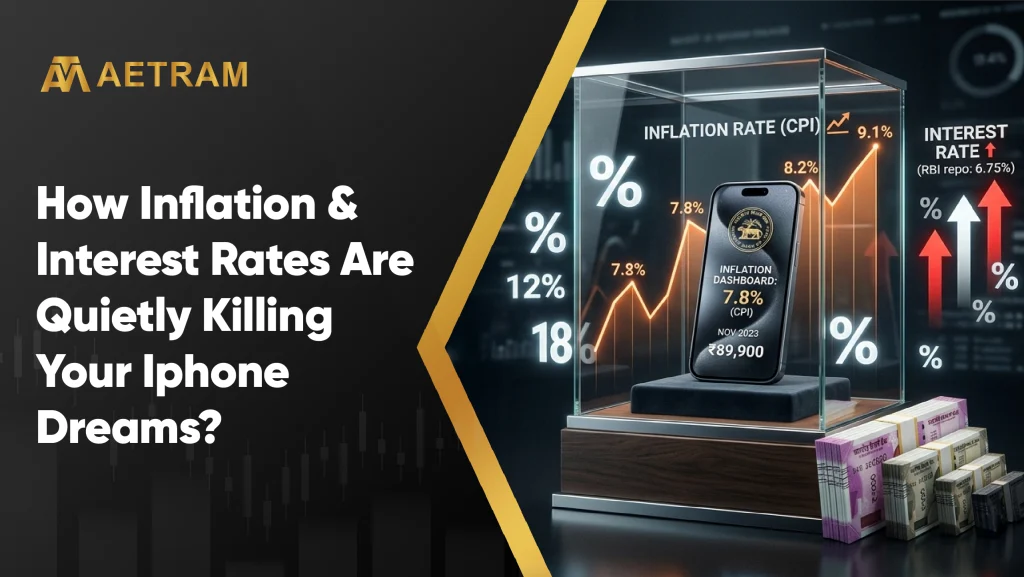
You’ve been eyeing that new iPhone for months for a variety of reasons including its performance, camera quality and privacy. So you do the math, check the EMI options and maybe you have even saved a little on the side.
But somehow, owning one feels further away than ever, even though your salary has gone up. Something doesn’t add up, does it? It’s not your imagination. Inflation and rising interest rates are doing their jobs silently in the background which makes everything expensive including premium products like iPhone. This makes premium smartphones like the iPhone difficult to afford for a common man earning an average salary.
If your iPhone dreams feel more distant today than they did three years ago, here is the real reason which we will discuss in this blog.
iPhone’s price tag is a mirage
At first glance, Apple’s pricing seems reasonable given its superior hardware and smooth software. The base iPhone 17 was launched at a price comparable to previous generations. So what’s the problem?
The problem is what economists call real price versus nominal price. While the market price has not moved much, inflation has quietly eroded the value of your rupee. If you want to own a phone that costs about Rs 80,000 or Rs 1 lakh, it may require some sacrifice from you with respect to spending on other stuff because everything else has become costlier. For instance, your groceries, rent, fuel, school fees and EMIs have all climbed but your purchasing power did not.
Your EMI is not what it used to be
India has become a country where people depend on loans to buy consumer electronics. Be it smartphones or air conditioners, etc., there are multiple financial institutions which are facilitating it.
It is well known in India that most of the iPhones (around two-third or more) are bought using EMIs. EMIs stands for equated monthly installments which allows people to own goods today and pay for them gradually over a period of a few months instead of paying the full price upfront. That number alone tells us something important and that is, a large number of people simply cannot afford to pay upfront for a device that costs upwards of Rs 80,000.
EMIs were supposed to help people own assets and for a while, it worked. EMI schemes made the monthly outgo look manageable but that phase is fading.
When the Reserve Bank of India raised interest rates to combat inflation, borrowing costs climbed across the board. Personal loan rates, credit card loans, EMI charges and consumer durable loans, etc. became more expensive.
The affordable monthly instalment that made your iPhone feel within your reach had quietly gone up. A loan that might have cost you a few thousands, rose quickly depending on the tenure, risk associated with the borrower and your lender.
And if you add this to your existing financial commitments like a home loan, a car loan, a personal loan, etc., you can quickly see how rising interest rates have compressed your monthly financial breathing room, leaving little left for a premium smartphone purchase.
The Double Squeeze: Your Costs Rise, Your Savings Fall
When there is high inflation in the economy, it becomes uncomfortable for the average aspirational buyer. Inflation does not just raise the price of things you buy today, it also erodes the value of the money you’ve been saving for tomorrow.
If you have been saving Rs 5,000 every month hoping to buy an iPhone next year, you are likely losing ground and are in a disadvantageous situation. Savings account interest rates in India have rarely kept pace with inflation. Banks, in the last decade, have decreased the savings account interest rate significantly. In real terms, the value of the money you are saving every month is shrinking due to inflation, even as you dutifully add to it.
This is the double squeeze that inflation creates. Your expenses rise on one end and at the same time your savings lose purchasing power on the other. The iPhone you planned to buy with your savings may increase marginally, but your ₹90,000 saved will feel more like ₹85,000 in real terms.
So you may go for an EMI to own that iPhone. And if you are relying on an EMI, you are paying interest along with the principal amount on a depreciating asset. The moment you unbox that iPhone, its market value starts falling. You may keep paying interest for the next 12 to 24 months which would be higher than the market price of the phone.
Apple’s Global Pricing Tells the Honest Story
Apple has largely held US prices steady but consumers outside America have already experienced what inflation-adjusted iPhone ownership truly looks like.
In October 2022, Apple raised App Store prices by 20% across the Eurozone and by over 30% in Japan, citing the weakening of local currencies against the US dollar. The iPhone 14 and Apple Watch Series 8 also saw price hikes in Europe, Japan, and the UK that same year. None of this happened in America.
What this reveals is that Apple does respond to currency and inflation dynamics , just not symmetrically. When the dollar strengthens and your local currency weakens, for example, as the rupee has done over the years, the effective cost of owning Apple products in India rises. Import duties, currency fluctuations and localised pricing adjustments quietly add to the burden. Indian buyers, who already pay a premium over US prices due to import duties and GST, feel this effect more acutely than most.
The opportunity cost nobody talks about
Beyond the price of the phone itself lies a more dangerous financial trap and it is called opportunity cost. When you stretch your budget and commit to a 12 or 18-month EMI or dip into savings to buy a premium smartphone you are buying something which will not appreciate in value and losing it on putting it to better use. You’re not investing it in a SIP or building an emergency fund. You are also not paying down an existing loan faster and closing it faster.
In a high-inflation, high-interest-rate environment, the cost of not investing is severe. Money sitting outside a well-chosen investment loses value more quickly than you think. Money going into interest payments on a consumer loan , for a depreciating gadget , is doubly punishing.
This is not an argument against ever owning an iPhone. It is an argument for being clear-eyed about what it actually costs you, not just in rupees, but in financial goals delayed or derailed.
What should iPhone buyers do?
Being smart and having awareness about inflation and interest rates doesn’t mean swearing off premium smartphones forever. It means approaching the purchase of the iphone differently.
If you want to own an iphone you may wait and pay cash. You may plan accordingly to buy an iPhone after 12 to 18 months from now. Meanwhile, you can set up a recurring deposit or a liquid mutual fund specifically for this goal. Let the money grow while you save, instead of paying interest while you spend.
Avoid high-interest EMI routes because any EMIs through credit card or personal loans for buying a smartphone like iPhone are among the most expensive financial decisions you can make in today’s high interest rate environment. Zero-cost EMI schemes from banks and retailers are acceptable if you can genuinely afford the monthly outflow without any strain on your wallet.
You can also consider buying last year’s model because with each new iPhone launch, the price of the previous model drops in price. A year-old iPhone may cost you less than the new model without much compromise on the technology. In inflationary times, value-seeking is not compromise but it is wisdom.
Ask yourself if you really need a new version of iphone if the current iphone is working properly. This is the oldest personal finance question, but it has never been more relevant. If your current phone works fine, you may not need to upgrade especially during inflationary times and rising interest rates.
Conclusion
Inflation and interest rates are not abstract macroeconomic concepts but they affect our lives in more ways than one. They are the quiet forces that make your salary feel insufficient, your savings being eroded and your aspirations feel perpetually out of reach.
Owning an iphone is not impossible and not a sin but in today’s economic environment, achieving it without hurting yourself financially requires planning, patience and a clear understanding of what your money is actually worth. As money tends to compound over a long period of time, buying an iPhone should be decided after carefully assessing your financial health.