Is India’s Forex Reserves Enough To Arrest Indian Rupees’s Fall?

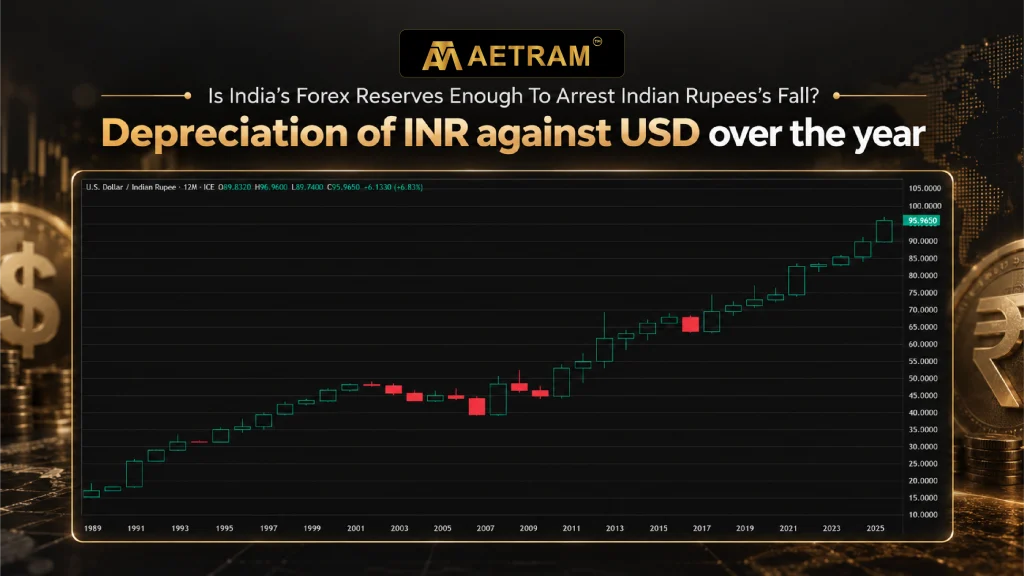
The Indian Rupee has seen its worst performance in 2026 as it has crossed INR 95 per one US Dollar. This has made all stakeholders from traders, importers, exporters, policymakers and everyday Indians to get anxious and check the news periodically because they would like to know how far the rupee can fall. And, more importantly, is the Reserve Bank of India prepared to face even more depreciation of the currency.
The Indian currency has been volatile as it has swung widely in recent months. And the RBI has been forced to step in and sell the US Dollars from its forex war chest and it has been doing a lot of the heavy lifting behind the scenes.
But with reserves still well below their peak and oil prices still being high, many people are asking whether India’s reserve buffer is genuinely enough or whether it’s simply buying time. Let us look at where the Indian rupee stands and how people can be affected if it depreciates even more.
Where Things Stand Right Now
As of the week ended July 17, 2026, India’s foreign exchange reserves stood at $676.24 billion, and it has climbed compared to the week ending June 26, 2026, when the forex reserves stood at $666.93 billion.
To put that in perspective, the forex reserves had touched an all-time high of $728.49 billion back in February 2026, before a sharp slide dragged them down to $666.93 billion by late June. That’s a drop of over $61 billion in just four months.
The recent recovery is welcome, but the forex reserves is still short of about $50 billion compared to its all-time high. Meanwhile, the rupee has had an equally dramatic year. The rupee started 2026 trading near 89.86 to the dollar but fell to a record low of 96.84 by May 20 and then it clawed back to around 94.35 by mid-year. And since then it has depreciated further to about 96-96.6 range by late July as crude oil prices increased and geopolitical tensions in West Asia flared up again.
What Forex Reserves Actually Do for a Currency
Before we worry about whether the forex reserves are enough to meet external payments in the US Dollar, it is always prudent to understand where the forex reserves are used. Forex reserves serve three main purposes:
Import cover: Reserves need to be large enough to pay for essential imports, especially crude oil, in case foreign inflows dry up temporarily. India imports more than 80% of its crude oil requirement, so it is very important to have enough US Dollars otherwise we would be having to issue oil bonds or there would be an energy crisis. As of now, India’s current reserves are more than enough to meet up to ten months of imports. This is well above the internationally accepted safety threshold of three to four months.
Intervention capacity: Whenever there is a sharp fall of the Indian rupee, the RBI may sell dollars from its forex reserves to slow down the fall. This measure by the RBI may not affect the rupee’s long-term trend, but can soften the abrupt, erratic swings of the currency.
Confidence signalling: If a country’s central bank has a healthy forex reserves it will send a positive signal to foreign investors, global financial institutions, rating agencies, etc. that India can meet its external obligations even during a crisis, which indirectly supports the currency.
How Much Firepower Does the RBI Actually Have?
The RBI has clearly been active this year. Reports suggest the central bank sold a net $6.1 billion in the forex market in May alone, following an even larger $8.9 billion in sales the month before. That kind of intervention isn’t cheap, and every dollar sold to prop up the rupee is a dollar drawn down from the reserve buffer.
Compare this to earlier stress episodes which happened during the 2013 Taper Tantrum and in the late 2024. India’s reserves in 2013 were much smaller relative to the size of the economy. During that time the Indian rupee fell sharply and the central bank had to introduce special deposit schemes to attract dollar inflows.
Starting from October 2024 to January 2025, the RBI were net sellers of $55.79 billion to defend the currency, an intervention pace that proved unsustainable and eventually forced the RBI to let the rupee fall.
The lesson from history is fairly consistent and that is the forex reserves can smooth volatility for a while, but if the underlying pressure persists, the central bank eventually has to let the currency adjust rather than keep burning through its buffer.
Factors weighing on the Indian rupee
Several headwinds are converging at once against the rupee and that is why it is seeing a steep decline.
Elevated crude oil prices: Crude oil prices which are both WTI Crude and Brent Crude have been trading high amid the ongoing US-Iran war. As India imports a vast majority of its oil requirements, every dollar increase in crude oil prices will directly increase the import bill for India and it will put pressure on the Indian rupee.
Geopolitical tensions: There has been continued tensions between countries like Russia and Ukraine; the US and Iran and other Gulf countries which have kept the global markets on the edge. This has forced investors to choose safe-haven assets like the US Dollar.
Tariff overhang: A steep tariff by the US government on Indian exports remains a drag on trade competitiveness of Indian products. As a result, exporters are finding it difficult to sell their products in the US and other parts of the world and bring in more dollars which is weighing on the trade balance.
Stronger dollar: Global dollar strength doesn’t just affect the rupee; it affects most emerging market currencies simultaneously, making it a headwind India can’t fully control on its own.
Are Forex Reserves Enough?
There’s a reasonably strong argument that India is better positioned than the recent volatility suggests. Reserves have already been rebuilt since its recent lows, showing the recovery is happening gradually.
The RBI introduced a package of capital-account reforms in early June specifically aimed at attracting foreign inflows into Indian bonds and equities, and these measures appear to be working.
Import cover of roughly ten months is well within the comfort zone, even by conservative standards.
Gold holdings within the reserve mix have grown meaningfully over the past year, a deliberate diversification strategy that reduces reliance on dollar-denominated assets alone.
All three conditions needed for a sustained reserve rebuild, namely stable oil prices, continued foreign capital inflows, and a supportive global dollar environment, are currently in place, even if fragile.
The Case for Caution
On the other hand, there are real reasons not to get too comfortable. Forex reserves are still roughly lower than $700 billion and rebuilding that gap to reach all-time highs again will take sustained good conditions, not just a couple of positive weeks.
Every large intervention episode in India’s history has eventually run into limits.Forex reserves which look good enough may erode quickly if oil prices increase and imports of other commodities also increase in tandem. The reserves will also get depleted if foreign investors remain risk averse towards the Indian financial market.
If India’s trade deficit and current account gap widen further, no reserve level will be permanently “enough.”
The rupee’s history shows it can stay under pressure for extended periods even with RBI support.
What This Means for Investors, Importers, and Businesses
If you are running a business that deals with imports or if you have taken loans in the US dollars, it is wise to hedge your currency risks instead of hoping the rupee will stay put.
Investors feel the pinch whenever the rupee weakens and imported goods get pricier. And this leads to higher inflation and this puts pressure on the RBI during interest rate policy decisions. All this spills over to the stock and bond markets. Meanwhile, exporters and IT companies actually benefit from a softer rupee and these exporters become competitive in the global market. So the effects of rupee weakening are not the same everywhere.
If you are just looking after your savings, the daily rupee movements don’t matter as much. What really counts is whether India’s fundamentals like its forex reserves, the current account, fiscal strength, improving manufacturing and service sectors output are solid enough to keep things from spiraling.
Conclusion
Though India’s forex reserves are healthy by conventional metrics, it is always better to be cautious. The forex reserves can only act as a buffer and slow down the pace of rupees’ fall and wait for underlying conditions to improve. India’s forex reserves cannot single-handedly reverse a slide driven by expensive crude oil, tariff war, geopolitical tensions and strengthening US dollar. The real answer lies in India drafting the right policies to increase FII and FDI inflows. They must also boost the export-oriented manufacturing and services sector to attract more US dollars so that the Indian rupee strengthens eventually.
Frequently Asked Questions (FAQs)
What are India’s current forex reserves as of July 2026?
India’s foreign exchange reserves stood at $676.24 billion for the week ended July 17, 2026, up from a recent low of $666.93 billion in late June, but still below the all-time high of $728.49 billion recorded in February 2026.
Why is the Indian rupee falling in 2026?
The rupee has been under pressure due to elevated crude oil prices amid US-Iran tensions, a steep US tariff on Indian exports, and broad global dollar strength, all of which have weighed on India’s trade balance and investor sentiment.
How many months of imports do India’s forex reserves cover?
India’s current reserves cover approximately ten months of imports, comfortably above the internationally recommended minimum of three to four months of import cover.
Can the RBI’s forex reserves fully stop the rupee from depreciating?
Not entirely. Reserves allow the RBI to smooth out sharp, disorderly currency moves through market intervention, but they cannot offset a structural trade or current account gap over the long term. Reserves buy time; they don’t fix the underlying causes of depreciation.
What should importers and investors do given the rupee’s volatility?
Importers and businesses with dollar liabilities are generally better off hedging their forex exposure rather than assuming the rupee will hold at any particular level. Investors should watch crude oil prices, Fed policy, and India-US trade talks as the key triggers likely to determine the rupee’s next major move.
Disclaimer: The information provided in this article is for educational and informational purposes only and should not be construed as investment, financial, or trading advice. Any financial figures, calculations, projections, examples, or scenarios are hypothetical, intended solely for illustrative purposes, and do not represent actual or future performance. The content is based on information obtained from credible and publicly available sources. While reasonable care has been taken in its preparation, no representation or warranty is made regarding its completeness, accuracy, or reliability. References to indices, securities, or other financial products are for illustrative purposes only. Actual investment outcomes may vary. Investors are advised to carefully read the relevant scheme, circular, or product offering documents and consult a certified and SEBI-registered financial advisor before making any investment decisions. Neither the author nor the publisher shall be liable for any loss, damage, or liability arising from the use of, or reliance on, the information contained in this article.