India’s Balance Of Payments Deficit Rise. What it means for you?
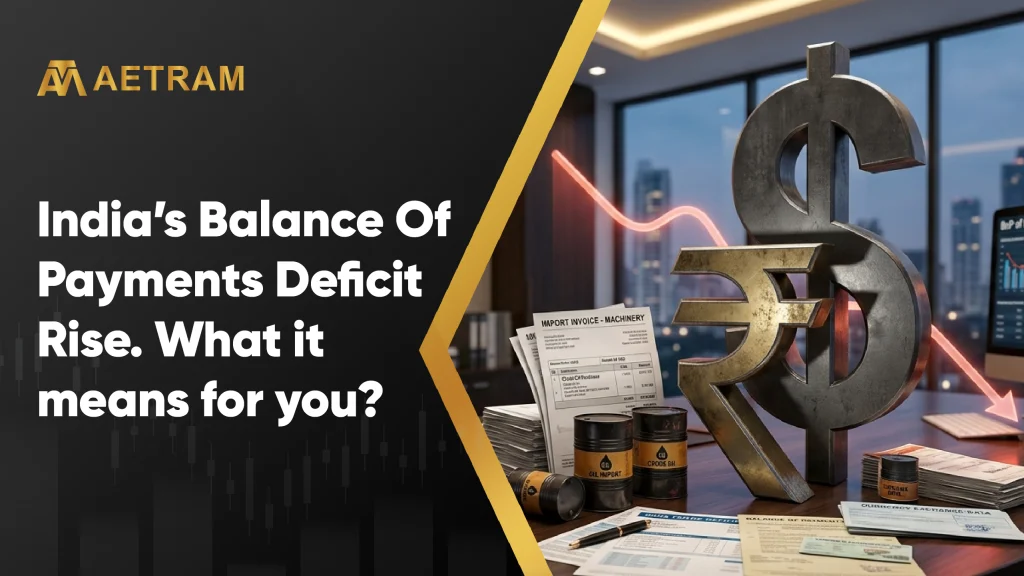
You might have recently noticed that your monthly grocery bill has risen or your dream vacation to Europe suddenly feels a bit more expensive or your favorite gadgets are becoming costlier without any big technological upgrade. This is because of an underlying reason and a powerful macroeconomic force: India’s Balance of Payments (BoP) deficit rise.
The term Balance of Payments may sound technical and an economic jargon used by economists, central bankers, Wall Street analysts, finance professionals, etc. But it has a direct and tangible impact on your personal finances. If you are an investor or a consumer, understanding this metric is no longer optional but necessary.
In this blog, we will discuss the reasons due to which there was a rise in BoP in FY26 and its ripple effects on the broader economy. We will also discuss the steps you can take to protect your wealth during uncertain macroeconomic situations.
What is the Balance of Payments (BoP)?
Let’s first understand the term Balance of Payments. It is like a ledger for the whole country which has a lot of financial and economic activities with other countries in the world and these activities or transactions must be recorded.
The BoP has two components and they are as follows:
Current Account
The current account will track selling and buying of goods, services (IT, Tourism, BFSI, etc.) and transfers such as Indian remittances from abroad. If the Indian imports exceed the Indian exports, we have a situation where India has a Current Account Deficit (CAD). In contrast, if Indian exports are more than imports, then we have a surplus.
Capital Account
A capital account keeps track of the flow of investment capital. It includes Foreign Direct Investment (FDI), Foreign Portfolio Investors (FPI) flows and external commercial borrowings (ECBs).
A BoP deficit is the result of the total outflow of money (payments to the rest of the world) surpassing the total inflow (receipts from the rest of the world). A small deficit is typical for a growing, developing nation that has to draw foreign direct investment and buy capital goods. But a growing deficit can expose economic weaknesses and set off a flight of money out of the country.
India’s BoP situation in FY2026
The country’s balance of payments increased as the economy came under stress during FY2026 due to various factors although the overall economy was resilient.
During the first quarter of financial year 2026, which is between April 2025 and june 2025, the current account deficit stood at a modest USD 2.4 billion, just 0.2% of GDP. This was an improvement from USD 8.6 billion in Q1 FY25. Strong services exports and a surge in NRI remittances, up 18% year-on-year, offset the blow of a widening merchandise trade gap.
By Q2 FY26 (July–September 2025), the CAD widened to USD 12.3 billion (1.3% of GDP), but was still much better than the USD 20.8 billion deficit recorded in the same quarter of previous year. Foreign exchange reserves, however, depleted by USD 10.9 billion, a sharp contrast to the accretion of USD 18.6 billion a year earlier.
The first half of FY26 told a clear story and that was the overall BoP swung from a surplus of USD 23.8 billion in H1 FY25 to a deficit of USD 6.4 billion in H1 FY26. This was a reversal of fortunes and not a small deficit. The country was drawing down reserves, not building them.
During Q4 FY26 (January–March 2026) the country recorded a current account surplus of USD 7.1 billion which is 0.7% of GDP and it was driven by strong exports in the services sector and robust remittances. But this came alongside a ballooning merchandise trade deficit of USD 83.4 billion compared to USD 59.3 billion in the same quarter of FY25. Services receipts of USD 60.4 billion helped offset the damage, but the gap in goods trade was increasing.
For the full financial year, India’s current account deficit came in at USD 25.2 billion which was 0.6% of GDP. While the ratio to GDP held steady from the previous year, the absolute widening in a globally volatile year signals structural pressure that cannot be ignored.
Causes behind widening deficit
India’s balance of payments rose in FY2026 because of a few unexpected events. The first reason was the higher crude oil prices. India imports about 80% of its oil needs and this crude oil dependence remains India’s most stubborn import burden.
With West Asian geopolitical tensions flaring intermittently through the year, oil prices stayed elevated which directly weighed on the crude oil prices, widening the trade deficit and pushing up the import bill.
The second reason was that the gold imports staged a dramatic comeback. A surge in gold purchases particularly during October 2025 played an important role in bloating the merchandise deficit significantly. Gold, alongside crude, became the biggest drain on India’s foreign exchange.
In addition, FPI volatility and FDI repatriation put pressure on the capital account. Foreign portfolio investors pulled out heavily through Q2 and Q3, and foreign direct investment witnessed elevated repatriation. Global investors booked profits on existing Indian positions and as the rupee started to weaken, the investors started to take capital out of the country. This structural weakening of the capital account made it harder to finance even a moderate current account deficit.
Depreciating Indian rupee
Between FY22 and FY26, the rupee fell from Rs 74.5 to more than Rs 91 per dollar. That is not a headline figure. That is a more than 22% erosion in the purchasing power of India’s currency against the world’s reserve currency and it affects you directly.
When the rupee weakens, every dollar India spends on imports becomes more expensive in rupee terms. Crude oil priced in dollars becomes costlier to buy. Imported electronics, machinery and raw materials see prices climb. And because a weaker currency is partly a symptom of BoP pressure with capital outflows and trade deficits putting selling pressure on the rupee the two feed into each other in a vicious cycle.
Some forecasts now project the rupee at around Rs 95 or even Rs 100 per dollar by end-2026. If no significant trade deals are struck and tariffs remain elevated, that trajectory could even worsen. For a salaried professional or a small business owner, that kind of currency movement is invisible until suddenly it is not showing up in fuel prices, airline tickets, imported gadgets, and college fees for children studying abroad.
How BoP hits your monthly budget
Whenever there is a geopolitical event or a macroeconomic data affecting us, we do not take it seriously but this is where macro becomes personal.
Fuel costs: India is heavily dependent on gulf nations and other oil and gas producing nations for its energy requirements. This dependency along with a weaker rupee and a wider trade deficit translate almost immediately into higher petrol and diesel prices. Transport costs rise, which feeds into the cost of vegetables, grains, cereals, packaged goods, tourism, logistics, etc. This is the classic case of imported inflation.
Fertilisers and food: India imports significant quantities of fertilisers and edible oils. A depreciating rupee makes both more expensive. Farmers face higher input costs and consumers face higher grocery bills.
Electronics and appliances: Smartphones, laptops, semiconductors most of these are imported or assembled using imported components. When the rupee weakens, their prices inch upward and the final product is priced higher.
Interest rates and EMIs: To attract foreign capital and stop capital outflows during a BoP stress period, the RBI may be compelled to keep interest rates elevated or even raise them. That directly impacts your home loan EMI, car loan, and any floating-rate personal loan. The RBI can come up with a scheme offering higher interest rates to NRIs .
The relationship is not always instant but it is reliable. A worsening BoP makes everyday life more expensive, especially for small and medium enterprises who depend on bank loans to run their business and the aspirational middle class in India who depend on bank loans to achieve their dream home, vehicle, etc.
Should investors be worried?
For retail investors tracking their portfolio and BoP situation has several indirect implications.
Currency risk on imported inputs affects mid-cap and small-cap companies in sectors like chemicals, electronics assembly, and consumer durables. A weaker rupee compresses their margins and can impact stock valuations.
FPI flows drive short-term market sentiment. When BoP pressures mount and the rupee weakens, foreign institutional investors often reduce their India exposure and they create selling pressure in equity markets.
Debt funds are affected by interest rate decisions taken by the RBI. If the RBI tightens monetary policy to defend the rupee or attract capital flows, bond yields rise and debt fund NAVs can fall in the short term.
As far as long-term SIP investors, they should not worry. India’s GDP grew 7.7% in FY26, and the current account deficit was at 0.6% of GDP which is within sustainable limits. But it is also a good time to review your portfolio and its exposure to import-dependent sectors. You should also make sure you have exposure to international funds so that your portfolio is diversified and also acts as a hedge.
How is the RBI tackling the situation
The RBI has been actively managing the fallout and taking active steps to save the Indian rupee. Through H1 FY26, it intervened in forex markets to smooth rupee volatility by selling dollars from its reserves to prevent the sudden depreciation.
In June 2026, both the government and the RBI announced a package of structural measures aimed at attracting foreign capital and bridging the BoP gap which included steps to facilitate NRI investment, streamline FDI approvals in key sectors, and strengthen export promotion frameworks. These are early-stage interventions and their full impact will only be visible in the coming months and in the FY27 data that would be released by the government.
What can investors do?
You cannot control the trade deficit but you can make smarter decisions with your money by closely tracking your portfolio and reallocation if necessary.
Review your gold allocation and make diversification part of your portfolio. Gold historically performs well during currency depreciation phases. If your portfolio has less gold allocation it would be a good decision to invest in gold ETFs or gold mutual funds rather than physical.
Hedge your foreign currency exposure. If you have kids who are planning to study abroad or plan to travel internationally, locking in forex rates early through a forex card or a partial forward booking can shield you from further rupee depreciation.
Diversify internationally as Indian rupee depreciation actually boosts the rupee-denominated returns of international fund investments. A modest allocation within the SEBI-permitted limits to US equity market or global equity funds provides a natural currency hedge.
Don’t stop your SIPs and step up your SIPs if possible. Market volatility driven by BoP pressures is temporary. India’s long-term growth story driven by demographics, talent pool, digitalisation and infrastructure remains intact. If you stay invested and invest across different types of assets and let compounding do its work, you may become financially secure.
Track inflation closely because inflation can erode your real returns. So you must look at shifting a portion of your fixed-income allocation to inflation-indexed instruments like RBI Floating Rate Savings Bonds which will adjust with benchmark rates.
Conclusion
Every country in the world has a Balance of Payments situation and India is not alone in this globalized economy. It is a topic to be discussed as it affects each one of us differently. Macroeconomic factors are real and it affects our expenses. The reasons that are adding pressure to Indian households include widening current account deficit, structural shift from BoP surplus to deficit in H1 FY26 and the steady erosion of the rupee. Being financially aware of these forces and taking simple, proactive steps is what separates serious investors who are acting on it compared to those who are just consuming it.
Frequently Asked Questions (FAQs)
1. What is India’s Balance of Payments and why does it matter?
India’s Balance of Payments is a comprehensive record of all financial transactions between India and the rest of the world which includes trade in goods and services, foreign investments as well as remittances.
2. Is India’s current account deficit sustainable at 0.6% of GDP?
At 0.6% of GDP, the CAD is within manageable limits. According to economists, it is generally considered that a CAD below 2% of GDP is sustainable for a developing economy like India. The country is , given its forex reserve cover and strong services export base.
3. What are the main reasons behind India’s widening BoP deficit?
India’s BoP deficit is largely driven by a heavy dependence on imported crude oil and gold, a persistent gap between merchandise exports and imports, and volatile foreign investment flows. When global commodity prices rise or foreign investors pull money out, the deficit tends to widen quickly.
4. How does a Balance of Payments deficit affect the common person?
A BoP deficit weakens the rupee which makes imports more expensive. This will lead to higher fuel prices, costlier groceries, pricier electronics and higher inflation in the economy. due to this the central bank may even increase the interest rate which will directly impact your home loan EMIs and other EMIs.
5. Should retail investors be worried about the BoP situation?
Long-term investors need not be worried about this. A moderate BoP deficit is a normal feature of a developing or an emerging economy. However, investors should remain aware of its indirect effects on equity markets through FPI sentiment, on debt funds through interest rate movements and on import-dependent companies through margin pressure.