Content Creators Beware! Are You Paying More Tax Than You Should?

India’s creator economy has exploded since the covid pandemic in 2020 as everybody wants to be an influencer and some have even become full-time content creators. From YouTube channels to Instagram influencers and Spotify podcasters, some creators have millions of subscribers and they command lakhs of rupees per post as their posts go viral garnering millions of views.
According to industry estimates and various reports, India is home to millions of content creators with the top cities and towns earning crores cumulatively every year. But here is the uncomfortable truth that most creators don’t want to hear and that is the Income Tax Department is watching you.
With a surge in digital transactions, GST registrations, income from advertisements and brand sponsorship payments, etc. the tax authorities have significantly increased their scrutiny of creator income.
Notices, audits and demands are no longer rare and it is normal for creators to receive them who have either ignored their tax obligations or simply did not know that they were supposed to follow a set of income tax rules.
There are also some creators who do not realise they are overpaying taxes without the right deductions they are eligible for. They are overwhelmed by the enormous range of legitimate deductions, exemptions and planning strategies available specifically to them and do not know how to use them to their advantage.
This blog will throw some light on how content creators in India are taxed, what can content creators deduct from their income and how can content creators save more money legally for which they have worked so hard to earn.
Income Streams Content Creators Must Declare
Many content creators are coming into this digital media industry and a lot of them do not have a good understanding of what constitutes income and creates confusion. Here is a list of income streams which content creators must know that they should declare.
Platform Revenue
- YouTube AdSense earnings (paid by Google Ireland Ltd or Google LLC)
- Instagram Reels Bonus / Creator Fund payouts
- Facebook Stars and in-stream ads
- Twitch subscriptions and bits
Brand & Commercial Income
- Sponsored posts, videos, and stories
- Long-term brand ambassador contracts
- Product reviews and unboxing deals
- Paid shoutouts and collaborations
Affiliate & Referral Income
- Amazon Associates commissions
- Cuelinks, VCommission, and other affiliate network payouts
- App referral programmes (Zepto, Zomato, Meesho, etc.)
Direct Monetisation
- Paid subscriptions on Patreon, YouTube Memberships, Instagram Subscriptions
- Tip/donation platforms (Buy Me a Coffee, Ko-fi)
- Super Chats and Super Thanks on YouTube
Digital Products & Services
- Online courses and masterclasses
- E-books and digital templates
- Preset packs (for photographers and videographers)
- Consultation or coaching sessions
Appearances & Live Events
- Speaking fees at conferences and summits
- Event appearances and hosting fees
- Live performance or meet-and-greet revenue
Gifted Products
When a brand sends you a phone worth ₹80,000 or a skincare hamper worth ₹15,000 in exchange for a review, this is classified as income in kind. The fair market value of such gifts is taxable as business income. You cannot ignore it just because you didn’t receive cash. If the product was received as part of a business arrangement, it must be declared.
How are content creators taxed in India?
If you are a content creator then you are not like a salaried individual but you are a business. So your income will be taxed under the head “Profits and Gains from Business or Profession” (PGBP) under the Income Tax Act, 1961, similar to income taxed for freelancers, consultants and self-employed professionals.
This categorization is important for content creators because you will be allowed to deduct all legal expenses related to your content creation business from your gross income before tax is computed. The potential reduction in your taxable income can range anywhere between 30–60% depending on your expense profile.
Which ITR should you file?
| Scenario | ITR Form |
| Creator with business income (not opting for presumptive scheme) | ITR-3 |
| Creator who also has capital gains or foreign income | ITR-3 |
| Creator opting for presumptive taxation under Sec 44ADA | ITR-4 (Sugam) |
If you are doubtful or do not have the required knowledge to file taxes then it is better to take professional help from a certified Chartered Accountant (CA) and let the CA person take care of all the ITR filing matters. Because, filing the wrong ITR form can attract notices from the assessing officer of the Income Tax department.
Tax slabs applicable
If you are a content creator then you are taxed under the same individual income tax slabs as any other taxpayer. You have a couple of options and you can choose between the two of them.
Old Tax Regime: In this regime, you are allowed for deductions like 80C, HRA, business expenses, etc. If you are not sure about these deductions, it is better to consult a licensed Chartered Accountant who will help you with reducing your tax burden.
New Tax Regime: Here, the slabs rates are lower but have fewer deductions available for you compared to the old tax regime.
- Up to ₹4,00,000: Nil tax
- ₹4,00,001 – ₹8,00,000: 5%
- ₹8,00,001 – ₹12,00,000: 10%
- ₹12,00,001 – ₹16,00,000: 15%
- ₹16,00,001 – ₹20,00,000: 20%
- ₹20,00,000 – ₹24,00,000: 25%
- Any income above ₹24,00,000: 30%
The new tax regime is not suitable for every content creator and for some creators with significant business expenses, the old tax regime may be beneficial, but it is better to take suggestions from a tax advisor before filing the ITR.
TDS for content creators
TDS stands for tax deducted at source and if there are any payments made to you by brands or companies for collaborations then you will receive the payment after deduction of required taxes. This TDS amount is part of your payment and the TDS is paid to the government by the brand or the companies. You can claim for a refund if the total taxable income is below the taxable income.
If you are an influencer, it’s worth knowing how TDS applies to the different types of income you earn:
Section 194J: When you are paid for professional services like creating content then that income falls under Section 194J and the company or brand paying you is required to deduct 10% as TDS before the money is paid to you.
Section 194C: If you are working on a specific project or under a contract arrangement, then TDS will be deducted at a lower rate of just 1% (for individual or HUF) compared to Section 194J. It is 2% if the payee is a company or any other entity.
Section 194R: If any brand is sending you freebies, gifts, or any other perks like free samples or sponsored trips, etc., , then also you will be taxed. If the total value of such benefits is above Rs 20,000 then a 10% TDS is applied on the amount, regardless of whether you had received it in cash or in kind.
It is your responsibility to reconcile TDS entries in your Form 26AS and Annual Information Statement (AIS) with actual payments received and any mismatches or discrepancies will trigger an IT notice.
GST for content creators
Goods and Services Tax (GST) is a separate compliance requirement from income tax and many content creators do not have much knowledge about it.
Should content creators register for GST?
You must register for GST when your annual turnover crosses ₹20 lakhs (for most states) and Rs 10 lakhs (for special category states like Manipur, Mizoram, Nagaland and Tripura).
Once you cross this threshold, it is mandatory for every content creator for GST and not optional. Failure to register for GST attracts penalties and interest.
GST rate on content creation service
Content creation will fall under the services category and it will attract 18% GST. This means when you raise an invoice to a brand for a sponsorship worth Rs 1 lakh, you must charge Rs 18,000 as GST and the total invoice will be Rs 1,18,000. Then, you have to deposit the Rs 18,000 with the government after claiming Input Tax Credit.
Input Tax Credit (ITC) for content creators
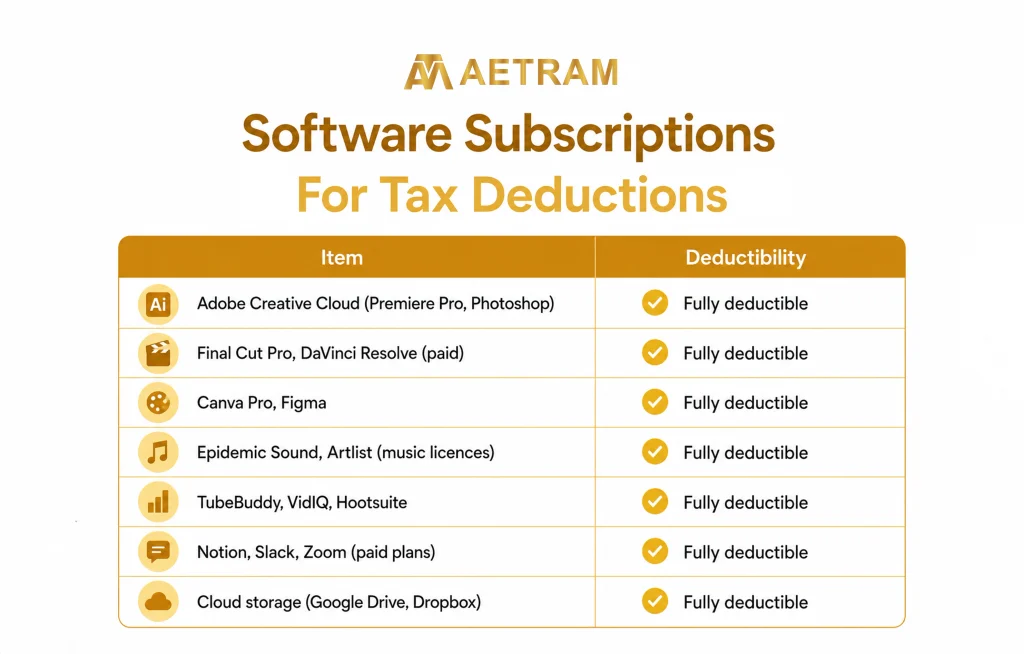
There are benefits if your business is registered under GST. You can reclaim the GST that you have paid on your own business purchases. When you buy a camera or a camera stand or pay for Adobe Creative Cloud or purchase any other product or software service as part of doing your business, the 18% GST embedded in those prices can be claimed back as ITC against your GST liability.
International/Foreign income
Most of the content creators use platforms like Youtube, Facebook, Spotify, etc., to upload their content and earn. These are foreign companies and when they pay content creators in India, it is considered as foreign income. Even income from international brand deals is foreign income. So, when you receive foreign income, there is extreme compliance and rules to be followed.
If you earn any income from foreign platforms like Google AdSense and when the payment is made to Google Ireland, this is considered an export of services under GST rules. In that case, you do not have to pay GST on this income and still you can claim input tax credit (ITC) on your business expenses.
But to get these benefits without having to pay GST upfront or wait for a refund, you need to submit a Letter of Undertaking at the start of each financial year on the GST portal which is a simple and free process.
Foreign income is fully taxable in India if you are a resident Indian and you cannot avoid tax by saying it came from abroad. However, you are entitled to credit for any tax withheld at the source country under the Double Taxation Avoidance Agreement (DTAA).
For example, if Google withholds a small amount of tax in the USA or Ireland before remitting to you, that amount can be offset against your Indian tax liability. You can claim this via Form 67 filed before your ITR.
FEMA Compliance
As a content creator you must receive any foreign inward remittance via a legal banking route and procure an FIRC or an e-FIRC from your bank against this receipt. This FIRC acts as evidence of the export and is required for LUT under GST.
ITR Schedules for Foreign Income
Suppose you have foreign income, you must fill Schedule FSI (Foreign Source Income details), Schedule TR (Tax Relief claimed under DTAA), Schedule FA (Foreign Assets) if you hold any foreign accounts or assets. Failure to disclose foreign assets and income can attract severe penalties under the Black Money Act, 2015.
Deductions available for content creators
Many content creators are not aware of the deduction they are eligible for and miss saving lakhs of rupees and end up paying a lot of taxes. Content creators are eligible for a variety of deductoins from their income under Section 37(1) of the Income Tax Act. Let us tale a look at the deduction you as a content creator is eleigble.
Equipment & Technology
| Item | Eleigible for deducting expense |
| Camera bodies, lenses, gimbals | Depreciable asset |
| Laptop and desktop computers | Depreciable asset |
| Smartphones used for content | Partial deduction |
| Microphones, audio interfaces | Depreciable asset |
| Lighting equipment, reflectors | Depreciable asset |
| Hard drives, SSDs, memory cards | Depreciable asset |
| Green screen, backdrops | Deductible |
| Tripods, stabilisers, mounts | Depreciable asset |
It is important to note that equipment is not elegible for deductions as a lump-sum expense in the first year after it is bought rather it is depreciated over time. For most electronic equipment, the Income Tax Act allows 40% depreciation per annum under the Written Down Value (WDV) method. A Chartered Accountant can help you track and maximise these type of deductions.
Internet, Phone & Utilities
Your monthly internet bill, mobile data plan, and a proportionate share of your electricity bill can be used for deducting the expense from the income to the extent they are used for business purposes. If you use the internet 80% for content work, 80% of your bill is deductible. It is important for you to keep the invoices and documentation of your usage rationale.
Studio & Workspace
If you rent a dedicated studio or recording space, the full rent is deductible. If you use a portion of your home as a dedicated workspace (a home office or shooting area), you can claim a proportionate share of home rent, electricity, internet, etc. For example, if your dedicated workspace is 20% of your home’s total area, 20% of these expenses can be claimed.
Travel Expenses
If you plan to travel for business purposes then the expense is fully deductible. Travel to shoot locations, travel to brand events, press conferences, influencer meet-ups, client meetings, fuel expense, tolls, cab fares (Ola/Uber bills are acceptable evidence), airfare and hotel stays for work-related travel are all deductible. The travel must have a genuine business purpose and you must keep the receipts carefully with you so that you can produce it to your Chartered Accountant.
Team & Freelancer Payments
As content creators, it is very difficult to work alone or with a single person. The content creators at least need a team of a few people to be a successful content creator. So they employ or take the services of other professionals.
If you pay anyone to help your business, those payments are deductible like video editor fees, thumbnail designers, social media manager, virtual assistant, scriptwriter, makeup artist or stylist for shoots
If you pay any individual more than Rs 30,000 in a single payment or Rs 1,00,000 in a year, you are required to deduct TDS at 10% under Section 194J before paying them.
Marketing & Promotion
- Paid advertising (Meta Ads, Google Ads, YouTube Ads to promote your channel)
- Agency fees for PR or influencer management
- Photography for promotional material
Professional Development
- Courses on videography, SEO, content strategy, editing
- Conference and workshop registration fees
- Industry publications and memberships
Conclusion
Being a content creator has become a serious business in India today and is not just about posting some selfie videos or writing some random posts. You have to employ people and there are related costs and responsibilities just like any other entrepreneur.
The Indian tax system might seem complicated but it offers entrepreneurs a lot of options to deduct expenses from your income and then you are supposed to pay taxes on your profit.
Many creators either end up overpaying because of not understanding their rights or end up underpaying the taxes which could lead to notices, penalties and interest, etc. and this is likely to cost more than the tax you had saved.
As a responsible and sensible entrepreneur, you should know your entitlements, keep solid records of your expenses, plan your taxes ahead of time and work with a Chartered Account who truly understands the unique challenges of the creator economy. By doing so, you can reinvest in your business and grow your business, all within the ambit of law.
Disclaimer: This blog is intended for informational purposes only and does not constitute professional tax or legal advice. Tax laws are subject to change, and individual circumstances vary. Please consult a qualified Chartered Accountant for advice specific to your situation.