Breakout vs Pullback Trading: What’s the Difference?
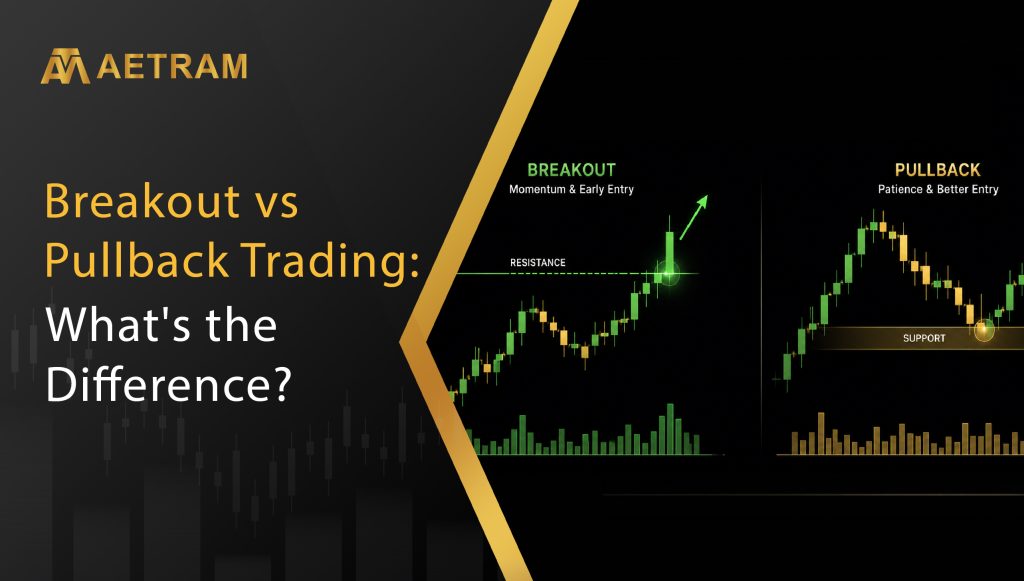
You have been keeping track of a stock that has recently broken above an important resistance level. What will you do? Buy the stock now or wait until the price returns back? This is a classic example that shows one of the most common contrasts in technical trading – breakout trading and pullback trading. Both systems are intended to make profits from price changes, but they differ in entry levels and risk factors. Thus, knowing this difference might be useful for choosing the best trading system.
What Is Breakout Trading?
Breakout is when the price crosses important levels of support/resistance with an increase in volume. To give an example, assume that there was a stock which kept failing to cross the resistance level of ₹500. After all, once the price crossed the level of ₹500 with the presence of active buyers, it might be considered the breakout.
Why Would a Trader Look for Breakouts?
A breakout could imply that there is a shift in the sentiments of the market. The rise above resistance means buyers are becoming more powerful while the fall below support implies that there is increased selling. Not all breakouts will be real. False breakouts, which are also known as fakeouts, involve the situation where the price briefly breaks above or below the level before reversing. Fakeouts represent some of the dangers of breakout trading.
What Is Pullback Trading?
The pullback refers to a price move in the opposite direction of an established trend. Assume a stock is moving up from ₹400 to ₹500 and then declines to ₹470. In the event that the overall upward movement is intact, some traders will interpret this decline as a pullback rather than the start of a reversal. Contrary to buying on the first breakout or price spike, the trader opts to wait for the retracement.
Breakout vs Pullback: What’s the Difference?
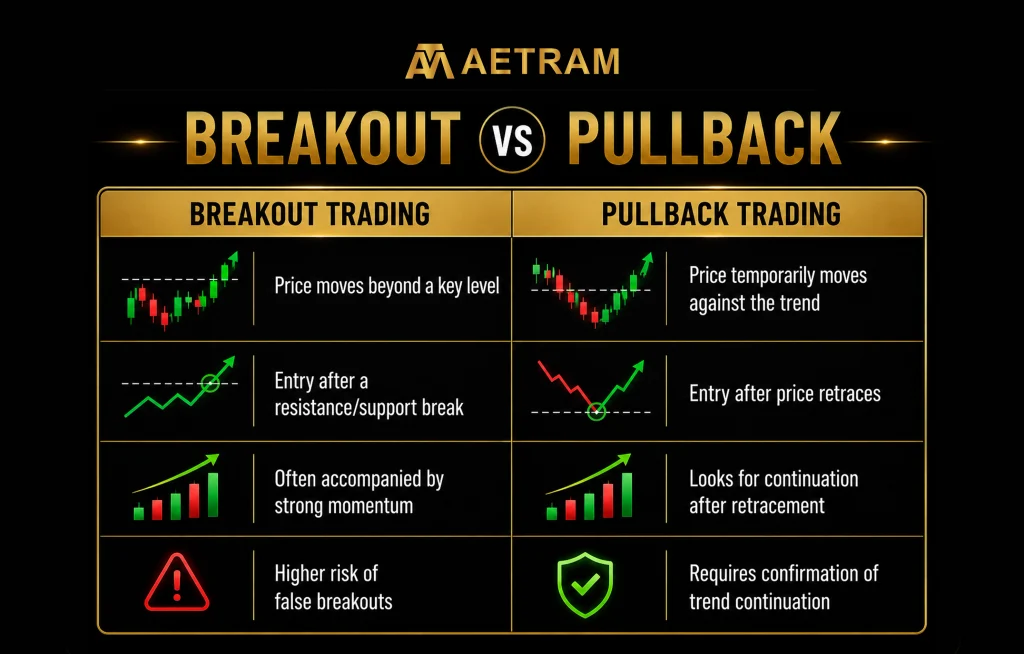
| Factor | Breakout Trading | Pullback Trading |
| Entry | During or after a key level is broken | After price retraces within a trend |
| Main idea | Capture a new price move | Enter an existing trend at a potentially better price |
| Key focus | Resistance/support and momentum | Trend, retracement and support/resistance |
| Major risk | False breakout | Pullback becomes a reversal |
| Potential advantage | Earlier entry into a new move | Potentially better entry price |
| Patience required | Moderate | Higher |
Neither of the two strategies has any inherent advantage over the other; which one to use ultimately depends on the circumstances at hand.
Identification of a Potential Breakout
Some of the criteria often used by traders to judge breakouts include:
• The existence of a defined support or resistance level
• Large-scale price movement through this level
• Volume increase
• Sustained movement and not a mere price spike
• Market confirmation
Volume could be especially significant in this regard since a breakout along with high volume could give traders better confirmation than if the breakout occurs in exceptionally low volume. However, there is no guarantee that the breakout will be successful.
Identification of a Potential Pullback
In order to trade a pullback, traders usually have to do the following:
• Determine whether there is a defined trend in place
• Move against this trend for some time
• Movement of price towards a former support or resistance level
• Lack of selling pressure in the case of an upward trend
• Signs of re-emerging of the original trend
It is important to distinguish a valid pullback from a trend reversal.
Which Approach Is More Favorable to Beginners?
There is no one-size-fits-all solution here. Breakout trading could be appealing since it offers an opportunity to enter early in the potential new trend. But there is always a risk of false breakouts that could lead to quick drawdowns. The pullback approach could give better prices to trade with, but it also implies a certain risk: the reversal may not occur. It is essential to consider both opportunities and risks when deciding which approach is worth using and not choose the one only due to its profitability.
Don’t Ignore the Stop-Loss Order
Regardless of the approach, risk management is key in any trading operation. Before opening any trade, a trader should know:
- Where the trade becomes invalidated
- How much money he is ready to put into the trade
- What price could be used as the stop-loss order
- What kind of a reward would justify the risk
For a breakout trade, the place where a stop loss order could be used could be a relevant support level depending on the trade’s setup. As for the pullback trades, the invalidation point may be considered at the level that contradicts the assumed trend continuation. The stop loss order should always be based on the particular trading strategy and market structure. A stop loss order may be considered around a relevant support level depending on the setup.
Know Your Trade
While breakout trading and pullback trading seem similar on the chart, the method used is actually different. In breakout trading, traders wait until the price breaks an important level before making their move. In pullback trading, traders wait until a price retraces temporarily before making the trade along the existing trend. Both strategies cannot guarantee success. Conditions may be unpredictable even with the best setups.
It’s not about predicting prices. Rather, it’s about understanding your trading setup, knowing the risk and making trades according to your set plan. But before thinking about whether you should trade a breakout or a pullback, first ask yourself if you know what trend you’re trading, your entry point and how you will know if your trade has failed.
For more practical insights on technical analysis, stock trading and financial markets, explore Aetram.
Frequently Asked Questions
- What is breakout trading?
Breakout trading involves entering a trade when the price moves beyond an important support or resistance level, with the expectation that the price may continue in the breakout direction. - What is pullback trading?
Pullback trading involves waiting for a temporary price retracement within an existing trend and looking for a potential entry when the original trend appears to resume. - Is breakout trading riskier than pullback trading?
Not necessarily. Both strategies have different risks. Breakouts can fail through false moves, while pullbacks can turn into reversals. - How does volume help confirm a breakout?
Higher-than-usual trading volume during a breakout can indicate stronger market participation. However, volume alone cannot guarantee that the breakout will succeed. - Which is better: breakout or pullback trading?
Neither is universally better. The choice depends on the trader’s strategy, risk tolerance, market conditions and ability to identify reliable setups.