Will Trump Tariffs Impact The Pharma Sector?
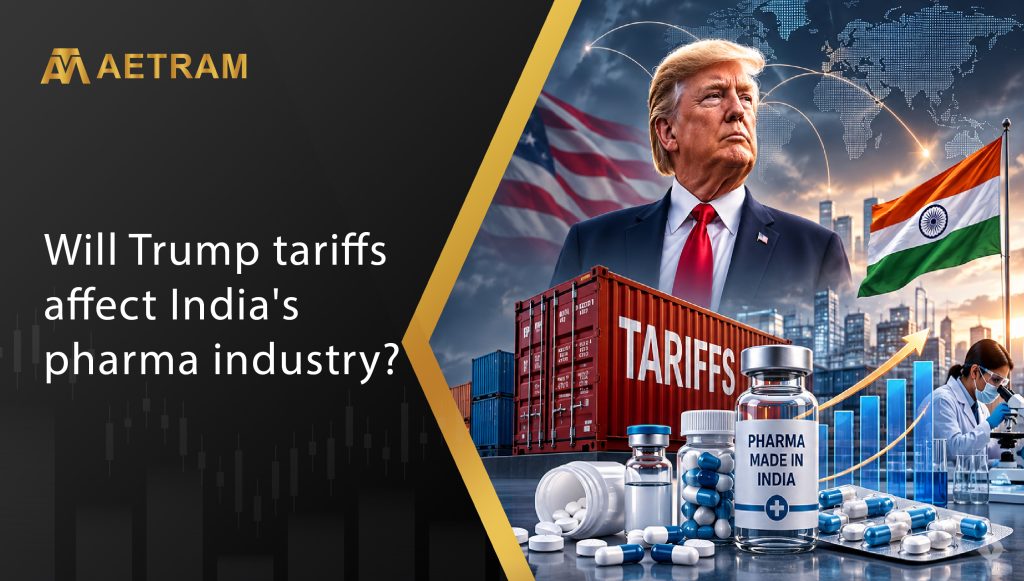
India’s pharmaceutical sector is one of the important sectors which brings a lot of forex revenues. The sector has become so popular that it has earned the title “pharmacy of the world” as it continues to supply nearly half of all generic medicines consumed in the United States. It also topped global charts in volume.
But the US President Donald Trump dropped a bomb on the sector when he announced a fresh round of tariffs targeting pharmaceutical imports into the US. When the news was picked up by the media, it was only natural for Dalal Street to sit up and take notice.
The Nifty Pharma index fell and big pharma names lost their market capitalization. Many market participants and people who track the market started to debate whether this was a genuine threat or just noise.
For many Indian investors and market watchers they were worried about the announcement. Moreover, it was not about just will tariffs hurt pharma? But how much and when would hurt the pharma sector and who will be affected the most?
This blog breaks down exactly what Trump announced, how exposed Indian pharma companies are, how markets have reacted, and what it means for investors.
What Did The US President Donald Trump Announce?
The US President Donald Trump on July 22, 2026, announced a phased tariff roadmap for imported generic medicines via a post on Truth Social. He said that for the first two years starting from August 1, 2026 to July 21, 2028, generic medicines will continue to enter the US duty-free. Then from August 1, 2028, for one year, there will be a 100% jump in tariffs on imported generics. Then from August 2029. The tariffs will increase to 200% on generic drugs.
Trump is doing all this for Indian and other foreign pharmaceutical companies to set up factories on the US soil and start manufacturing on the US soil. So, companies which toe the line and start building manufacturing plants and produce generic drugs in the US are expected to be safeguarded from these tariffs. In contrast, companies which do not start manufacturing generic drugs are likely to face steep costs on every consignment shipped into the US after the buffer time is over.
This tariff on generic drugs must make companies sit up and be cautious because this generic drug vertical is the backbone of India’s pharma exports. A separate, earlier announcement had already targeted branded and patented medicines, with a 100% tariff effective October 1, 2025. However, even with respect to these branded and patented medicines, there is an exemption if foreign companies start manufacturing in the US.
How Exposed Is India’s Pharma Industry?
India’s pharmacy industry is kind of important to the world as the country plays a vital part in the global drug supply chain. It is a large external source of medicines for many developed nations, especially the US. India exports a lot of pharma products to the US and the latter is kind of important to Indian pharma companies as the US consumes about 35-38% of India’s total pharmaceutical exports.
In 2025, India’s pharma exports touched $25.8 billion globally, with exports to the US alone estimated to be about $9.7 billion, according to a Global Trade Research Initiative (GTRI) report.
India exports close to half of all generic medicines consumed in the US which includes everyday medicines like blood pressure medication, diabetes drugs, antidepressants, birth control, etc. Many large-cap companies earn 30-50% of their overall revenue (approximately) from the US market alone.
India also has the highest number of US FDA-approved manufacturing plants outside America itself. This is a structural advantage and it took decades for Indian companies to build this ecosystem and achieve this cost efficiency.
As the US healthcare system is so dependent on Indian pharma companies, any tariffs or sanctions or disruptions can affect both the countries and also have negative impacts to the US consumers. There have been many reports which say that Indian drug imports have saved the US healthcare system over a trillion dollars in the last decade through cheaper generic drugs.
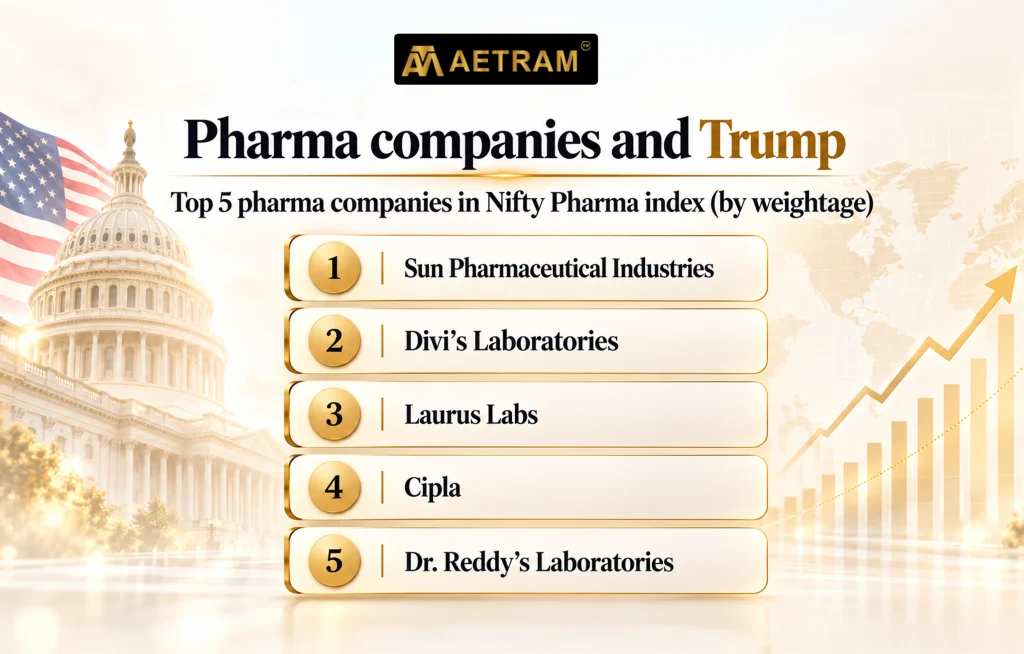
Market Reaction on Nifty Pharma
Markets, as they usually do, reacted before all the fine print was even out. On the day of the announcement, the Nifty Pharma index fell nearly 2%, making it the worst-performing sector on the NSE that session. This is not an isolated event because whenever tariffs were announced on India and its products, pharma was one of the sectors which got affected.
When the 100% tariff on branded and patented drugs was first announced in September 2025, the Nifty Pharma index tumbled over 2%. Even a general 25% blanket tariff on Indian imports (unrelated specifically to pharma) added to pharma sector jitters, given how sentiment-driven the sector had become.
Interestingly though, Nifty Pharma has been a resilient sector in 2026 despite all the noise. It has risen since the drop in January 2026. Compared to benchmark index Nifty 50, Nifty Pharma has outperformed. Analysts attribute this relative outperformance of the Nifty Pharma to defensive positioning by investors. A weaker rupee which benefits export-heavy sectors like pharma and IT and improving earnings visibility across the sector has acted as a tailwind for the sector.
Near-term Impact on Pharma Sector
Actually, in the near-term, i.e., for the next two years, the pharma sector need not be worried. The actual tariff on generic medicines won’t even begin until August 2028 and that’s a full two years away from the announcement. That grace period is quite long and several market experts believe near-term earnings for FY27 and FY28 are unlikely to see any considerable disruption.
As of now, generic drugs attract zero tariff and that status quo is expected to continue until mid-2028. The Indian pharmaceutical market itself is projected to grow strongly on the domestic front too from roughly $60 billion in 2026 to nearly $80 billion by 2031. This will give Indian companies a lot of cushion in terms of growth outside their overseas market.
Shifting generic drug manufacturing to the US isn’t something that can be done overnight. Setting up FDA-compliant plants takes years and significant capital, meaning the threat itself may act more as a negotiating lever than an executable near-term policy.
However, there is a lot of uncertainty in terms of policy and this could act as a headwind. Even without any actual tariffs on pharma products, the mere possibility of tariffs on pharma products can weigh on the stock price. These tariffs will also dampen any capital expenditure decisions and make the US clients cautious about long-term contracts with Indian suppliers.
The Real Long-Term Risk
The biggest concern for India’s pharmaceutical sector with respect to strategy is not so much the eye-catching figures of 2026 but rather what would happen in 2028 when the tariffs kick in.
Trump’s overarching mission is clear and that is to grow and strengthen pharmaceutical production within the United States. If major Indian exporters fail to create or grow US-based manufacturing in the said transition period, they could encounter tariffs that would significantly undermine their pricing advantage.
This situation presents Indian pharmaceutical firms with two main strategic options. Firstly, India has to broaden export markets outside the US. It has to expand its business in Europe, Africa and other developing regions to lessen dependence on a single geography.
Next, India must improve its value chain by concentrating on complex biosimilars and specialty products. It is one of the areas where India must focus because the country’s cost-effectiveness and manufacturing capacity are not easily duplicated, even in light of the US tariffs.
Further, some of the larger companies can consider selective manufacturing partnerships with their US counterparts or clients. The Indian companies may also look at acquisitions in the US as a precautionary measure against future tariff increases. However, strategy requires substantial capital and it is likely restricted to firms with a strong financial position.
What Should Indian Investors Watch For?
If you are monitoring the Indian pharmaceutical sector or the overall healthcare industry, there are several important triggers to watch out for.
India-US trade talks: Any positive update and progress on bilateral trade agreement may significantly impact the implementation or easing of these tariffs.
US manufacturing updates: Keep an eye on the capital expenditure commitments by Indian companies in the US. If any Indian company announces a new manufacturing plant in the US , then it is a sign of how Indian companies are preparing for 2028.
Quarterly earnings insights: During earnings season, there will be commentary, sector outlook, quarterly guidance and annual guidance from the company’s management. These are important events which every investor must track as they give insights with respect to exposure to US revenues and pricing strategies. These will provide early indications before the tariffs take effect.
Nifty Pharma technical indicators: Given the sentiment-driven nature of the sector, technical support and resistance levels are expected to undergo frequent evaluation in response to any tariff-related news.
Currency fluctuations: A declining rupee can help mitigate tariff-related margin challenges for export-centric pharmaceutical companies, making INR-USD trends important to monitor.
Conclusion
Trump’s tariff plan is a risk for India’s pharma industry but it is not an immediate one. The two-year buffer time before generic medicines face any duty, combined with the sheer difficulty of relocating complex pharmaceutical manufacturing at scale, suggests the sector has some time to adapt. Indian pharma companies have navigated regulatory shifts, pricing pressures, and global supply chain disruptions before, and many are already using this window to diversify markets and move toward higher-value, harder-to-replicate products.
For Indian markets, the near-term story is likely to remain one of headline-driven volatility rather than fundamental earnings damage at least through FY27 and FY28. The real test will come in the year 2028, when the industry’s ability to adapt or its failure to do so, will become far clearer in company balance sheets and stock performance alike.
Frequently Asked Qustions (FAQs)
- When will Trump’s tariffs on Indian generic drugs actually take effect?
Generic medicines remain duty-free until August 1, 2028. Tariffs will then rise to 100% for a year, followed by 200% from August 2029, unless companies establish US manufacturing. - How much of India’s pharma exports go to the US?
Approximately 35-38% of India’s total pharmaceutical exports are directed to the US, amounting to nearly $9.7-$10.5 billion depending on the reporting period used. - Which Indian pharma stocks are most exposed to US tariffs?
Companies with high US revenue dependence tend to see the sharpest stock reactions to tariff-related news, given that 30-50% of their revenue often comes from the US market. - Will these tariffs affect medicine prices in the US?
Since Indian generics are significantly cheaper than domestically manufactured alternatives, steep tariffs may eventually raise costs for US consumers and insurers if companies pass on the added expense.
Disclaimer: The information provided in this article is for educational and informational purposes only and should not be construed as investment, financial, or trading advice. Any financial figures, calculations, projections, examples, or scenarios are hypothetical, intended solely for illustrative purposes, and do not represent actual or future performance. The content is based on information obtained from credible and publicly available sources. While reasonable care has been taken in its preparation, no representation or warranty is made regarding its completeness, accuracy, or reliability. References to indices, securities, or other financial products are for illustrative purposes only. Actual investment outcomes may vary. Investors are advised to carefully read the relevant scheme, circular, or product offering documents and consult a certified and SEBI-registered financial advisor before making any investment decisions. Neither the author nor the publisher shall be liable for any loss, damage, or liability arising from the use of or reliance on the information contained in this article.