Key Differences: Equities vs. Commodities
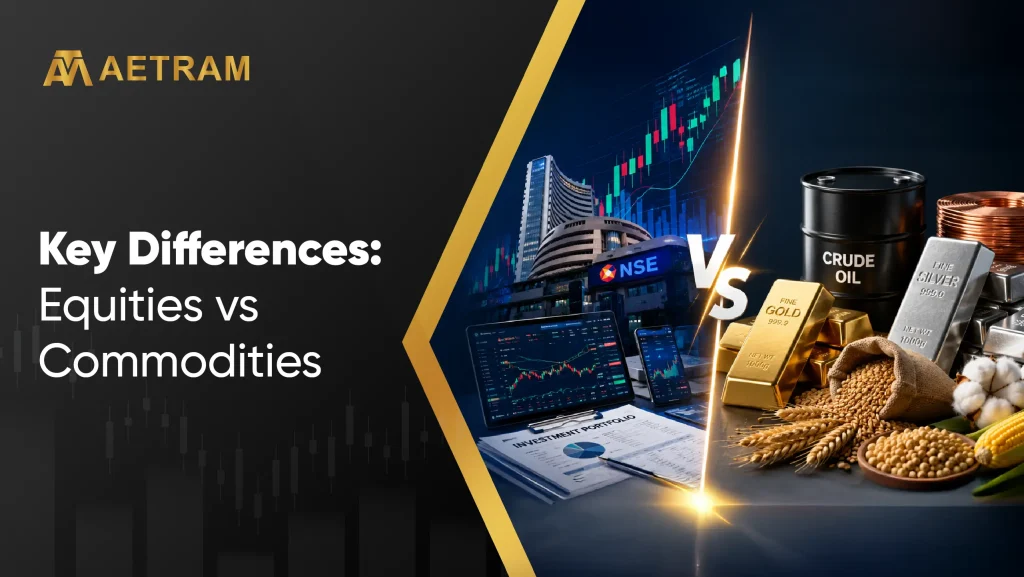
Indian financial market provides a wide range of investment and trading avenues for market participants to build wealth and hedge their positions. Among them, equities and commodities are two segments which provide unique investment and trading opportunities for investors and traders. In this article, we will be discussing about these two segments so that you can take informed financial decisions and start your investment and trading journey with Aetram Trades.
What Are Equities?
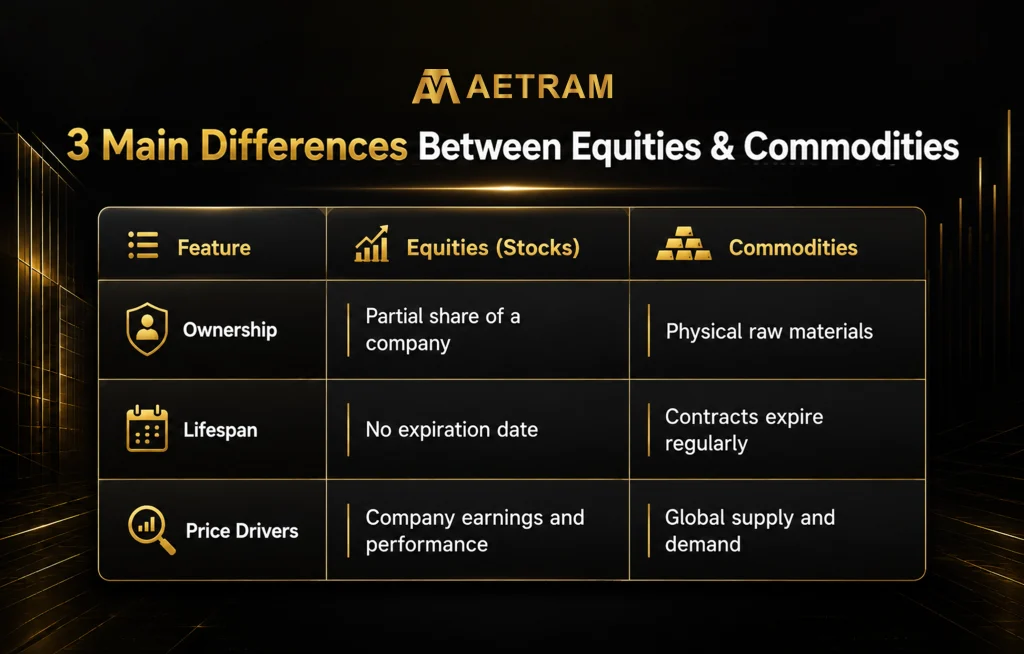
Equities are financial instruments through which you can become a part owner of a company. Equities are also known as shares or stocks in the market. Shares are first introduced to the public through an initial public offering by a company. So when a company goes public, shares are sold by the company and they are bought by retail investors, high net worth individuals and institutional investors.
When an investor buys shares of a company, the investor becomes a part owner of the company. Investors buy and sell shares through two exchanges and they can hold the shares perpetually as long as the company is listed in any one of the exchanges.
Equities are influenced by multiple factors like a company’s fundamentals, performance, earnings potential, overall market sentiments, industry and sectoral trends, etc.
Exchanges Where Equities Are Traded
There are two main exchanges in India where equities are bought and sold. The exchanges are National Stock Exchange (NSE) and Bombay Stock Exchange (BSE). The BSE is the older exchange and the NSE is the newer one. BSE has more stocks listed than NSE. However, NSE has more overall liquidity than BSE and the volumes are significantly higher on the NSE than the BSE.
Who Can Invest In Equities?
Long-term investors prefer investing in equities or stocks because it gives them an opportunity to build wealth over a long period of time and also due to capital appreciation of stocks. In addition, when you hold shares of a company there are chances for you to receive dividends every year and you become eligible for stock split, bonus issue of shares and rights issue. It is also less volatile compared to trading in commodities.
How Can You Invest In Equities?
To invest in equities, you should have a good knowledge of fundamental analysis, technical analysis and ratio analysis. You must also know to read balance sheet, profit and loss statement, cash flow statement, annual reports, etc.
As an investor, you can either invest in equities directly through a demat account or indirectly. through mutual fund schemes or ETFs. If you plan to invest directly, you can buy the desired stock from one of the two exchanges namely NSE and BSE. For that you need a demat and trading account which can be opened freely with Aetram Trades. Further, you can also invest in over 3000+ mutual fund schemes through Aetram Trades as it is authorized by AMFI.
What Are Commodities?
Commodities are raw materials and tangible products like gold, silver, crude oil, etc. There are four broad categories of commodities that you can trade on the MCX. They are bullion, base metals, energy and agri commodities.
What Is Commodities Trading?
Commodities are traded via futures or options on exchanges like MCX to make profits or hedge the positions. There are also other exchanges in India such as NCDEX and ICEX. In NCDEX, you can trade commodities like cereals, pulses, fibres, spices, oil and oil seeds, etc.
As commodities are traded in the futures and options market, you can buy these commodities only in lots and these futures and options contracts come with expiry dates. Therefore these are suitable for short-term investors, traders, and speculators.
Unlike equities, when you buy a futures or options contract you do not have ownership of the commodity. You only own the commodity if the contract is executed during the expiry date. Until then you can only trade the contracts in exchanges like MCX, NCDEX and ICEX.
Factors Affecting Commodities Trading
Commodities prices are impacted by a host of factors like weather conditions, geopolitical situations, war, supply and demand, production, global supply chain, interest rates, inflation, forex, etc. These commodities are bought and sold in the derivatives market by traders to hedge their position against any price fluctuation and protect their capital.
Since it is traded in the derivatives market, leverage is used by traders to buy many lots with minimum margin requirements which will likely result in higher profits or losses. Trading in commodities is more risky than investing in equities as the prices are impacted by unpredictable global events and traders must really have good knowledge about the commodity to navigate the markets. If you are a retail investor you can invest in commodities through ETFs that are available on Aetram Trades trading platform.
Conclusion
Equities and commodities are two unique and distinct assets classes, and as a prudent investor you must have exposure to both the asset classes. This will help you as an investor to create a well-diversified portfolio and it will provide optimum risk-to-reward ratio. Investors should also be aware of the right allocation mix based on their risk appetite and expected returns.
Frequently Asked Questions
1. What is the key difference between investing in equities and commodities?
If you buy equities (which is commonly known as shares or stocks), you become a part owner of the company. This is not the case with commodities. It can be traded through future or option and you can own it at the time of delivery at expiry.
2. How do I start investing in equities?
Open a demat and trading account with a SEBI-registered and trusted stock broker like Aetram Trades and buy shares listed on NSE or BSE.
3. Are commodities trading riskier than equity investing?
Yes. Commodity prices are highly volatile and influenced by unpredictable global events like weather, geopolitics, inflation, etc. Further, as commodities are traded in derivatives (futures and options) segment, the contract expire after some time and the buyer cannot hold the contracts for a long time like in the case of equities investing.
4. Is there a way to invest in commodities without trading in futures or options?
You can invest indirectly through commodity ETFs or mutual fund schemes available through Aetram Trades. Many asset management companies allow investors to have exposure to various commodities as they provide diversification into physical assets.
5. What is the recommended approach for building wealth?
Equities and commodities are distinct and unique asset classes and as a prudent investor you should have exposure to both asset classes through the right allocation of capital that will help you to balance risk and reward.