What Is Yield to Maturity (YTM) in Bonds?
Yield-to-maturity (YTM) is a metric which is used to calculate the returns on a bond investment if it is held till maturity. Yield is defined as the return you are likely to earn from a bond investment during a tenure. Calculating the yield is useful for bond investors because it will help you determine how much returns a bond investment will generate and if an investment is worth it.
Understanding YTM with an example
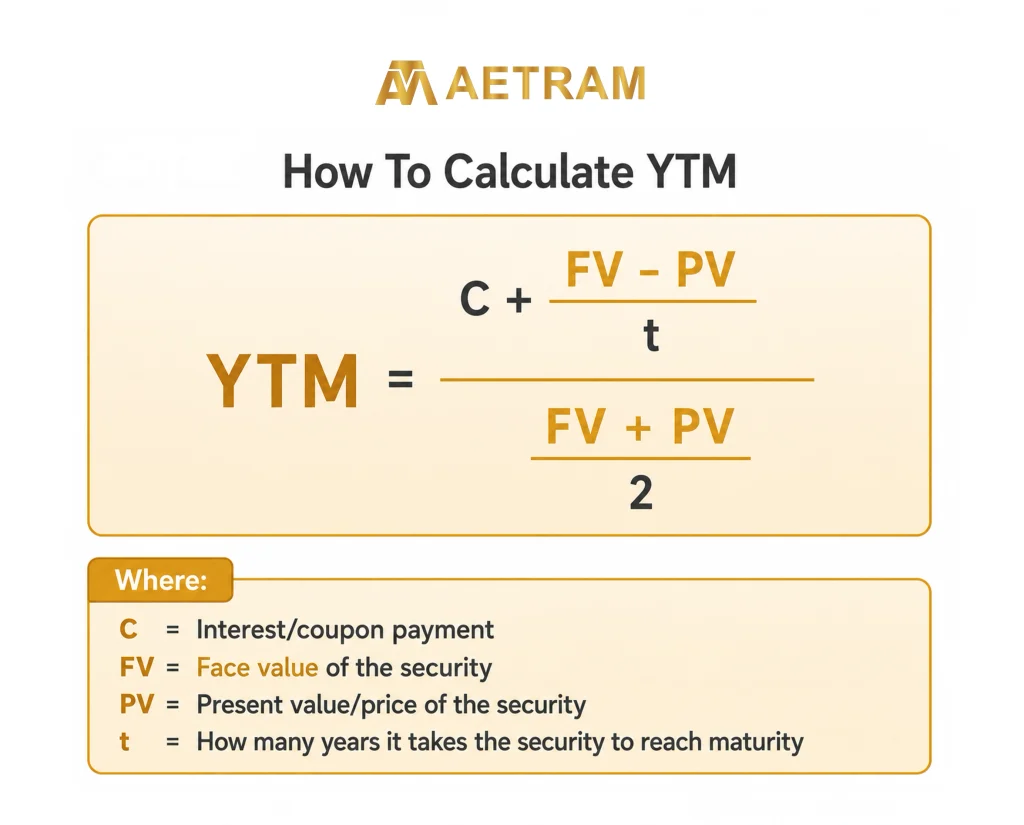
Once we know the formula, it is easy to calculate yield-to-maturity. Let us understand with an example. Assume,
Annual coupon rate of the bond = 7%
Face value (purchase price at issuance) = Rs. 1,000
Current market value of the bond = Rs. 750
Annual coupon payment = Rs. 70
Years to maturity = 6 years
YTM Calculation:
YTM = [70 + (1000 − 750)/6] / [(1000 + 750)/2]
YTM = [70 + 41.67] / [875]
YTM = 111.67 / 875
YTM ≈ 12.76%
Now, suppose the current market value rises to Rs. 850. The YTM would then be:
YTM = [70 + (1000 − 850)/6] / [(1000 + 850)/2]
YTM = [70 + 25] / [925]
YTM = 95 / 925
YTM ≈ 10.27%
Interest amount (I)
The interest amount is paid regularly by the bond issuer to the bondholder or investor. This interest payment is also known as the coupon payment and when the coupon rate is higher, then the bondholder will receive higher returns provided other factors remain the same.
Face Value (FV)
The face value of a bond is also called as the par value is the amount which will be repaid to a bondholder when the bond matures. Every bond that is issued will come with a maturity date.
Maturity Date
This is the date on which the bond issuer must repay the principal amount as clearly defined in the contract. This is important for calculating the yield to maturity.
Present Value (PV)
The present value of a bond represents what investors are currently willing to pay for it in the open market. This amount reflects the bond’s current market price and can be higher or lower than its face value, depending on factors like prevailing interest rates, supply and demand in the bond market and geopolitical reasons.
Number of Compounding Periods (T)
The number of compounding periods is simply the total number of times interest is applied over the life of an investment or bond. For example, if a bond matures in five years and pays interest twice a year like every six months then there are 10 compounding periods (5 years × 2 payments per year).
Key points to remember while calculating YTM
When we are calculating YTM, we are assuming the coupon rate and bond price but the price of the bond is expected to fluctuate due to many factors like the central bank’s interest rate decision, demand and supply, etc.
Even interest payments are presumed to be reinvested at the same coupon rate for simplification of calculations. However, in reality this may not be the case and any changes in interest rate can affect the decision of investors with respect to holding or selling the bond.
The simple standard formula does not take into account other scenarios where the investors might withdraw payments and do not reinvest and this may create some discrepancies between calculated returns and real returns.
A high YTM does not always mean a better investment but it can also indicate that the bond is priced lower and it could be negative for bond buyers.
Further, the formula does not consider costs like brokerage fees, transaction charges, and other expenses tied to buying or selling a bond. These hidden costs can significantly weigh down on the actual returns.
Then there is a tax implication that is often overlooked. If an investor redeems the bond before maturity may be within three years then there is a short-term tax on the returns. Even if the bond is held until maturity, the returns are still subject to long-term capital gains tax. These tax consequences are not factored into while doing the calculations.
How is YTM useful?
Knowing how to calculate YTM is useful because it will help you to determine the potential returns of different bonds and compare them even if they have different coupon payments or maturity dates. By doing so, you will be a well-informed investor and you will be able to select bonds which are best suited for your financial goals and risk appetite.
You will have a better understanding if a bond is fairly priced in the market or not. If the YTM of a bond is higher compared to similar ones, then it might mean the bond is under valued. On the other hand, a lower YTM might mean that the bond is overpriced. So by knowing this information, you can make better buying and selling decisions.
For investors managing a bond portfolio, calculating YTM for each bond will give an overall and complete view of your portfolio and the average return it is generating.
If you know how to calculate YTM, then it will be helpful for you if there are any interest rate changes by the central bank and its impact on your bond’s value. When interest rates rise, then the YTM of existing bonds also rises because new bonds issued at higher coupon rates become more attractive and it causes the market value of older bonds to fall. Understanding this equation between interest rate and bond yield will help you stay informed of market changes and also make better investment choices.
Conclusion
Understanding the concept of YTM and knowing to calculate it will help any investor to make an informed decision. You will be able to manage your portfolio better by following the right asset allocation and stay confident during uncertain times. However, you must also know the limitations of the formula and take into account other factors like market conditions, credit rating of a particular bond issued by a particular entity, etc. before you invest.