What is a Sector Rotation Strategy?
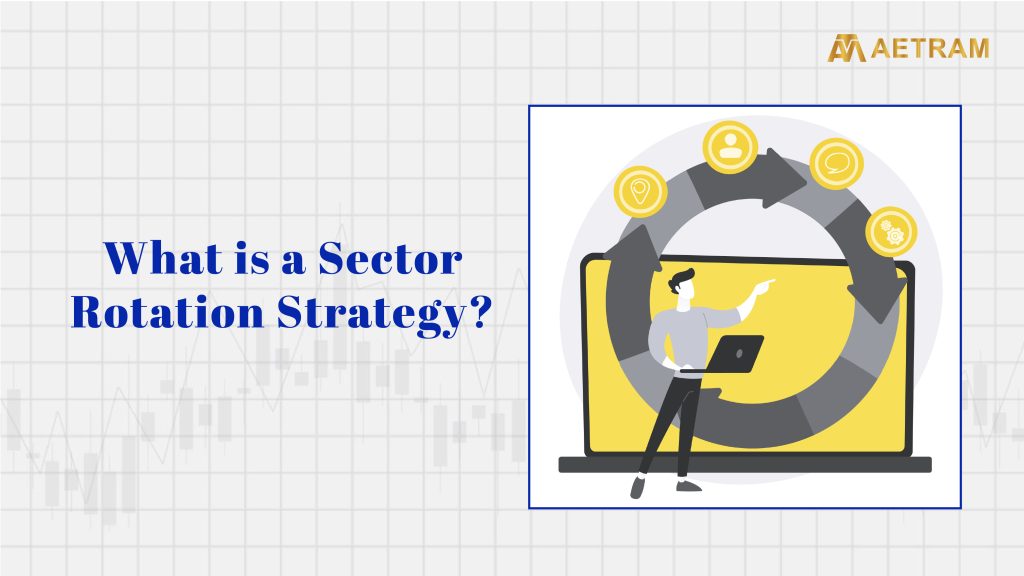
Sector rotation strategy is a method followed by investors to invest in different sectors during different economic or business cycles. In this method, investors will shift their capital from one sector to another based on the macroeconomic factors and economic cycle. Let us take a look at how sector rotation depends on the economic cycle and how investors can use this strategy to make investment decisions.
What is an economic cycle?
Generally speaking, economies will go through four phases namely expansion, peak, contraction, and recovery. So during these phases different sectors are expected to perform better than other sectors at different times.
For example, when the economy is growing, certain industries thrive, while others lag. Investors use this pattern to move money from one sector that is not doing well or which is overvalued to other sectors that are undervalued. It’s essentially about timing your investments cycle to match the economic cycle, buying when things look promising and selling when they’re already hot.
Different phases of economic cycle
Broadly speaking, there are four phases of the economic cycle namely recovery, expansion, peak and contraction. We will discuss these different phases in this section.
Recovery
When the economy rebounds after a downturn, economic indicators like GDP and industrial output will start showing positive numbers as against negative numbers as economic activity starts picking up. During this phase, the central banks would have already reduced the interest rates to improve credit flow and companies would find it to raise capital for business expansion. In this phase, revenue would start rising, while inventory levels being low, creating a favorable environment for growth and improved profits. Some sectors which show early signs of recovery are financials, technology, automobile, industrials and materials.
Expansion
As we move from the recovery phase to expansion phase, the economy will show continued growth. Activity picks up, lending expands, and companies maintain solid profits, even as the economy witnesses a slight rise in inflation. During this phase, companies go on a hiring spree to produce more to keep up with rising demand. Companies invest in new projects and increase capital expenditures. As a result, there will be a lower unemployment rate. Meanwhile, consumer confidence increases that will lead to higher spending by customers. Rising sales and strong consumer demand generally improve business profits. Sectors like information technology, real estate, hospitality, renewable energy and consumer discretionary tend to perform well.
Peak
Companies across sectors would be operating at maximum capacity but the economy begins to show signs of overheating and inflation rises above normal levels. As a result, the central bank becomes cautious and thinks of tightening monetary policy. They slowly start increasing the interest rate and it would lead to credit becoming harder to access and companies will find it difficult to maintain healthy profit margins. Sales growth starts to slow down, which leads to unexpected inventory buildup and higher cost. During this phase, FMCG, consumer goods, industrials, etc. are likely to do well.
Recession
During the recession phase, economic output (GDP) declines and companies lay off workers to cut costs due to falling demand. There will be reduced spending by consumers on various goods and services. There will be less disposable income in the hands of consumers which will lead to higher saving money and lesser spending on durable goods and discretionary items. Corporate profits fall, often leading to reduced investment and business activity. Central banks become dovish and think of reducing the interest rates to stimulate the economy. Sectors like consumer staples, healthcare, pharmaceuticals and utilities are expected to be resilient during this phase.
Understanding the benefits of sector rotation
As an investor, if you understand the economic cycle, you will be in a better position to move your capital from overvalued sectors to companies in undervalued sectors. It is an efficient way to minimize your opportunity cost. Here’s why it may work well for investors:
Economies do not move randomly and they follow predictable patterns. By understanding the economic cycle, you can be well-prepared to make your move when the cycle begins. So when an economic cycle begins you can shift your investments before the market shifts, giving you a head start.
You can also look at diversifying your investments in different companies across various sectors, instead of putting all your money in one basket. This reduces the risk of losing your capital, if one sector takes a hit.
Further, when you invest your money in sectors that are about to boom, you’re positioning yourself to benefit from potential strong growth in the future. By buying securities when prices are low and selling when the prices are rising, you are trying to maximize your expected returns. However, these securities must be fundamentally strong, otherwise investing would be too risky.
Risk factor to consider in sector rotation
If you plan to invest based on sector rotation, you will be able to build a better portfolio based on your economic outlook and the various stages of the business cycle. By understanding how different sectors have historically performed in each phase of the economic cycle, you may be able to navigate the markets effectively during sideways movements or when there is correction.
However, this approach comes with risks and moving capital from one sector to another frequently might increase portfolio volatility and investment cost due higher brokerage and STT. It may weigh on your overall returns and lag behind broad market benchmarks. Moreover, industries within the same sector often have distinct fundamental drivers, which can be obscured by sector-level performance and result in uneven outcomes at the industry level. While diversification might help you manage overall risk, it is important to remember that there is no room for guaranteed returns when you invest based on sectoral rotation.
Conclusion
As an investor, you will have an edge if you understand the economic cycle and plan your investments based on sector rotation strategies. By analyzing historical patterns and keeping up with current trends, investors can anticipate shifts and position themselves to benefit from emerging sectors and sunrise industries.