What Is Price-to-Book Ratio and When to Use It?

Price-to-Book ratio is one of the important financial ratios used by investors in evaluating a company. It is part of fundamental analysis and it is used by investors to determine if a company is overvalued or undervalued. Let us take a look at P/B ratio in detail.
What is price-to-book ratio?
The price-to-book ratio is used by investors to compare the share price of a company to its book value per share. In other words, it helps the investor to determine how much investors are willing to pay for each rupee or dollar of the company’s net assets.
A high P/B ratio might mean that investors are confident about the company’s growth in the future and they are willing to pay more for its assets. Whereas, a low P/B ratio could indicate that the stock is undervalued or the investors are not so confident about the company’s future growth.
Calculating P/B ratio
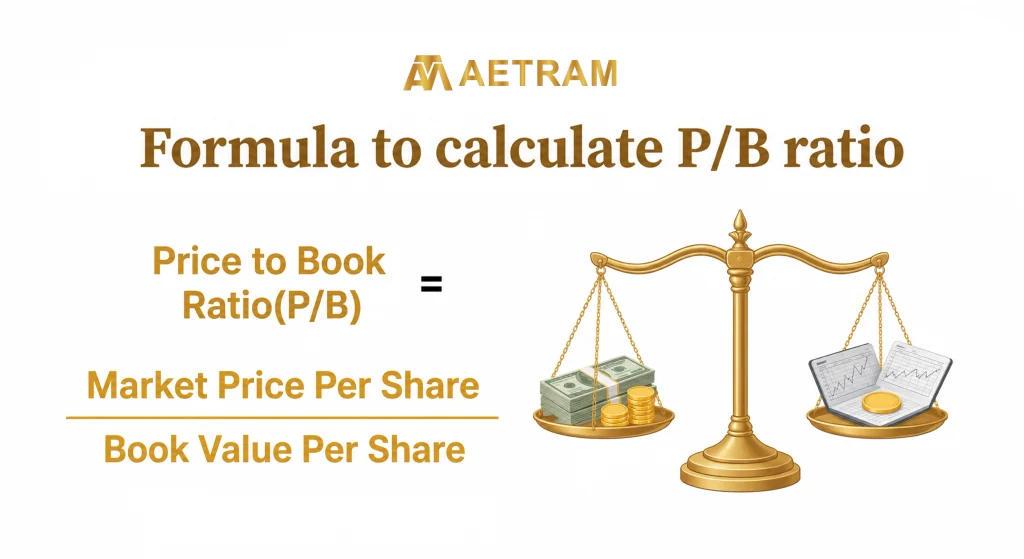
To calculate the price-to-book ratio, you must know the share price and the book value.
Price-to-book = share price / book value per share
Share price is the price at which the company’s shares are trading. You can also calculate the share price by the formula: market capitalization / number of outstanding shares.
The next is book value or book value of assets. It can be calculated by the formula: total assets (minus) intangible assets and total liabilities. Using these two components, we can calculate the P/B ratio.
Interpretation of P/B ratio
If a stock trades below its book value, then the P/B ratio would be less than 1 and it is likely a good entry point for long-term investors but not always. It could also point to deeper issues like weak earnings or poor long-term prospects. So, as a cautious investor, you should not only be dependent on this ratio but combine various financial ratios while evaluating a company. Investors must study the company thoroughly through its annual reports and various financial statements to understand the company before making any decisions.
When the P/B ratio is above 1, it means the share price is higher than the company’s book value and it may indicate that the stock is overpriced and value investors should be careful before they invest in the company.
A P/B ratio which is approximately equal to 1 indicates that the stock is trading at a fair price because the markets may be pricing the company’s tangible assets like property, equipment, cash, etc. correctly.
However, the P/B ratio can be different based on various factors. It can be different based on the industry, sector, company’s business model, the overall market, etc.
For instance, growth-oriented companies in tech or emerging sectors may have a higher P/B ratio and it is common. Investors are often willing to pay more because they believe these companies will grow rapidly and generate strong sales and net profit in the future. In these types of cases, a higher P/B may not be a red flag but it shows the confidence among investors with respect to the company’s future potential.
When to Use the P/B Ratio
The price-to-book ratio can be used by investors to find potential stocks that are overvalued or undervalued and make informed decisions before investing. The ratio can be used by value investors in finding stocks that are trading below their book value, essentially looking for undervalued companies. This approach is useful in asset-heavy industries like banks, insurance firms, financial institutions as well as in industries where physical assets make up a large part of the company’s worth.
Further, P/B ratio will be useful when a company reports negative earnings. This is because the price-to-earnings (P/E) ratio becomes irrelevant where the company reports losses. A low P/B ratio also suggests that the stock price does not reflect a strong underlying asset base and it will act as a potential buffer during losses or uncertain times.
Limitations of P/B ratio
The price-to-book (P/B) ratio is one of the widely used financial ratios in evaluating a company but it has its limitations which we will cover in this section. Normally when calculating the P/B ratio, we have to calculate the book value of assets and the calculation focuses only on taking into account tangible assets like machinery, property, equipment and cash, while intangible assets such as patents, trademarks, brand strength, and software are not considered.
For example, in technology and pharmaceuticals industries, innovation and intellectual property drive value. And when these kinds of intangible assets are not taken into account, it can lead to misleading results and may not capture the real worth of the business. Cyclical industries may see their market values swing during different periods of the economic cycle and this can affect the P/B ratio and the ratio can also fluctuate. This volatility makes the ratio less useful as a stable benchmark.
Further, accounting practices may vary across companies and geographies. Each country and company has different accounting standards and calculation of depreciation, goodwill or asset valuation may vary and influence the book value. A company using aggressive accounting methods might show a lower book value, making the company have a higher P/B ratio.
The P/B ratio is calculated based on past data and it is backward-looking. The P/B ratio does not account for future growth, market trends or investor expectations. A high P/B ratio might simply reflect optimism about a company’s future performance and not a sign of overvaluation. Similarly, a low P/B ratio does not guarantee safety because the company can be weighed down by debt. A firm which has posted strong results may still be over-leveraged and investing in such a company may be risky despite having a favorable P/B ratio.
Moreover, corporate actions such as dividend payouts or share buy backs can increase the P/B ratio without reflecting real performance of the business. A company giving back the profits or retained earnings to shareholders may appear more valuable than one reinvesting in growth, even if both have similar underlying operations.
Conclusion
The P/B ratio is a useful ratio when used along with other financial ratios. These ratios can show a quick snapshot of a company’s financial position, but if the P/B ratio is used separately, it would not show the correct picture of the company. Investors should use it as one of the many financial ratios and it should be combined with industry context, growth outlook, macroeconomic indicators, etc. to make informed decisions.