MCX vs NCDEX: Which Exchange Is Right for You?
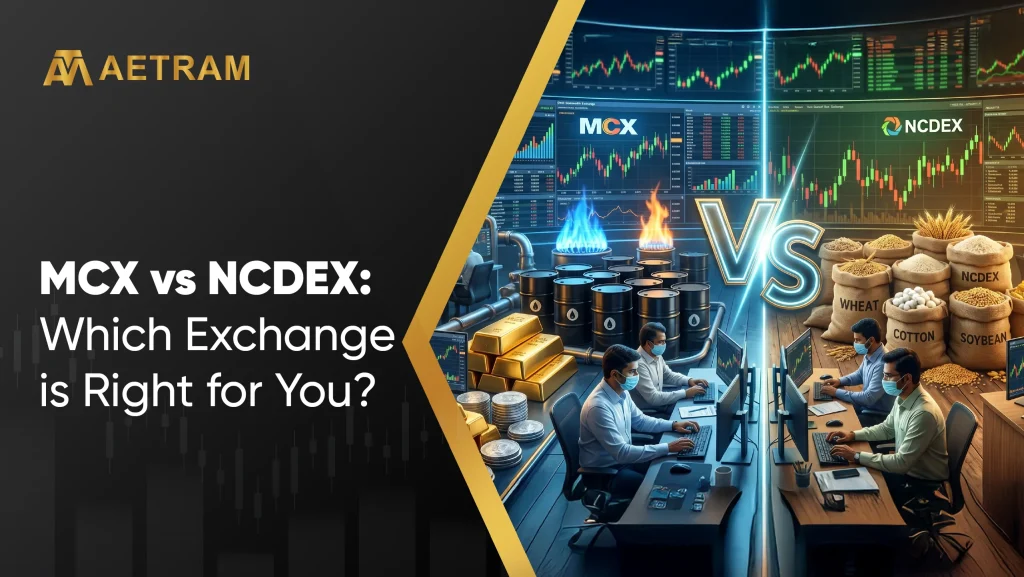
Commodities are raw materials and tangible items that are used to manufacture other goods. Commodities also consist of basic essential goods like agricultural products which are used for production, consumption and investments. These items are also traded on exchanges through financial instruments like derivatives.
The two major commodities exchanges in India are the Multi Commodity Exchange (MCX) and the National Commodity and Derivatives Exchange (NCDEX). Let’s take a look at these two exchanges in detail.
What is Multi Commodity Exchange (MCX)?
MCX is the biggest among these two exchanges due to the large volumes being traded on the exchange and global interest because commodities like gold and crude oil are traded in MCX. Due to this, the exchange has higher liquidity in the products that are traded and better price discovery. With its state-of-the art technological infrastructure and well-regulated platform, the exchange is popular among retail traders, domestic institutional investors and foreign institutional investors.
Following are the products that are traded on MCX,
- Bullion: Gold, Gold Mini, Gold Guinea, Gold Petal, Gold Ten, Silver, Silver Mini and Silver Micro.
- Base Metal: Aluminium, Aluminium Mini, Copper, Lead, Lead Mini, Nickel, Steel Rebar, Zinc and Zinc Mini.
- Energy: Crude Oil, Crude Oil Mini, Electricity, Natural Gas and Natural Gas Mini.
- Agri Commodities: Cardamom, Cotton, Cotton Seed, Wash Oil, Crude Palm Oil and Kapas Mentha Oil.
What is National Commodity and Derivatives Exchange (NCDEX)?
NCDEX is comparatively smaller to MCX as it primarily deals in agricultural commodities, though they provide trading in non-agri products also. Government programs and Farmer Producer Organizations are more and more connecting farmers to the NCDEX market, promoting direct involvement.
NCDEX gains from a range of government-supported schemes like e-NAM and schemes to keep prices steady, which makes it a key player in India’s agricultural commodity ecosystem.
Following are the products that are traded on NCDEX,
- Cereals and Pulses: Chana, Barley, Bajra, Wheat, Moong, Maize Feed Industrial Grade, Paddy (Basmati) – Pusa 1121 and Unprocessed Whole Raw Yellow Peas.
- Oil and Oil Seeds: Groundnut, Crude Sunflower Oil, Castor Seed, Refined Castor Oil, Cotton Seed Oilcake, Soybean, Refined Soy Oil, Mustard Seed, Crude Palm Oil, Natural Whitish Sesame Seeds and Hipro Soybean Meal.
- Fibres: Kapas, 29 mm Cotton and Cotton Wash Oil.
- Spices: Turmeric, Coriander, Jeera and Jeera Mini.
- Soft: Gur (Feed Grade), Robusta Cherry AB Coffee and Isabgol Seed.
- Guar Complex: Guar Seed 10 mt and Guar Gum Refined Splits.
- Metals: Steel Long
Differences between MCX and NCDEX
- MCX focuses more on hard commodities like crude oil, gold, silver, etc., while NCDEX primarily focuses on agri-based commodities.
- Trading hours in MCX is from 9:00 AM to 11:30 PM, whereas trading in NCDEX happens between 10 AM to 5 PM.
- Total trading volumes and liquidity in MCX is higher than NCDEX.
- Factors that affect commodities traded in MCX are global prices, global production, global supply-demand dynamics, exchange rates, geopolitical tensions, etc. Whereas commodities traded in NCDEX are influenced by seasonality, monsoon conditions, agriculture policies by the central government, climate risks,etc.
- MCX clients are companies in the oil and gas sector, metals sector, jewellery industry, traders, hedgers, etc. NCDEX clients are agro-based companies, farmers, crop traders, etc.
Similarities between MCX and NCDEX
- Both the exchanges are regulated by India’s market regulator, Securities and Exchange Board of India (SEBI), ensuring transparency and investor protection.
- The two commodity exchanges offer futures and options contracts for various commodities that are used for hedging against uncertainty and price volatility of commodities.
- MCX and NCDEX support both cash settlement of derivative contracts and physical delivery of commodities. However, many derivative contracts in NCDEX require to be settled through physical delivery of the commodity.
- MCX and NCDEX provide their own trading ecosystem and it can be accessed easily by traders and investors across India through registered stock brokers.
Conclusion
As a trader, you must choose MCX or NCDEX based on trading preference, trading style and market hours. If you want to trade agricultural commodities then NCDEX must be your first choice as they offer a variety of agri products, where if you are serious about trading in any hard commodities like crude oil, natural gas, gold, silver, etc., MCX must be your best bet.