Difference between large-cap, mid-cap and small-cap stocks

The stock market is a good place to grow your wealth if you are being invested for a long time but they are inherently risky. The main risk stems from investing in the stock market without the right knowledge. So it is important for experienced as well as beginners to know how the stocks are classified based on the market capitalization, fundamentals, technicals, etc. This gives them an idea about blue-chip companies, companies that have potential growth and risky companies they must stay away from.
The size of a company can be determined using different financial metrics but when it comes to the stock market, the size of a company is generally ascertained by market capitalization. Based on this market capitalization, a company is categorized as large-cap, mid-cap and small-cap stocks.
The formula for market capitalization of a company is outstanding shares multiplied by the share price. Due to fluctuation in market cap, a company could lose its large-cap status and become a mid-cap stock or vice-versa. In this article, we will take a deep dice into how stocks and companies are classified based on market cap and how to invest in these stocks.
What is a large-cap stock?
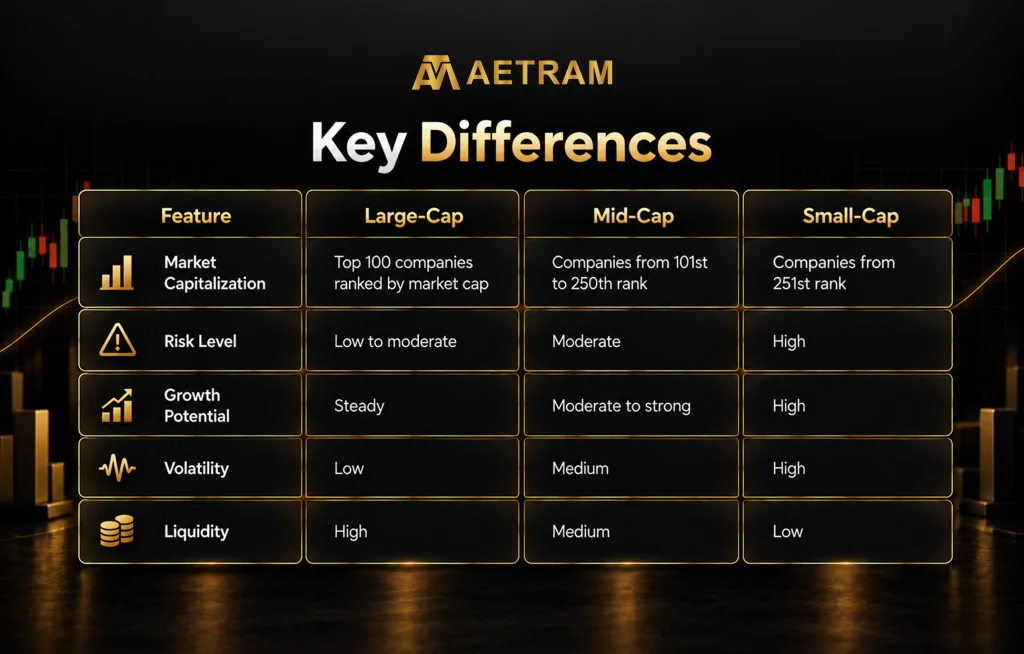
A large-cap stock is a stock whose market capitalization is one among the top 100 companies by market cap. Some of the popular indices for tracking large-cap are Nifty 50, Nifty 100, Sensex, BSE 100.
Most large-cap stocks are reputed companies with a huge market share and they have been in operation for many years. They are industry leaders in the sector they operate. These companies have steady growth in terms of revenue and net profit and they pay dividends to investors regularly. These stocks give stability in one’s portfolio and decent returns.
The transaction volumes in these stocks are really high and there is less price volatility and high liquidity. Stocks which fall in this category are also called blue-chip stocks. Some examples of large-cap stocks are HDFC Bank, Reliance Industries, Airtel, TCS, etc.
What is a mid-cap stock?
A mid-cap stock is a stock which is ranked from 101 to 250 based on its market capitalization. If you want to evaluate the mid-cap stocks, then as an investor you must follow Nifty Midcap 50, Nifty Midcap 100, BSE Midcap, Midcap 150, etc.
Mid-cap stocks represent companies with solid fundamentals and business models, and these companies have a lot of room to grow and capture market share from incumbents. Mid-cap stocks are popular among investors as they have the potential to grow sales and profits faster than large-cap companies and also provide some stability in terms of price.
What is a small-cap stock?
A small-cap stock is a stock that is ranked from 251 and beyond based on their market capitalization. Investors can easily track small-cap stocks by following these indices – Nifty Smallcap 50, Nifty Smallcap 100, Nifty Smallcap 250, BSE Smallcap, BSE 250 SmallCap Index, and BSE SmallCap Select Index.
Small-cap stocks are smaller in size with respect to market capitalization, revenue, net profit compared to mid-cap stocks and large-cap stocks. Small-cap stocks have a better chance for capital appreciation because companies belonging to small-cap stocks have a greater scope for market expansion, revenue growth, launching new products, capturing new geographies, etc.
Having said that, these stocks come with higher risk and only investors with high risk appetite and risk tolerance must look at investing in these types of stocks. Thorough research must be done and the share price must be keenly watched to seize the right opportunity at the right time.
How to invest in large-cap, mid-cap or small-cap stocks?
Aetram Trades investors have a couple of ways to invest in these stocks. You can invest directly in these stocks by opening a free demat account with Aetram Trades. To open a free demat account in a couple of minutes, all you have to do is click the link and enter the details. Along with a free demat account, you also get a trading account. With it, you can track these indices and add your favourite stocks from these indices to your watchlist and start trading or investing at a very low cost. Aetram Trades offers attractive brokerage plans for beginners and pro traders alike.
The second way is you can invest in these stocks through one or more mutual fund schemes. Aetram Trades in partnership with all asset management companies in India offers a wide range of opportunities to invest across various sectors.
Aetram Trades also has introduced Stock SIP schemes where investors with a free demat account in Aetram Trades can subscribe to a list of stocks which are carefully curated by expert analysts. These schemes are likely to offer investors long-term growth and capital appreciation, stable returns with favourable risk-to-reward ratio. Investors can always feel free to contact Aetram Trades through 044-48680008/044-49477777 or mail us at [email protected] to invest in mutual fund schemes or Stock SIP schemes.
Conclusion
As an investor it is important for you to know about market capitalisation and the companies’ ranking based on them. Every six months the stocks are reshuffled based on their performance, liquidity, transaction volume, etc.
Investing across various companies based on their market capitalization, strong fundamentals and diverse as well as emerging sectors can result in better return at the same time managing your risk profile. Focus on large-cap or mid-cap or small-cap may lead to a lot of missed opportunities. So it is wise and smart for investors to diversify their portfolio across sectors and based on market capitalization for optimal returns and mitigating huge risk.
Frequently Asked Questions
1. How is a company’s stock classified in the stock market?
A company’ stock is classified into large-cap, mid-cap and small-cap based on market capitalization.
2. What are large-cap, mid-cap and small-cap stocks?
SEBI issued guidelines on Oct 6, 2017, regarding classification of stocks. According to the guidelines, stocks are classified into large-cap, mid-cap and small-cap stocks based on a company’s total market capitalisation. The first 100 stocks by market cap are large-cap stocks. The next 100, i.e., from 101 to 250 are mid-cap stocks. The rest of the stocks listed in BSE and NSE ranked from 251 are small-cap stocks.
3. What is market capitalization?
Market capitalization can be easily calculated based on the following formula.
Market capitalization (Market cap or m-cap) = Outstanding shares * Share price.
4. Which one among large-cap, mid-cap and small-cap stocks is the best for investment?
Each category – large-cap, mid-cap or small-cap – offers investors unique opportunities, advantages and disadvantages. It is always best to pick a stock after thorough analysis of fundamentals and technicals, and not just on market cap.
5. Can small-cap stocks become mid-cap or large-cap stocks?
Yes. Small-cap stocks can become mid-cap and large-cap stocks as they continue to grow steadily in terms of revenue, net profit and market capitalization.