Dematerialization vs Rematerialization
The Indian stock market has seen an exponential growth in the past few years driven by economic growth, new-age online discount brokerage firms, and most importantly crores of demat account openings. The market, which was once dominated by institutional investors, has seen crores of retail investor participation. As of January 2026, India has more than 20 crore demat accounts compared to just 2.54 crore in FY16. So, what is a demat account? Let’s find out in this blog
Understanding demat accounts and dematerialization
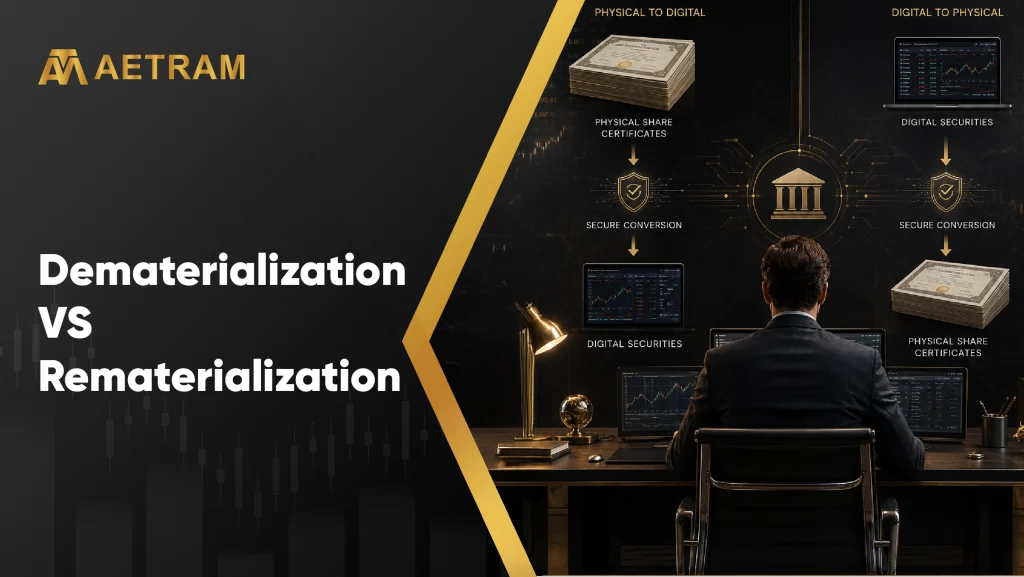
Demat stands for dematerialization and demat account is required for all investors in India to hold shares. According to SEBI, India’s market regulator, dematerialization is the process by which physical certificates of an investor are converted to an equivalent number of securities in electronic form.
Old investors might have their shares held in physical form and to convert it into digital form, they need a demat account. The market regulator, recently, said that all securities must be issued in dematerialized form and it should be in demat form to sell it on the exchanges.
How to convert physical shares to dematerialized form?
- The first step is the investor must open a demat account with SEBI-registered broker and depository participant like Aetram Trades.
- Request for a dematerialization request form (DRF), fill the form and submit it to the DP with the physical share certificates you have.
- The DP will start the process and the request is sent to the depository. In India there are two depositories and they are CDSL and NSDL.
- After dematerialization, the original physical share certificates are not valid.
- The depository informs the depository participant about the completion of the dematerialization process.
- The electronic form of the shares will be credited and it will reflect in your demat account within 15 to 30 days.

What is Rematerialisation?
Rematerialization is the opposite of dematerialization and according to SEBI, rematerialization is the process of converting securities held in electronic form in a demat account back in physical certificate form.
Steps to convert shares from electronic form to physical form
- If you have a demat account with a broker and you hold shares in it, you must request a form called remat request form (RRF) and fill the form with the help of your broking firm.
- Then it is sent to the depository participant and it will begin the process and the form is submitted to the depository and registrar.
- The registrar will inform the DP and depository about the rematerialization of the shares and the physical share certificate is printed and dispatched to the investor.
Advantages of dematerialization
Dematerialization offers a lot of advantages to traders and investors and holding your securities in demat form will save a lot of time. Let us take a look at the benefits of dematerialization.
Holding your shares or any other securities in demat form provides enhanced safety as there is less chance of loss, theft, damage, or forgery. There are two depositories, CDSL and NSDL, which hold the securities in demat form with multiple layers of encryption and security protocols.
It is very easy and convenient to hold the securities in demat form and you can easily access and manage them from anywhere using a computer or mobile.
Since securities are held in demat form, the selling and buying of securities happen electronically in a few seconds or minutes. This improves settlement time and improves liquidity in the market.
A single demat account can hold different kinds of securities like equities, bonds, FnO contracts, ETFs, etc. and this simplifies portfolio tracking and management for investors. This also reduces paperwork and other administrative costs. Any stock split, bonus issue of shares, and rights issues are reflected sooner in the demat account and it removes the risk of loss in transit or delays in receiving the benefits.
You can easily pledge your stocks or mutual funds held in your demat account very easily for extra margins or loans as it is easy to verify your holdings. You can easily manage your nominees and make changes whenever you want if you have a demat account.
Conclusion
In this 21st century, when everything is connected digitally and almost everyone has a smartphone, it makes a lot of sense to have a demat account and hold the securities in electronic form rather than in physical form. It is quick, safe, convenient and cost effective to open a demat account and have all your holdings in dematerialized form.