Confusing Risk Tolerance With Risk Capacity Could Be Your Costliest Investing Mistake

I had a friend who was working in the IT sector and he was talking about how one of his colleagues has been investing in mutual funds for the past few years and the investment has grown multifold times. So my friend also decided to move his savings including his emergency funds into mutual funds without a second thought and then reality struck.
The market had a major correction a few months down the line and my friend’s portfolio was down by more than 20%. He panicked and sold his mutual funds units at a loss. He was confused because though the market had corrected his overall portfolio was in red while his colleagues portfolio had also corrected but was in green. He did not have much knowledge about risk-to-reward ratio, asset allocation and being invested for a longer period of time. He also did not understand the difference between risk tolerance and risk capacity which is what we will discuss in this blog.
What is risk tolerance?
Risk is an inherent part of investing and investing is not all about strategies, math and formula but is also about psychology and emotions and that emotional part is called risk tolerance.
When your portfolio fluctuates and that uncomfortable feeling you get when you open your trading app and see a 25% or 30% fall staring back at you tells you about your level of comfort and degree of risk tolerance.
It comes from a very intimate level. Your personality, understanding of money, past financial experiences, family money management during your childhood, cultural background, etc., all help to define your risk tolerance.
For instance, numerous generations of middle-class households in India grew up observing their parents store wealth in gold and fixed deposits. That conditioning would make anyone be more inclined toward safety rather than investing in assets that have the potential to give higher returns, even when that person’s present financial status might easily support riskier investments.
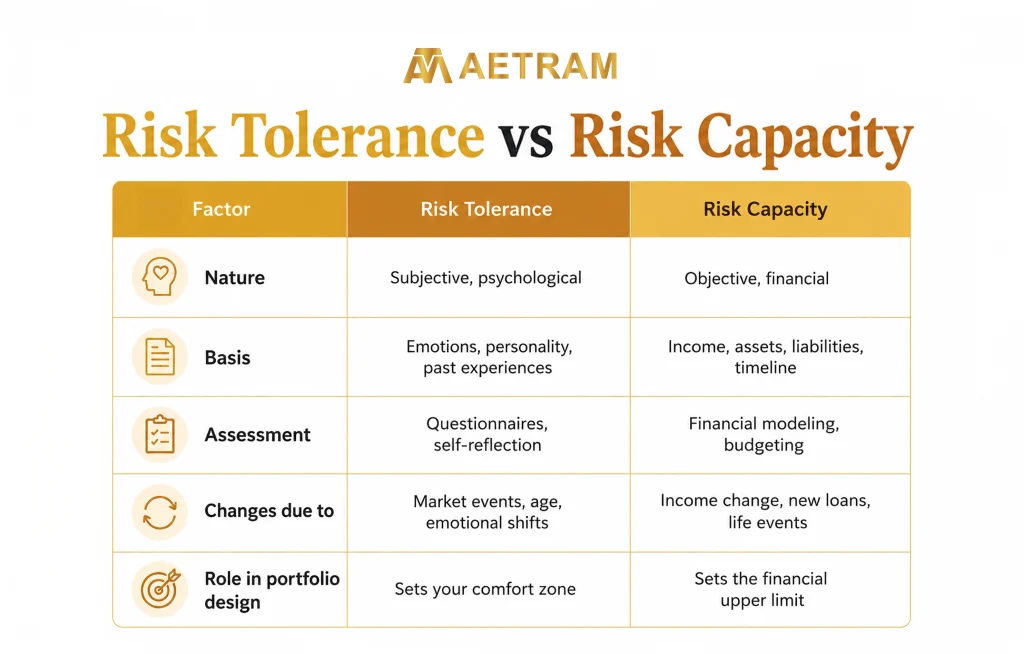
Risk tolerance is subjective and behavioral. It is about emotions rather than facts. Financial planners sometimes evaluate it with surveys that include inquiries including “If your portfolio fell 30% in six months, what would you do?” The results show how you would probably react under financial stress, which is often very different from what you would expect.
Fundamentally, risk tolerance can change over time. You can become permanently more cautious because you had survived a market collapse in the past. A windfall or a rally may briefly increase your aggressiveness and risk appetite. However, someone nearing retirement will naturally become more risk-averse regardless of how daring they felt at 30.
How to assess your risk tolerance
One of the effective ways to assess your risk tolerance is by being honest to yourself as risk tolerance is subjective and psychological. You may start answering questionnaires before you start investing. You can answer hypothetical questions like “how would you react if your portfolio fell 30% over six months?” to gauge your emotional reaction and understand yourself better. Some questions you can ask yourself are:
- Have I invested in equities before? How did I behave during a correction?
- Was I simply checking my portfolio continuously when markets fell last time?
- Did I react impulsively during a market crash or did I have a stop loss?
- Would a 20% paper loss affect my sleep or my relationship with money?
- Have I ever panic-sold an investment that later recovered?
Answering these types of questions and keeping a journal will reveal your real tolerance and how you have reacted or are likely to react when the market is under stress. Knowing your risk tolerance helps you choose investments that you will actually stay invested in, rather than abandon at the worst moment.
What is risk capacity?
Risk capacity is completely different from risk tolerance because risk capacity is completely independent of your emotions. Your financial situation determines everything and how money you can afford to lose without affecting your daily and monthly financial responsibilities.
The risk capacity is an objective indication of how much investment risk you can really manage without jeopardizing your key financial objectives. Risk capacity is something to do with your savings, expenses, your assets and liabilities, while risk tolerance lives in your mind and it has something to do with your mindset and behaviour.
Factors determining risk capacity
Time horizon
Assume a situation where you have financial goals to achieve that are long term, say 15 years down the line, then short-term volatility is noise and you do not have to worry about. You have enough time to wait till the market or your portfolio recoups its losses and also 15 years is a good enough time for compounding.
But if you need the funds in three years for a house construction or renovation, a wedding or college costs, it is not safe to place the money in risky assets that may change value quickly. If the market value falls by 30% suddenly, the person will not be in a position to achieve his financial objectives which is likely to happen soon and he may be forced to liquidate his portfolio at a lower profit or worse even at a loss.
Income stability
Only people with some sort of steady cashflow can take risks with confidence. So a government employee or an employee working in the private sector with a reputed company with a fixed monthly salary has higher risk capacity than a freelancer whose income fluctuates month to month. When you have steady income, you are in a better position to survive a bad year because you know that you have the money to meet your daily and monthly expenses.
Emergency fund & insurance
When you have an emergency fund and insurance, you have a stronger footing with respect to your risk capacity. When you have six months to one year of living expenses sitting in a liquid fund and are covered by comprehensive health insurance, your investment portfolio can absorb market volatility or any correction without threatening your daily life. If not for this buffer, even a moderate market drop may force you to redeem investments at exactly the wrong time.
Liabilities
If there is any significant liability, then it can increase your risk and undermine your capacity to take more risks with respect to investing. A large mortgage EMI, vehicle loan, or credit card payment reduces your financial flexibility to take on investment losses. You have less room to take risks and your risk capacity decreases as a major chunk of your income may go to debt repayment and if you miss your loan EMI, then it will start to compound and spiral into a debt trap.
Net worth
A solid and diversified asset base and net worth can help an investor to take more risks in the present and in the future. Even if the equity segment sees a major correction, the investor can absorb the temporary notional losses and it won’t derail their life. This is not possible if you have your savings invested in deposits or other fixed-income securities only.
How to assess your risk capacity
Unlike risk tolerance, which usually calls for introspection and a survey, risk capacity can be determined. This is a sensible beginning point:
First, start by alignment of your timelines and objectives. Make a realistic timetable for each significant financial objective: marriage costs, retirement, home acquisition, children’s education. This helps you right away determine which sources of money are really long-term and can tolerate equity exposure and which are short-term and hence low-capacity.
Create a budget highlighting your maximum loss capability. If you have a monthly expense of Rs 80,000 and take-home salary is ₹1,50,000, then you are left with ₹70,000 in hand after all the expenses are deducted. Before you plan to invest this amount in equities or any other risky assets, consider paying off those loans, insurance premiums, and allocate the required amount for your emergency fund. What is left is truly investable; your ability to assign to stocks relies on when you will need it.
Evaluate your income stability. Tell the truth about the stability of your income. Plan in a greater safety buffer before assuming market risk if you operate in a unstable industry or manage your own company.
You must always keep a tab on your load of debt and make sure not to increase your debt burden. Fixed debt payout schedules greatly lower your capability. Taking big equity risk when you have an impending loan with high-interest is a recipe for financial disaster.
Aligning risk tolerance and risk capacity
Understanding both risk tolerance and risk capacity is paramount to building a robust investment strategy you can live with and it is only useful if you use them together.
Your risk capacity must define your asset allocation and that must be your upper limit. If your financial situation objectively justifies a 70% equity allocation, that is the most you should think about and you should not consider it as a goal you must reach at any cost.
Let your risk appetite determine your actual comfort level under that limit. Start with 50% allocation to stocks, if you feel a 70% equity allocation is risky and make you uncomfortable during any market corrections. Being conservative in investments is better than being aggressive in the beginning and panicking and selling at a loss during market downturns.
You should categorize and segment your goals based on a parameter, say time frame. You must have short-term, medium-term and long-term goals. If you have goals which you would like to achieve within three years then that money should be in capital-preserving instruments like liquid funds, short-duration debt. Medium-term goals which are in a time frame between three and seven years can be achieved by investing in balanced or hybrid funds. Goals beyond seven or ten years like kids’ education or marriage or your retirement, can comfortably hold a larger equity allocation through systematic investment plans (SIPs) in a balanced fund.
You should review your goals and portfolio regularly or at least annually and at life milestones. A job change, salary increment, new loan or any addition to your family can shift your financial standing. A sudden illness or market crash can shift your emotional picture. Both need to be attended to and cannot be ignored.
Use SIPs to build tolerance gradually. For investors with low risk tolerance but high capacity, a systematic investment plan in equity mutual funds is a psychologically easier entry point than a lump-sum investment. It smoothens volatility through rupee cost averaging and builds your confidence as your portfolio would have experienced many market cycles.
Conclusion
Risk tolerance and risk capacity may sound similar but they are completely different. One is about your emotional capacity to handle a downturn and the other one is how much money you can afford to lose notionally.
Most investors invest according to their risk tolerance while completely ignoring their risk capacity. They ask, “Will I feel okay if this drops?”, but forget to ask “Can I actually afford for this to drop?”
The result is that emotional investors overinvest in risky assets during bull markets, panic during corrections, and lock in losses at precisely the moment they should be staying calm or even adding more.
So as an investor who wants to build lasting wealth you must know both numbers and build a strategy that respects both. It is not about the highest possible return or the safest possible instrument, but a portfolio that is financially as well as emotionally sustainable.
Frequently Asked Questions (FAQs)
Is risk tolerance the same as risk capacity?
No, they are not the same. Risk tolerance is about how emotionally comfortable you are with market ups and downs and it is psychological. Risk capacity is about how much financial risk your current situation can actually afford and it is based on your income, savings, debts, and investment timeline.
Which one should guide my investment decisions?
Ideally, both should work together and guide your investment decision. However, it is better to prioritize risk capacity as it would set the boundaries of your investment strategy, because it’s based on hard financial facts.
Can my risk capacity change over time?
Yes, your risk capacity can change when your financial situation changes and it can be a new job, a salary hike, a loan, a new baby, or getting closer to retirement.
Will my risk tolerance change over time?
Your risk tolerance can change after emotional experiences like living through a market crash, a financial windfall or simply growing older and becoming more cautious with your investments.
How do I find out what my risk capacity is?
You can start by mapping your financial position by listing your income, monthly expenses, existing loans, insurance coverage and the timeline for each of your financial goals. You can also segment and categorize your investment goals based on timeframe.