Common behavioral biases that influence investment decisions
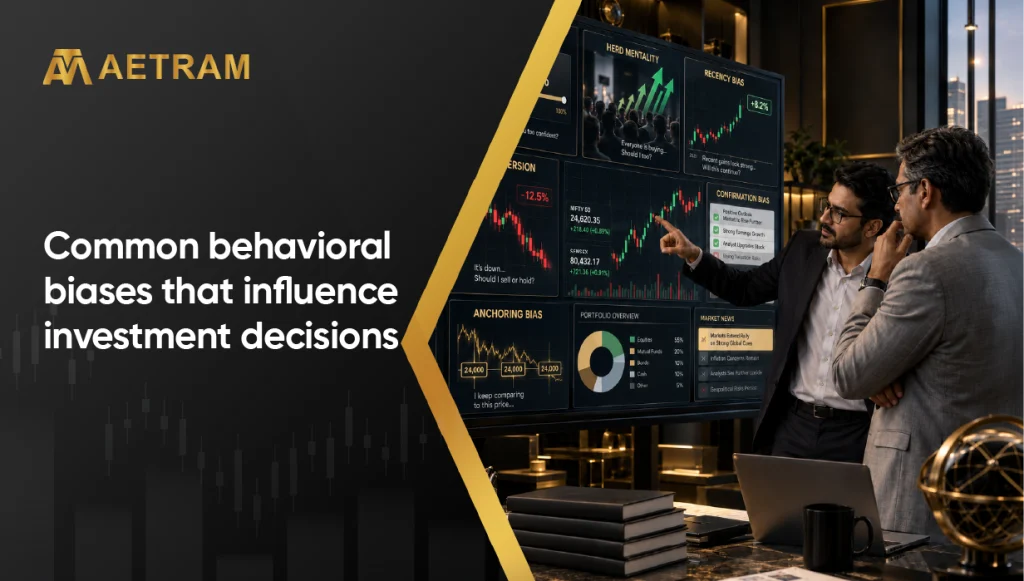
Classical finance theory is built on the comforting assumption that investors and market participants are rational actors who weigh the risk vs. return trade-off with calculation. Anyone who has seen a friend holding on to a losing stock “until it recovers” or jumping into an IPO because their WhatsApp group was going wild about it knows how far this assumption falls short.
The existence of behavioural finance is itself a corrective response to this assumption: emotions, fear or greed, peer pressures, etc. play a much bigger role in influencing the decision-making process.
Therefore, investing patterns of retail investors play a bigger role than what classical finance theory says. This is all the more important in India where retail investors are growing while financial literacy is still somewhat lacking.
In fact, it is this entire space of emotions, heuristics and social pressures which behavioural finance seeks to understand. Whereas, classical finance assumes investors have a precise model in their mind when considering risks and the corresponding trade off.
There’s evidence both of this in aggregate, and for individual investors. In 2025, SEBI undertook a survey of 90,000 Indian households in order to understand engagement in the securities market and what drives such decisions.
The findings were informative, but not surprising, as they point towards the same biases that surface regularly. Below are the biases which tend to afflict Indian investors, along with supporting evidence, and what can be done to mitigate the effects of each.
Herd Mentality
Herd mentality takes place when investors are swayed to take actions by the fact that others are taking similar actions, as opposed to making a decision based on their own analysis.
India’s booming futures and options market is the best example of herding in action. SEBI’s most recent study found that 91% of individual traders in India’s equity derivatives market lost money in FY24-25, with net losses surging 41% year-on-year to ₹1,05,603 crore, with participation and volumes remaining high despite that. A SEBI study covering 26.5 lakh unique retail traders across 19 crore trades found 84% of participants ended the year in net losses – despite F&O trading being a more sophisticated instrument than regular equity investing.
What makes this bias particularly evident is the participation numbers. Despite one of India’s most consistent loss patterns on record, over 75% of loss-making traders continue to participate in F&O trading in the years studied. The crowd continues to gather, despite the odds.
Loss Aversion
Loss aversion is the tendency to feel losses more intensely than equivalent gains. It’s a big reason behind why a lot of Indians still prefer fixed deposits, gold, and real estate as a primary form of investment, despite the long-term benefits afforded to equities.
SEBI’s household survey finds this fear taking place right at the entry point to investing, as 34% of non-investors cited fear of losing money as one of their primary motivations for remaining uninvolved in the stock market in the first place. The fear of losses far outweighs the possibility of gains, and so many simply opt out of an instrument despite long-term positive track record.
But this does not discourage Indians who are already in the market. In fact, loss aversion often manifests as reluctance to book losses and quick booking of small or even mediocre gains (this is discussed further below in the section on anchoring).
Confirmation Bias
Confirmation bias is the tendency to seek out information which supports your viewpoint and ignore information which refutes it. It’s exacerbated substantially on finance content on YouTube, Telegram, and X, where investors tend to seek out voices which agree with their existing bullish or bearish stance on a stock.
This is particularly problematic in a market where research comparing behavioural biases across India, the US, and UK found that anchoring bias and mental accounting had negatively impacted Indian investors specifically. This is a bias which is easy to both reinforce and ignore, when your information diet is only ever confirming your existing position.
Overconfidence Bias
The overconfidence bias is believing you know more or can predict markets better than you actually can, and it is by far the most-researched source of anomalies in Indian behavioural finance literature. It is the most prevalent bias among Indian investors as per a study on presence of behavioural biases among Indian investors, which found overconfidence to be the most influential factor, with age, profession and trading frequency determining how strong it was.
SEBI’s own household survey finds a clear disparity between perceived knowledge and actual knowledge among investors, with 50% of existing investors classifying as having low knowledge of the securities markets (including basic concepts like inflation), and 53% of affluent investors only having moderate or high knowledge, with nearly half being ill-informed when making decisions, yet still trading actively in complex instruments, convinced of their own judgment.
But nowhere is this more evident than in India’s derivatives space. A recent SEBI study tracking traders over multiple years found something counter-intuitive: experience did not result in improved returns. In fact, as experience increased, the ratio of loss-makers increased as well (roughly 91% of new traders were loss-makers, and over 95% of those who started trading for 4 or more consecutive years were also loss-makers).
Anchoring Bias
Anchoring happens when people fixate on a particular stock price (often their purchase price or a stock’s all-time high), without regard for other factors.
This shows up frequently in Indian retail behaviour as refusing to sell a stock until it gets back to what they paid for it, or not buying a fundamentally strong stock because it used to sell for less and “feels expensive.” The anchor isn’t wrong in that it represents a specific value but the markets rarely care.
Recency Bias
Recency bias is the tendency to place greater importance on the most recent events as if they’re indicative of a trend. It’s the reason why the best performing mutual fund category of the last twelve months gets the most money poured into it, even as it’s most likely for a correction.
This bias can also work the other way around: a poor quarter for equities can convince many first-time SIP investors to halt contributions (right as rupee-cost averaging is doing its job). Interestingly enough, it’s this exact bias that SEBI and AMFI’s financial literacy efforts are aimed at countering, with the latter’s push for greater mutual fund adoption in light of low financial literacy and cultural preference for traditional savings instruments in Tier-2 and Tier-3 cities.
Mental Accounting
Mental accounting is a tendency to treat money differently depending on its source, even though a rupee is a rupee. A Diwali bonus may get spent freely on a “fun” stock tip, whereas the same amount earned via salary would never see risk taken in that way. Similarly, many Indian households treat “safe money” (FDs, gold, PPF) and “risk money” (equity, F&O) as separate, without any consideration on whether or not the portfolio allocation matches goals or risk capacity.
This bias is linked to why many Indians are under-allocated in equity relative to their long term goals, even when there is separate money sitting idle in low-yield instruments they’d never consider investing in.
Disposition Effect
The disposition effect is selling winning investments early to “lock in” gains, and holding on to losing investments indefinitely hoping to recover losses. Essentially, it’s the combination of loss aversion and anchoring, and is one of the most common patterns amongst Indian retail portfolios.
Research comparing India, the US, and UK found that this pattern along with affect heuristic, herding, and status quo bias, was associated with a positive short term impact on Indian investors however the same research warned that the same biases can lead to irrational decision making and adversely impact investment outcomes in the long run. In other words, the occasional lucky break doesn’t validate the habit.
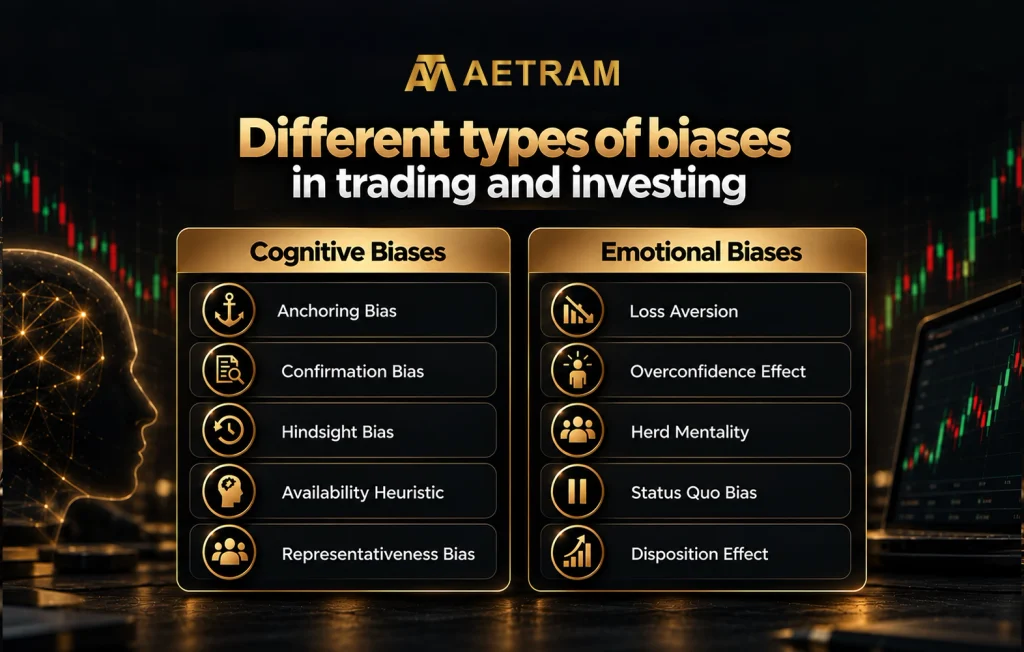
How Indian Investors Can Overcome These Biases
None of these biases can be completely eliminated, but their impact can be mitigated.
Automate decisions (such as through SIPs) in order to avoid the emotional decision-making around “when” to invest, which is where recency bias and loss aversion take maximum toll.
Write down investment theses and what would make you sell them. Revisit them later, not in the moment
Diversify across asset classes to avoid having a dominant mental accounting or anchor point
Use SEBI and AMFI investor education resources which are designed specifically to address gaps in knowledge which feed into overconfidence
Consider consulting a fee-only financial advisor for major moves. An outside party has less of a history of interaction with the stock in question, and is therefore less likely to be anchored to a purchase price
Conclusion
While it may not seem that way, behavioural biases aren’t a sign of intelligence; they’re the same across everyone. It’s not knowledge which differentiates successful investors, it’s the recognition and mitigation of these tendencies which allows them to operate successfully, and as SEBI’s own data shows, experience alone is not a substitute for such self-awareness.