Active ETFs vs Passive ETFs: Key Differences

ETFs, which stand for exchange traded funds, are financial instruments to invest across various asset classes. They are broadly classified as active ETFs and passive ETFs. When you invest in ETFs, your money is invested in a fund which tracks broader indices like Nifty 50, Sensex, etc. or a portfolio of stocks or commodity ETFs like gold or silver. Let us understand about ETFs and the difference between active ETFs and passive ETFs in detail in this blog.
What are ETFs?
ETFs are financial instruments which combine the features of shares and mutual funds which provide diversification. As the name suggests, ETFs can be traded on the stock exchange like NSE or BSE and these funds track a specific index. The price of an ETF can fluctuate during market hours as they are bought and sold like shares on the stock exchanges.
You can buy or sell ETFs on the stock exchanges just like you buy or sell shares during market hours. This is quite opposite to mutual funds because when you invest in mutual funds, you are provided with units which have a NAV (net asset value) and this NAV is calculated on the closing price of the assets that mutual fund scheme holds.
Why should you invest in ETFs?
ETFs are a cost-effective way to build a diversified and balanced portfolio.
By investing in just one ETF, you can gain exposure to a wide range of companies, sectors and industries. ETFs are generally considered cheaper than traditional mutual funds because they have lower expense ratios due to which more of your money goes into investment rather than AUM charges and other charges.
Another big plus is flexibility because unlike mutual funds which are bought and sold at the end of the day, ETFs can be traded like individual stocks during trading hours. This gives the investors the ability to buy or sell at any time during the trading window and this can be helpful if you want to enter or exit the position with respect to changes in the market.
And when it comes to taxes, ETFs often outperform mutual funds. Because they tend to generate fewer capital gains distributions and allow for more efficient tax treatment, they can help you keep more of your returns.
Core differences between active ETFs and passive ETFs
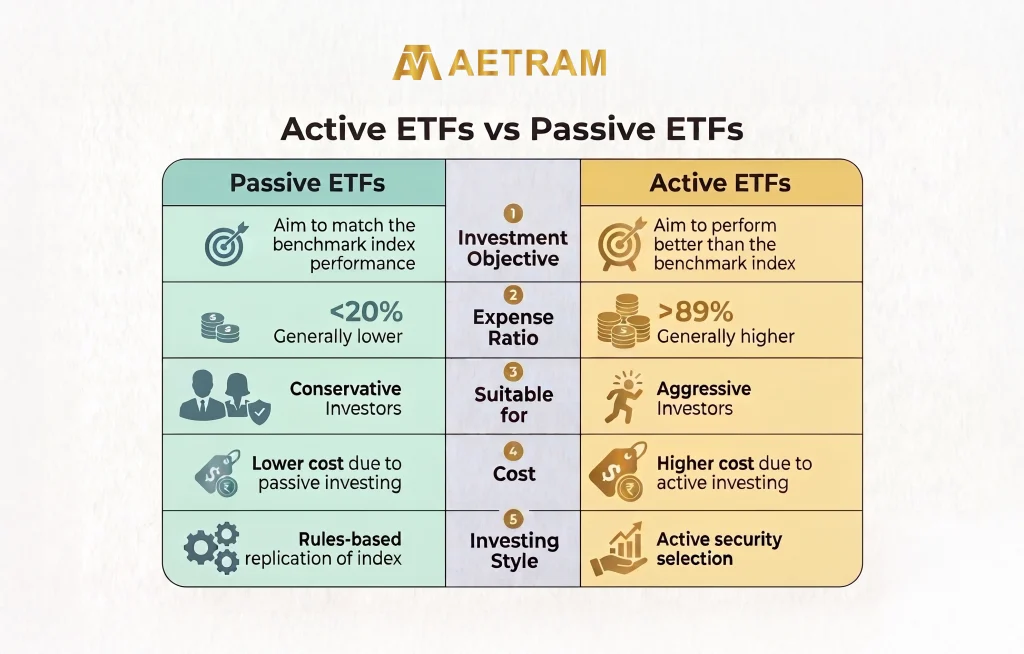
Active ETFs are managed by professional fund managers who make strategic investment choices aimed at outperforming the broader market or a particular benchmark index.
Extensive research is conducted and various investment strategies are applied in selecting securities so that the portfolio could deliver stronger returns than the average returns delivered by benchmark indices.
Active ETFs do not follow a fixed benchmark but the fund managers follow different strategies that adapt to changing market dynamics and tap emerging opportunities in sunrise sectors. As a result, investors who are looking for better growth opportunities are attracted to these funds.
Passive ETFs are designed to mirror specific indices like the Nifty 50 or Sensex and the main aim of this kind of ETFs is to deliver similar returns as the benchmark without making active adjustments.
For any passive investor with a long-term financial plan, these funds are considered as one of the most affordable options. Because of their low risk profile and simple investing strategy of imitating the index performance, passive ETFs have become popular among investors who prioritize stability and cost-efficiency in their portfolios.
Advantages of active ETFs
An active ETF is managed by professional fund managers and therefore they are always on the look out for identifying market opportunities so that their fund can perform better than benchmark indices which is also known as alpha. They also try to beat passive mutual funds or passive ETFs but the risks are higher in actively managed ETFs and the churn rate is also higher here.
While active ETFs are traded on exchanges (NSE and BSE) like stocks, their volatility is generally lower than that of individual stocks and due to this reason they are less risky options and more stable compared to equities.
Advantages of passive ETFs
Investing in passive ETFs is a reliable investment approach due to its consistency and stable growth with lower risks. Diversification is naturally built into each unit of a passively managed ETF as it is structured to reflect the weightage of the index’s components.
It is easy and affordable for retail investors to invest in high-value companies and shares which are costly, through ETFs. As a result, passively managed ETFs have become a cost-effective way to participate in the market leading to small ownership of major stocks.
Disadvantages of active ETFs
If you invest in active ETFs, then your expenses are likely to be higher because they involve higher fund management and transaction fees. Consequently, you will end up paying more overall and this extra expense can weigh down on your final returns.
When you invest in active ETFs, there is no guarantee of beating the benchmark returns but come with additional risks like higher volatility and higher churn rate.
Actively managed ETFs are less diversified than passive ETFs and the portfolio managers focus on a smaller number of securities. Some of these risks and inefficiencies are borne by the investors and may cost them during their long investment journey.
Disadvantages of passive ETFs
When you invest in passive ETFs, there is no way to beat benchmark returns as there is no active strategy involved. Passively managed ETFs are not preferred by active investors as there is less scope for them to generate huge returns.
Since passive ETFs mirror an index like Nifty or Sensex, there is no way to increase or decrease the weightage and add or remove your desired stocks in the portfolio. When you invest in passive ETFs, there is no way to generate alpha.
Conclusion
Selecting the right ETF depends on financial objectives, risk appetite, market conditions and time horizon. Performance outcomes may vary between the different types of ETFs in the short term and long term. However, exposure to equity markets can be gained more easily through ETFs and it can be your first step into the world of investing before you to do direct investing in stocks or other asset classes.