Why Can Expiry Day Create Sudden Price Swings?
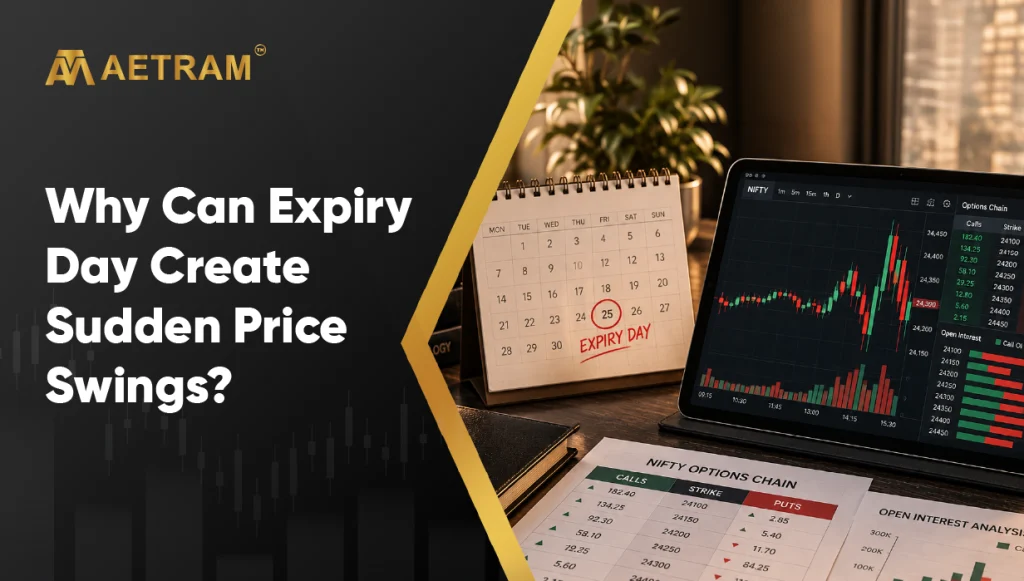
Let’s assume that prices have been consolidating throughout the morning. Now, as expiry time nears, prices spike, reverse and make a move in the other direction. Such sharp price moves may surprise traders in the options market. Sometimes, expiry days may witness more price volatility due to the sensitivity of options due to very little time left until expiry. Time decay, gamma, adjustments and hedges may all be responsible for such moves.
What happens on expiry day?
Expiry is the day when the option contract comes to the end of its lifespan. Once expired, the contract will be settled as per the exchange’s requirements. The closer expiry time gets, the lesser is the remaining time period for the option to become profitable. As a result, there will be a fast erosion of time value of the option, especially during the last hours before expiry. Any slight move in price can mean a lot for those options that trade around the strike price.
Time Decay Gets Easier to Observe
An important notion in expiry-day strategies is time decay or theta. Theta is one of the elements comprising the value of an option because there is always some time value in the price of the option. The time value of the option shows that there is a possibility of the underlying moving favourably prior to expiry.
On expiry day, the time is essentially coming to its end. Thus, an option possessing some amount of time value in the morning will have most of its time value depleted in just a couple of hours if the underlying does not move as anticipated. Therefore, buyers should take into account that the underlying should move fast enough and substantially.
High Gamma Can Lead to Very Responsive Options
Gamma is the rate of change of an option’s delta due to a change in the price of the underlying asset. At-the-money options near expiration may have very high gamma. Consequently, a slight change in the price of the underlying may lead to very fast sensitivity changes.
Consider an index trading near the strike price of an option. A slight increase in price can quickly lead to increased sensitivity of the call option to further increases. Should there be a turn in the price action, the increased sensitivity will drop equally fast.
Hedging Can Contribute to Price Moves
Options traders and market makers may hedge their positions in order to mitigate risks. Changes in the price of the underlying security may require changes in the size of hedges. Closer to expiry, such changes can be more frequent due to the higher sensitivity of options. It may include buying and selling of the underlying security in the process of adjusting the position sizes. In certain instances, such action may contribute to an ongoing price move. Hedging is just one of many factors influencing the price of the instrument and not all price movements on expiry day result from hedging activities.
Why Are Strike Prices Important?
Strike prices may become meaningful benchmarks in case there are many options placed around such strikes. If the underlying security price is near a significant strike price, where there is also significant open interest, then as the security breaks above or below such level, options prices can be quickly revaluated. It may contribute to heavy trading and quick price changes. High open interest at the strike price should not automatically serve as a guarantee for a support/resistance level.
Open Interest Takes Things a Step Further
Open interest (OI) refers to the number of derivative contracts outstanding which have not been closed, exercised or settled. Traders typically keep track of open interest at various strike levels to know where positions lie. Thus, for instance, where there is a significant amount of open interest at some particular strike, traders might be interested in what happens when the underlying asset gets closer to that level. However, open interest does not give any signals concerning the direction of movement in the future and needs to be taken into account along with price, volume, volatility and other market data.
Options Can Move Much More Than Underlying Assets When Expired
Imagine the case when an option is near the strike price before expiration. A modest price change in the underlying can affect the status of the option, making it go either out-of-the-money or in-the-money. Where there is a limited amount of time left to expiration, the market quickly reassesses the value of the option on the basis of new probability of being in-the-money at expiration.
Market News May Accelerate the Move
It should be remembered that apart from technical factors, the price of the underlying on expiry may fluctuate due to unexpected economic announcements, market news, global developments or anything else. If one of these events occurs on the day before expiration, the reaction of the price may be especially swift because there is not much time left for the market to adjust to the new conditions. Thus, the market news + high sensitivity of the options + lack of time may result in swift changes in prices.
The Risks Associated with Expiry Day Trading
Fast-moving prices may look tempting to the traders as they offer the possibility of making quick profits. However, the same process may work in opposite direction and a trader who purchases an option will see how the premium rises swiftly and drops back. At the same time, the factor of time decay is still influencing options with any remaining time value.
Is Each Expiry Date Always High-Volatility?
No. An expiry date doesn’t imply a big market movement. Expiry dates can sometimes be quiet for the market and other times they may experience wide fluctuations. The degree of volatility varies based on a number of factors like the market situation, news, liquidity, positioning and the behaviour of the underlying security. The expiry date may accentuate certain market movements, but it cannot determine the direction the market will take.
Comprehending Why an Expiry May Produce Fast Market Movements
An expiry date may create quick market movements as the options become more sensitive to the underlying security as the expiry date approaches. Quick time decay, gamma, change in open interest, position adjustment and hedging activities may work together to cause rapid fluctuations in the options premiums and, at times, in the underlying market too. This doesn’t imply each expiry date is high volatility, nor does it imply each fast market movement produces a trading opportunity For more market insights, trading resources and information to help you stay informed and make more considered decisions, explore Aetram.
FAQs
1. Why do options become more volatile near expiry?
As expiry approaches, there is less time for the underlying asset to move. Options close to their strike can therefore become highly sensitive to even small changes in the underlying price.
2. What is gamma in options trading?
Gamma measures how quickly an option’s delta changes when the underlying asset moves. Gamma can become particularly significant for at-the-money options close to expiry.
3. Why are strike prices important on expiry day?
Strike prices determine the terms at which options can be exercised. When substantial positions are concentrated around certain strikes, movements around those levels can lead to increased trading activity.
4. Does high open interest predict where the market will move?
No. Open interest shows the number of outstanding contracts, but it doesn’t independently predict the direction of the underlying asset.
5. Why can expiry-day options lose value so quickly?
Time value can decline rapidly as expiry approaches. If the underlying doesn’t move sufficiently in the expected direction, an option’s premium can fall sharply, particularly during the final hours.