What Is CAGR and Why It Matters in Equity Investing

CAGR stands for compounded annual growth rate and it is used for determining the rate of return based on the initial investment amount and final investment amount over the years. While calculating the CAGR, we must assume that the interest amount or the profit is reinvested throughout the investment years.
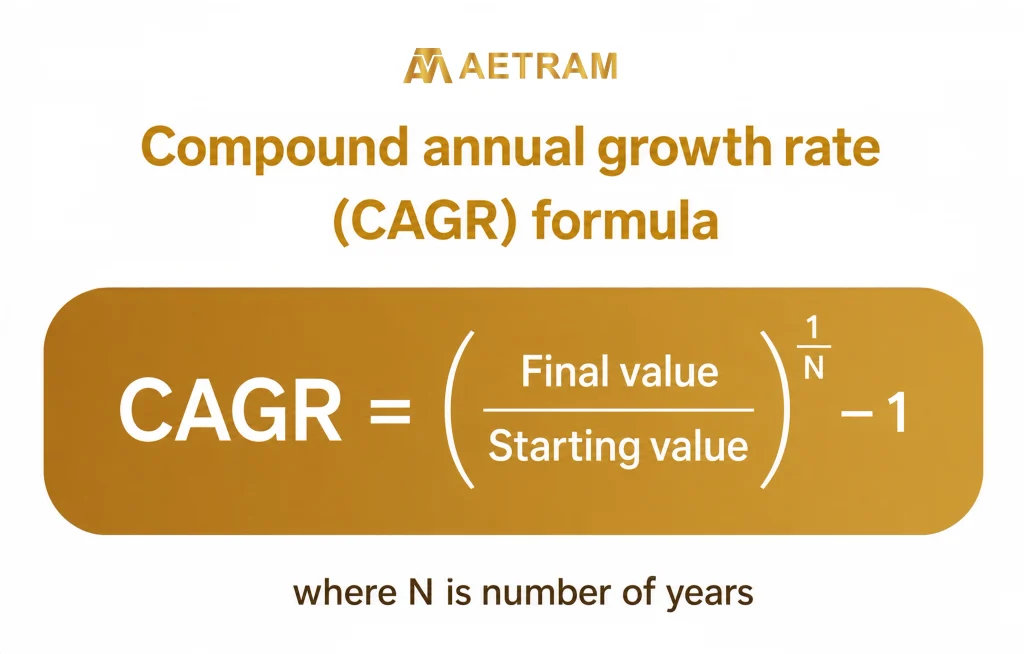
Formula for compound annual growth rate (CAGR)
Compound Annual Growth Rate (CAGR) can be calculated using the following formula
( ( (End value/ Initial value) ^ (1/n) ) – 1) * 100
Where n is the number of years
Assume that you have invested Rs 1,00,000 in a mutual fund scheme and after 30 years, your value becomes Rs 1 crore, then the CAGR comes to about 16.6%. The CAGR can be calculated using the above formula
CAGR = ( ( (1,00,00,000 / 1,00,000) ^ (1/30) ) – 1) * 100 = 16.6%
This means that the investment grew at an annual rate of 16.6% compounded over 30 years.
If you find this formula difficult to comprehend, you can use the online calculator provided by the market regulator Securities and Exchange Board of India (SEBI).
Absolute returns vs CAGR vs XIRR
There are different ways of calculating returns and we will take a look at the most common ways of calculating it. Absolute returns tell you the total profit or loss on an investment without taking time into account. It takes into account only the initial investment amount and final value of the investment, and not the number of years or months.
On the other hand, CAGR gives you a smoothed-out annual growth rate for a lump sum invested over a specific period, showing how much the investment would have grown each year on average.
XIRR is useful when you have multiple investments or withdrawals at different times, as it calculates the annualized return by factoring in the exact timing of each cash flow.
The main difference between these methods is how each one handles time and compounding. CAGR and XIRR consider when the money is added or withdrawn, while absolute returns ignore that timing entirely. To read more about the difference between CAGR and XIRR, click here
When to use CAGR
CAGR is different from calculating the absolute returns over the years. An investment in stocks or mutual funds would not have the same returns year after year. The return would vary and CAGR is a useful tool that smoothens out the ups and downs of financial performance over time.
While simple averages can be skewed by extreme highs or lows, CAGR takes into account the power of compounding. In other words, it shows how an investment would have compounded each year if it had earned a constant return over the entire period. When it comes to long-term investing, it is useful to calculate your returns with the help of the CAGR formula because it smoothens out the noise due to short-term gains or fluctuations.
By looking at the CAGR of various asset classes, investors can better understand which ones have the potential to grow steadily over years. Calculating the CAGR will give them a realistic picture with respect to returns and it will help them to align their decisions with their financial goals.
Limitations of CAGR
Though CAGR is a useful method to calculate the returns, it has its own limitations. While CAGR is used for calculations, it is based on past data and future investment returns cannot be predicted using past performance and market conditions can shift suddenly at any time.
CAGR calculation is influenced by the duration of investment and final value of the investment. It also does not take into account the regular cash flows or withdrawals which can distort the true returns. CAGR calculation does not take into account the risks involved in the investment and the volatility associated with it.
For investments with recurring contributions or withdrawals, like SIPs, SWPs or recurring deposits, CAGR does not provide an accurate picture. Finally, relying on CAGR alone gives a misleading view and it should be used with other metrics like volatility or the sharpe ratio to get a better understanding of performance.
Conclusion
As an investor it will be helpful for you to calculate the Compounded Annual Growth Rate (CAGR) as it will give a better and more consistent view on investment growth over the years. CAGR makes it easier to compare different types of long-term investments as compounding and the time component is factored in. However, CAGR has its constraints and it is prudent not to rely on it alone. Investors should make use of it alongside other indicators to get a fuller picture of performance and also informed decisions to achieve their financial goals.