What Are Tax-Free Bonds and Who Should Invest?

Tax-free bonds are fixed-income securities where the interest payments by the bond issuer is exempt from income tax. Tax-free bonds are normally issued by government-backed entities such as public-sector companies, municipal corporations, public-sector undertakings, state government companies and various government institutions like infrastructure companies which focus on long-term projects. Let us understand about tax-free bonds in this blog.
What are the various types of tax-free bonds in India?
Housing bonds
Housing bonds are financial instruments which are issued by institutions to fund affordable housing and real estate projects. These kinds of bonds are categorized as fixed-income debt securities and also called Mortgage-Backed Securities (MBS). Tax-free bonds are secure, interest payments are tax exempt and suitable for conservative investors who want stable returns over a longer period.
Infrastructure bonds
These funds are typically launched by infrastructure-focused companies with the goal of supporting large-scale development projects. They play a vital role in building and modernizing essential facilities such as highways, airports, electricity generation plants, and public transit systems. By investing in these critical assets, such funds help drive economic growth, improve connectivity, and enhance the quality of life for communities across regions.
Power bonds
Power bonds are financial instruments specifically created and issued by power generation companies to fund critical power infrastructure projects. These companies are bond issuers and they sell these bonds to investors who are called as bondholders.
The money raised is used for improving overall growth, ongoing maintenance of their power plants, increasing electricity generating capacity, upgrading existing facilities, installing new technologies, etc. This is done for not only strengthening the company’s ability to meet rising energy demand but also achieve energy security.
So, power bonds are a strategic tool to bridge the gap between energy needs and financial planning, helping power generation companies stay ahead in a rapidly evolving power sector.
Public Sector Unit bonds
Public Sector Unit (PSU) bonds are financial instruments which are issued by government-owned enterprises such as NHAI, HUDCO, NTPC, PFC, and REC. These companies raise capital to fund big projects and long-term projects. These companies are present in key sectors like affordable housing, infrastructure, transportation, energy, power generation, financial institutions, etc.
These companies try to tap into the capital markets by issuing bonds and they need these funds for development, national building, supporting critical infrastructure and public welfare initiatives. PSU bonds are a trusted and stable source of financing because private investments are limited in a few sectors due to long payback periods and higher risk.
Railway bonds
Railway bonds are a type of tax-free bonds issued by Indian Railways to raise capital for key infrastructure projects. The capital is used by the government and various entities under the Ministry of Railway to invest in growth and expansion of the country’s vast railway network. It is also used for the modernization of the railway sector and development of safer, more efficient as well as technologically advanced rail systems. This helps in improving transportation and connectivity across regions by reducing travel time, enhancing passenger and freight services leading to economic growth.
Who issues tax-free bonds?
- Housing and Urban Development Corporation Limited (HUDCO)
- India Infrastructure Finance Company Limited (IIFCL)
- Indian Renewable Energy Development Agency Limited (IREDA)
- Indian Railway Finance Corporation (IRFC)
- National Highway Authority of India (NHAI)
- National Housing Bank (NHB)
- NHPC Limited
- NTPC Limited
- Power Finance Corporation Limited (PFC)
- Rural Electrification Corporation Limited (REC)
Who should invest in tax-free bonds?
If you are a conservative investor who is looking at saving on taxes, these types of bonds are a good option because you can invest to protect your capital, receive regular interest payments as well as reduce your tax burden.
They not only provide steady returns but also help in lowering taxable income, making them a valuable tool in planning your long-term financial objectives.
Tax-free bonds are issued by government and government-owned companies to fund important infrastructure projects and these bonds serve two purposes such as supporting national development and individuals will get to invest in a tax-efficient way.
The central government and state governments across the country issue these kinds of bonds to raise capital and fund for infrastructure growth, offering citizens a chance to participate and contribute to state and national progress.
Tax-free bonds features and benefits
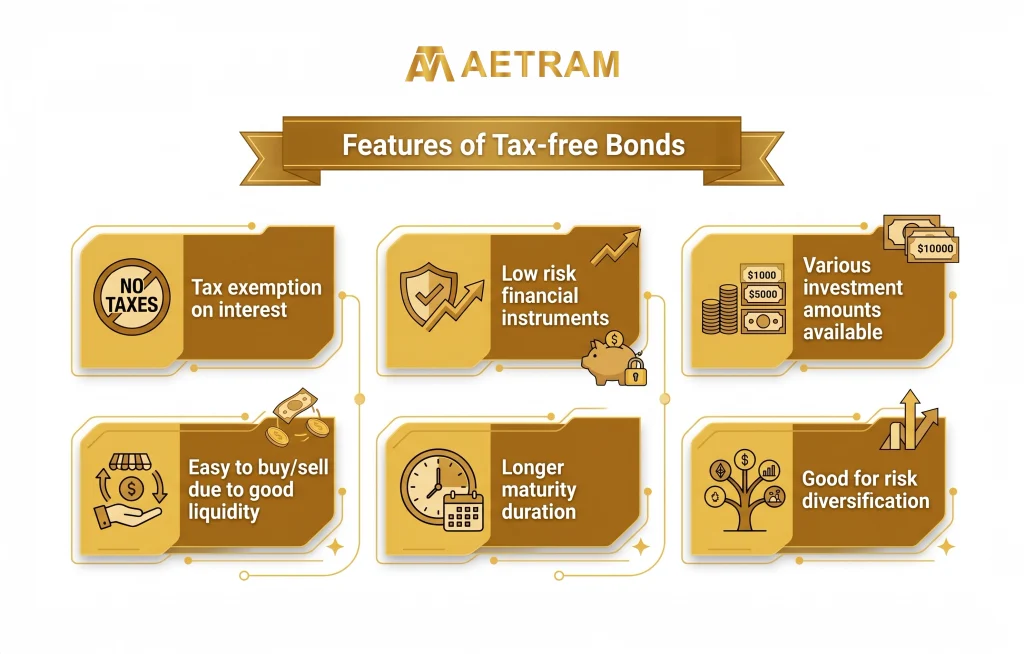
Tax exemption on interest
The interest earned from tax-free bonds are not taxable and this makes them attractive to investors who want to reduce their tax burden. Tax-free bonds are fixed income securities and they pay interest periodically to bondholders, even when the bond prices fluctuate. So, investors do not have to worry about their income getting disrupted.
Low risk
Tax-free bonds are less riskier compared to other financial instruments and are seen as safe investments because these kinds of bonds are issued by government entities and fully backed by the government. This gives a sense of security for investors and they feel confident that their money is protected.
Investment amount
Tax-free bonds have various investment amounts ranging from a few thousands to lakhs depending on the bond issuer. So anybody who has a small amount of capital or even wealthy individuals can invest in these tax-free bonds for a tax-efficent investment choice.
Liquidity
Tax-free bonds are quite liquid because they are traded on stock exchanges and as a result investors can buy or sell them during trading hours. Due to this reason, it is convenient for investors to adjust their investment strategy.
Maturity
Tax-free bonds have an allotment date and also a predefined maturity date which is usually between 10 and 15 years. Investors can either hold it till the maturity date or sell them on the secondary market if they want cash sooner. But selling may happen based on the market price, which may be higher or lower than the buying price.
Diversification
An investor who is looking for diversification can take a cautious approach of diversifying their investment portfolio by investing in tax-free bonds. By putting money into various asset classes, you will be able to lower your overall risk.
How to invest in tax-free bonds in India
You can easily invest in tax-free bonds through any online investment platforms or by just contacting Aetram Trades on 044-48680008 or 044-49477777. We will help you invest in different kinds of bonds. Though it is not necessary to open a demat account, having a demat account will make your life simpler as you can track all your investments from one place.
If you have a demat account and bonds are held in the demat account, it will be easy for you to buy and sell bonds in the secondary market and this will create liquidity.
Conclusion
You can be an individual, Hindu Undivided Family (HUF) or a Non-Resident Indian (NRI) to invest in these tax-free bonds in India after completing your KYC process.
Having said that, investors should understand the risk associated with bonds as bond prices and yields can be affected by macroeconomic factors and market conditions.
So when you are investing in bonds or any financial instrument, investors should evaluate their financial objectives, time horizon, various risks involved, tax implications, etc. before making any investments.