Rs 10 Lakh Health Insurance Sounds Enough… Until a Hospital Bill Destroys You.
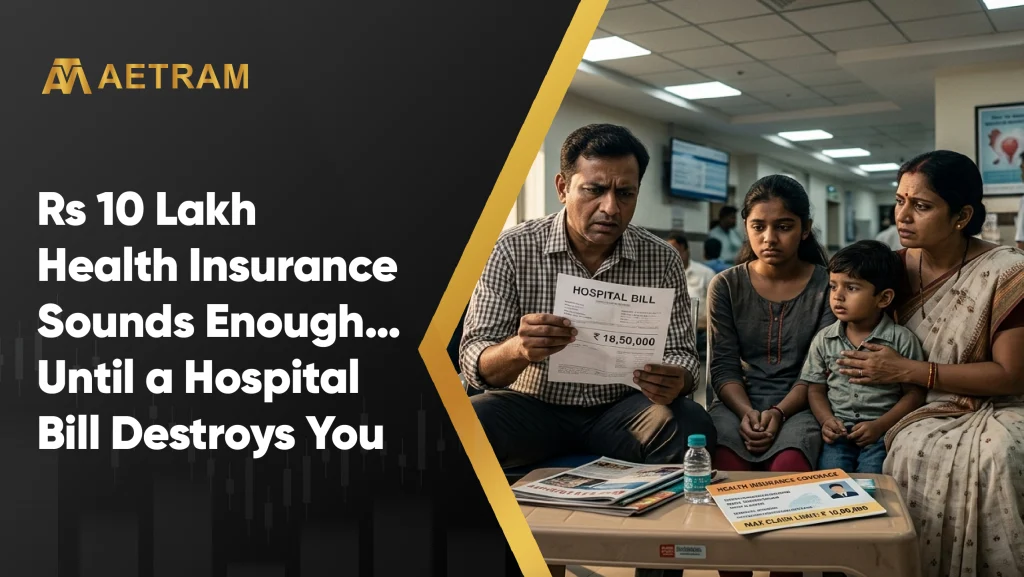
When people buy health insurance for the first time, many people buy health insurance for a cover of Rs 10 lakhs. Not Rs 5 lakhs or Rs 12 lakhs or Rs 15 lakhs. It is always Rs 10 lakhs.
There is something safe about the number ten lakh and it sounds reassuring. It is not too small to feel inadequate and not so large that it feels like you are overplanning.
For years, Rs 10 lakh health insurance was the number financial advisors suggested, agents sold and many Indian families settled on without much debate or calculations.
It sat quietly in a policy folder, doing its job of making people feel financially responsible. That comfort has not disappeared. But it has developed a very uncomfortable crack.
Not because Rs 10 lakh health insurance has become worthless, but because the healthcare world around it has changed faster than most policyholders have noticed.
Hospital bills look different now. Treatment costs have moved in one direction only and that has been upward. And the gap between what people expect their Rs 10 lakh insurance to cover and what it actually delivers has quietly grown into something that can destabilise a family’s finances in a single hospitalisation.
Medical Inflation
Medical inflation in India is rising in double-digits every year. Assuming an inflation of 14%, a medical procedure that costs Rs 5 lakh today will cost approximately Rs 18.5 lakh in ten years. A Rs 10 lakh cover would feel generous in the beginning but in real purchasing power terms, it may not suffice. One estimate puts the effective value of a Rs 5 lakh policy purchased five years ago would be just Rs 2.8 lakh in today’s hospital costs.
Your premium would increase during renewal but your sum insured may not keep pace with inflation just because you have paid a higher premium. The result is continuing your policy may have become costlier while offering less protection underneath it.
And this is not a problem that fixes itself. IRDAI data from FY25 shows that health insurance claims surged by 21% in volume, while payouts grew by only 12.8%. More claims, tighter settlements, rising costs are adding pressure on the policyholders.
Hospital bill that does not end at discharge
Many people assume that getting hospitalized as a single event where you fall ill, you get admitted in a hospital, get treated and discharged. Then the insurance company will pay for the expense and the matter is closed.
In reality, it almost never works like that. Before admission, there are multiple diagnostic tests across multiple labs. There are also specialist consultations and second opinions involved when you get sick. After discharge, there are medicines that need to be taken for weeks or months.
There are also follow-up visits, physiotherapy sessions, repeat scans to monitor recovery and status of your health and in many cases there would be going back to the hospital if complications arise. Many of these events involve a lot of money and they do not fit neatly within what most policyholders expect insurance to cover.
For cardiac cases, cancer treatment cycles, or extended ICU stays, the margin in a Rs 10 lakh policy can disappear before the discharge summary is even printed.
A single week in an ICU at a reputed private hospital in a metro city can cost Rs 1 lakhs to Rs 3 lakhs. Bypass surgery ranges from anywhere between Rs 4 and Rs 8 lakhs. A cancer treatment course can cost you a minimum of Rs 6 to Rs 15 lakh or even more. The insurance plan that sounded so solid at the time of purchase starts to feel very inadequate when you are actually enter the hospital and get admitted in a hospital.
The Family Floater Trap
There are many traps when you buy a health insurance policy and one of the traps is the family floater policy which shares the sum insured across all your family members.
Initially it may look efficient and you are saving on the insurance expense, until one hospitalisation claims a large portion of it. A single cardiac event involving your father or mother can wipe out Rs 6 – 8 lakh of the shared cover, leaving the remaining family members with a very thin buffer for the rest of the policy year.
A person in their twenties living alone may find Rs 10 lakh manageable. But when a spouse, children and parents come into the picture, the same cover begins to look insufficient which may create genuine financial risk. Add to that the deterioration of health and the risk associated with old age. One illness among your family members can lead to consuming most part of your cover and then the rest of the year you will be left with next to nothing.
Is Rs 10 lakh health insurance enough in 2026?
If you are a family of six (wife, 2 kids and parents) and living in a metro or tier -1 city, an insurance cover of Rs 10 lakhs is not irrelevant for everyone. There are specific cases or a set of people for whom it remains a reasonable starting point. If you are under the age of 30 with no significant health history, and living in a tier-2 or tier-3 city where hospitalisation costs are lower, a Rs 10 lakh individual plan may still provide adequate near-term coverage.
But the operative words here are near-term and starting point. Even in these cases, the cover should be reviewed every two years or three years. Medical inflation does not pause while your policy sits unchanged. A cover that is adequate today is not guaranteed to remain adequate when you actually need it.
For metro residents, anyone above 35, families with senior members, individuals managing chronic conditions, or sole earning members, Rs 10 lakh as a standalone cover is no longer a safe bet in 2026.
What can you do if you already have a Rs 10 lakh insurance cover
So the situation is not as bad as you think if you have a Rs 10 lakh insurance cover. You do not have to scrap your existing Rs 10 lakh policy insurance policy or immediately jump to a Rs 1 crore plan to close the gap. There is a more cost-efficient structure and smarter way to do it.
A super top-up plan is the most practical solution. Unlike a regular top-up that applies a deductible per claim, a super top-up applies the deductible only once per policy year. After that threshold is crossed, all subsequent claims within the year are covered. A Rs 10 lakh super top-up plan costs less compared to upgrading your base policy.
The recommended framework for a family in metro in 2026 is a Rs 10 lakh base policy supplemented by a super top-up extending total coverage to Rs 50–75 lakh. Add a critical illness rider that pays a lump sum on diagnosis, not just on hospitalisation, to address any sudden shock during serious illness. This kind of a plan would provide you a broad protection with a slightly higher premium that does not break a household budget.
After the government announced exemption on health insurance premiums effective September 2025, premiums have become meaningfully more affordable. As the market is adjusting to the new scenario, the average insurance cover chosen by new buyers has increased, but the question is whether you have adjusted to the new rules.
Health insurance is not a one-time decision
Perhaps the most expensive mistake Indian families make with health insurance is buying it once and forgetting about it. Insurance is often treated as a compliance exercise and something to tick off before the financial year ends, not something to actively manage every year.
Healthcare costs do not stand still and neither do personal circumstances. A policy that was right when you were 28 years old may be dangerously undersized when you are 38. A cover that worked for an individual is inadequate for a family of four or six. A sum insured that felt generous in 2020 has been quietly eroded by six compounding years of medical inflation.
Your insurance cover of Rs 10 lakhs has not failed you but it has been outpaced by a world that kept moving while your policy stayed the same. The fix is a careful review of your insurance policies every two to three years, an honest look at what your current cover can actually absorb and a willingness to add that super top-up before you need it rather than after.
The gap between what you expect from your insurance policy and what it actually does is only visible at the worst possible moment. And at that point, no amount of regret can rewrite the hospital bill or decrease it.
Disclaimer: This blog is intended for informational and educational purposes only and should not be construed as insurance, financial, or legal advice. The information provided does not constitute a recommendation, solicitation, or offer to purchase any insurance product. Readers are advised to consult a qualified insurance advisor or the respective insurer before making any insurance-related decisions. Aetram Trades Pvt. Ltd. is a SEBI-registered stock broker and is not associated with the sale, distribution, or advisory of insurance products.