RBI Monetary Policy 2026: Key MPC Decisions Every Investor Should Know

You wake up to see the RBI announcing the latest Monetary Policy. What do the headlines “Repo Rate Remains Unchanged” mean to you? Will there be any changes to your home loan EMI? Will you see improved FD returns? Will it impact the stock market? More importantly, how should you, as an investor, react to these changes?
The Monetary Policy Committee (MPC) of the Reserve Bank of India (RBI) is responsible not just for the setting of interest rates but also affects your borrowing costs, savings, investments, inflation and growth of the economy. That is why each policy announcement is important no matter who you are – a newbie investor, a salaried employee, a borrower or a retiree. In this article, we will discuss the RBI Monetary Policy 2026 decisions.
RBI Monetary Policy August 2026: At a Glance
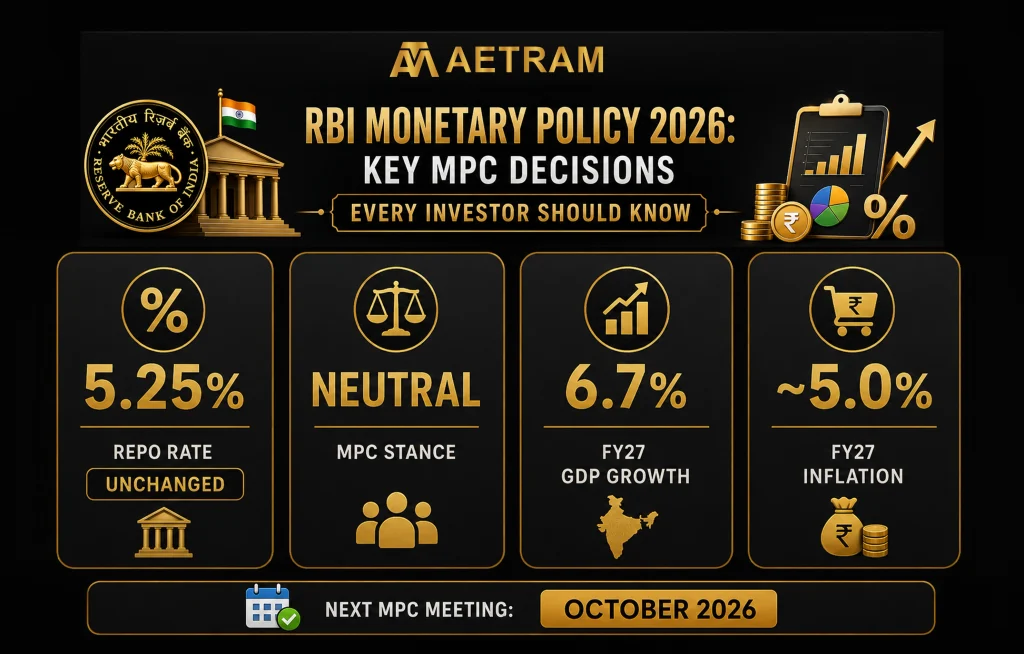
| Decision | Latest Update |
| Repo Rate | 5.25% (Unchanged) |
| MPC Stance | Neutral |
| FY27 GDP Growth Forecast | 6.7% |
| FY27 Inflation Forecast | Around 5.0% |
| Next MPC Meeting | October 2026 |
The MPC in a unanimous manner took the decision to maintain the policy repo rate at 5.25% while maintaining a neutral monetary stance, which shows that future decisions will depend on the development of inflation and economic growth.
What Is RBI Monetary Policy?
The RBI Monetary Policy is the policy adopted by the Central Bank to ensure price stability alongside economic growth. The Monetary Policy Committee (MPC), which comprises six members, evaluates various economic indicators every two months, such as:
- Inflation
- GDP growth
- Employment trends
- Global economic developments
- Liquidity conditions
Depending on these factors, the MPC increases, decreases or keeps the repo rate unchanged. The decisions made have an impact on almost all aspects of the economy including EMIs on loans and investments made.
Why did the RBI maintain the same repo rate?
As expected by many economists, the RBI kept the same repo rate. The Reserve Bank of India said in its press release that despite the fact that the Indian economy is still strong, there are certain global uncertainties. The rise in geopolitical tensions, volatile crude oil prices, trade uncertainties and weather-related inflation risks forced the RBI to be cautious with the decision and go for the “wait and watch” approach.
What does this mean for borrowers of home loan?
For those who have taken a floating rate home loan, it means that the EMIs will not be reduced in the near future since the repo rate has not been changed. For those borrowers who expect reduced EMIs from the home loan, they should be prepared to wait till the RBI starts reducing interest rates. For those who plan to take a home loan, the interest rates for the loan will remain stable in the near future.
What About FDs?
As the repo rate is not changing, we cannot expect any major changes in interest rates on fixed deposits (FDs) from banks in the near future. This is good news for conservative investors whose returns on deposits will remain stable unless there are some fundamental shifts in the market.
How Will the Policy Impact Stock Market?
Stock market does like stability in policies. With the repo rate remaining the same, there will be less uncertainty and businesses can plan their investments. However, stock market doesn’t move just by interest rates. Investors listen carefully to what RBI says about inflation, GDP growth, liquidity and the course of future policies. In its latest policy, the RBI remained confident about the strength of the Indian economy despite global challenges.
Why Investors Should Pay Attention
There is a common opinion that RBI announcements are relevant only to borrowers. In fact, monetary policy influences:
- Mutual fund performance
- Bond yields
- Equity market sentiment
- Fixed-income investments
- Gold prices
- Currency movements
Understanding these announcements helps investors make informed decisions instead of reacting emotionally to market headlines.
Key Highlights from the August 2026 MPC Meeting
| Key Decision | Why It Matters |
| Repo rate held at 5.25% | Borrowing costs remain largely stable |
| Neutral policy stance retained | Future action depends on economic data |
| GDP growth projected at 6.7% | Reflects confidence in India’s economy |
| Inflation expected around 5.0% | Inflation remains a key area of focus |
Should Investors Revise Their Strategy?
One decision by the RBI doesn’t mean that one has to entirely revamp his/her investment strategy. Rather than changing the investment plan in response to every piece of news, investors should always stay focussed on their own financial objectives. For those who are investing via SIPs, it’s not generally something to worry about their investments. In the same way, one shouldn’t make hasty decisions based only on anticipation of the upcoming policy moves.
Should You Change Your Investment Strategy?
| Investment Type | What to Consider After the August 2026 Policy |
| SIPs | Continue focusing on your long-term goals rather than reacting to one policy announcement |
| Equity Investments | Watch earnings, economic growth, inflation and liquidity along with interest rates |
| Fixed Deposits | Compare prevailing FD rates before making new deposits |
| Bonds/Debt Funds | Monitor interest-rate expectations and bond yields |
| Gold | Consider inflation, global uncertainty and currency movements |
| New Investments | Review them against your financial goals and risk tolerance rather than the RBI decision alone |
What Investors Should Avoid After an RBI Policy
Avoid:
- Stopping SIPs solely because the repo rate is unchanged.
- Taking a new loan simply because rates appear stable.
- Breaking an existing FD based only on a policy announcement.
- Making equity decisions based solely on the RBI headline.
- Trying to predict the next rate move with certainty.
Instead, consider the policy as one piece of information within your overall financial plan.
What Needs to Be Watched in Future?
Although there is no revision in repo rate at present, the following things need to be considered in future:
- Inflation trends
- Global crude oil prices
- Monsoon performance
- Geopolitical developments
- Economic growth
- Currency movements
The RBI has been very clear that its future actions would be dependent on data and not adhere to a pre-decided path.
Focus on Your Financial Objectives, Not Every RBI Announcement
Every monetary policy announcement of the RBI garners attention; however, it doesn’t mean that every RBI announcement needs to alter your financial strategy. The August 2026 RBI policy sends out a signal of stability for investors. By leaving the repo rate constant and taking up a neutral position, the RBI has decided to watch inflation and global trends. The main message for the investors is straightforward: keep yourself updated but let nothing interfere with your financial objectives. Whether you are investing via SIPs, looking for a house to purchase or accumulating money for your retirement corpus, consistency happens to be one of the best ways to generate wealth.
Explore Aetram for more practical financial insights, investment strategies and market updates.
Frequently Asked Questions
1. What did the RBI decide in the August 2026 Monetary Policy?
The RBI kept the repo rate unchanged at 5.25% and retained its neutral policy stance.
2. Will my home loan EMI change after this policy?
Since the repo rate was unchanged, floating-rate home loan EMIs are generally not expected to change immediately.
3. Why didn’t the RBI reduce interest rates?
The RBI cited global uncertainties, inflation risks, geopolitical tensions and volatile oil prices as reasons for maintaining policy stability.
4. Should SIP investors worry about the RBI policy?
Long-term SIP investors generally don’t need to alter their investment strategy based solely on one monetary policy announcement.
5. When is the next RBI MPC meeting?
The next scheduled RBI Monetary Policy Committee meeting is expected to take place in October 2026.