Explained: What is a bonus issue with an example?

Bonus issue of shares is one of the corporate actions taken by companies to reward their shareholders. Whenever a company announces bonus shares, the company will offer additional shares at no extra cost for existing shareholders based on certain parameters.
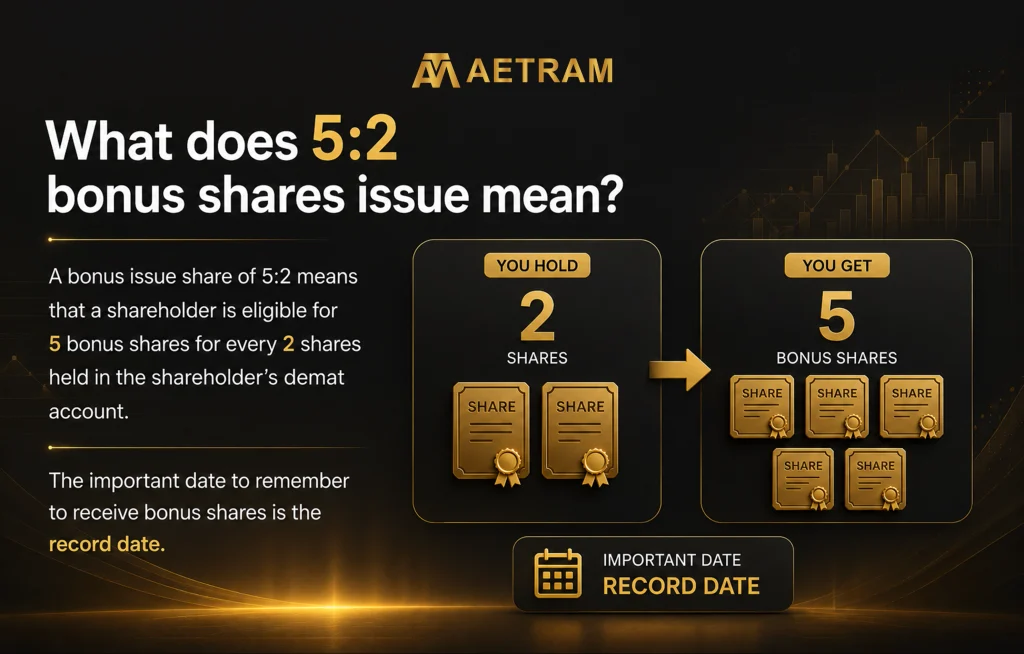
Let us understand this with an example. On 4th September 2025, Laxmi Goldorna House Limited announced bonus issue of shares in the ratio 7:5. This means, any existing shareholder having five shares will receive an extra seven shares. Due to this, the total number of shares will increase for the investor in their demat account, but there will be no increase in the total investment value.
Though shareholders get extra shares, their total investment value will remain unchanged. Only the price of a single share will get adjusted so that the investor’s total investment value remains the same before and after the issue of bonus shares.
This bonus issue of shares is sourced from a company’s retained earnings and it indicates the company is doing well in terms of revenue and profitability. A company decides to give bonus shares instead of dividends as it gives the company an opportunity to reward their shareholders at the same time preserving the cash. This cash can be used in the future for various purposes.
When an investor receives bonus shares and he/she holds on to that company’s shares, then he/she will receive a higher dividend amount in the future, provided the company decides to give dividends.
When a company issues bonus shares, the face value of the share is unchanged.
Why does a company give bonus shares?
There are quite a few benefits of giving bonus shares which we will discuss in this section.
A company issues bonus shares to existing shareholders for free to reward them and share a part of their earnings. These bonus shares are given by sourcing them from its retained earnings and reserves without charging the investors anything for the extra shares. The company does not distribute cash through dividends because it helps the company to preserve positive cash flow.
If a company announces bonus shares, it indicates that the company is financially healthy and it boosts confidence among existing investors and piques the interest of new potential investors.
After the issuance of bonus shares, the share capital base of the company will increase and the price per share will decrease. This makes the company’s stock more affordable and attractive among existing and new investors.
Issuing bonus shares increases the number of shares that investors can trade in the secondary market. This will increase liquidity and enable better price discovery for the company’s share.
After issuing bonus shares and if the company posts strong quarterly results, the share price of the company is likely to increase resulting in higher market capitalization.
Why are bonus shares beneficial to investors compared to dividend?
Whenever bonus shares are credited to an investor’s demat account they do not have to pay any tax on them. They only have to pay taxes when they sell those shares depending on their holding period. If those shares are sold within one year, the investor have to pay short-term capital gain tax (STCG).If those shares are sold after one year, the investor will pay long-term capital gain tax (LTCG).
In comparison, whenever a company pays dividend, it will get credited to the investor’s bank account linked to demat account. This dividend income will get added to the investor’s total income and it will be taxed under the respective income tax slab. The investor will not pay any STCG or LTCG on the dividend income. Further, the investor need not sell any shares to receive the dividend income.
Important dates to remember for investors
The two dates any investor must keep in mind with respect to bonus shares are record date and ex-date. The record date is finalized by the company and this date determines who are the eligible shareholders for bonus shares. The shares against a particular investor must reflect in the company’s record.
The other important date is the ex-date. This is the date before which an investor should make sure he/she buys shares to be eligible for bonus shares. If you buy shares on or after the ex-date, you will not be eligible for any bonus shares because the shares will not be in your name by the record date.
What do you need to do to receive bonus shares?
You need a demat account with a SEBI-registered stock broker like Aetram Trades India. You can open a free demat account and trading account with just a few click by going to our registration page and following the instructions on the page.
Conclusion
Bonus shares are important corporate events keenly watched by investors and it is crucial for them to be aware of the such events. Allotment of bonus shares play a vital role in the journey of the company issuing it and the investor receiving it. As an investor, you must be aware of the important dates and the implications of receiving the bonus shares as it can play a significant role in compounding your wealth in the long run.
Frequently Asked Questions
1. What is a bonus issue of share?
A company decides to issue bonus shares to existing shareholders to reward them instead of rewarding them with a dividend payout.
2. What are the important dates with respect to bonus issue of shares?
Record date and ex-date are the two important dates that investors must track.
3. Is every investor eligible for bonus shares?
No. Only existing shareholders of a company are eligible and they must have the shares in their demat account by the record date which is the cut-off date for an investor to be eligible for bonus shares of a company.
4. How to check whether my bonus shares have been credited?
You must check your demat account for credit of bonus shares. Inside your account you must go to the holdings section for the credit?
5. If a company announces 2:1 bonus shares, what does it mean?
It means for every 1 share held by an existing shareholder, he/she will receive 2 bonus shares for free.