Why has gold price crashed?

Gold price has been on a dream run for the past few months but it has hit a sudden break since the war started between Iran and Israel. Gold has crashed more than 20% since it touched lifetime highs in January 2026.
Gold is usually seen as a safe-have asset during geopolitical tensions, wars, high inflation and uncertain times. This should ideally push gold prices higher but it has entered bear territory recently and it remains significantly lower compared to last week. Let us examine the reasons that led to the price fall.
Key factors affecting gold prices
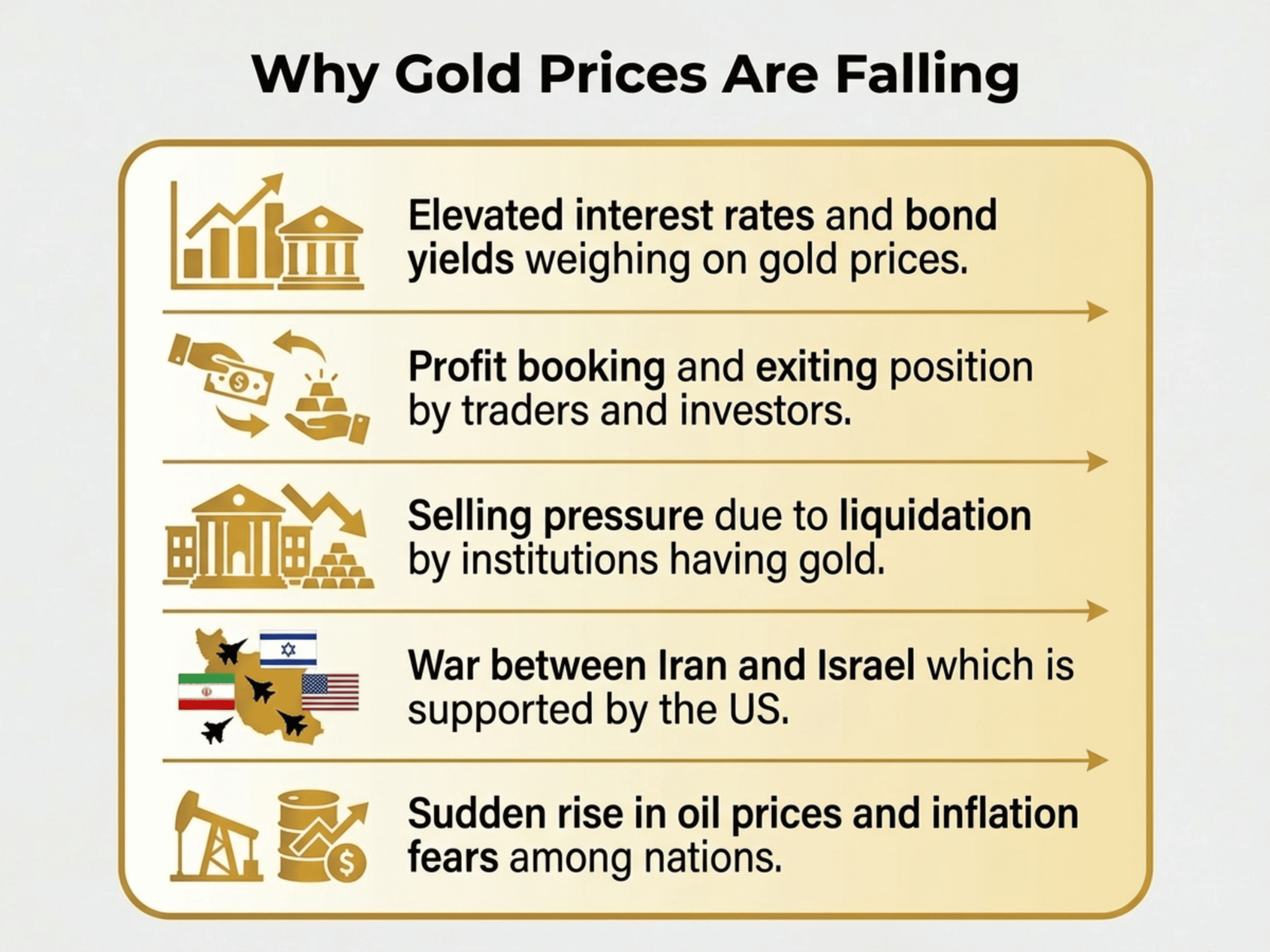
Iran-Israel war and rising oil prices
The recent war between Iran and Israel and its consequent negative impact on the Strait of Hormuz has pushed the oil price past $100 per barrel. As about 20% of the world’s total supply of oil is transported through this strait, it becomes one of the most important routes to supply oil to Asian countries.
India and China which are two big economies which are heavily dependent on their route for their oil needs and they will be affected. This has led to supply shock and inflation worries among consumers and market participants. Usually, when inflation rises, gold tends to gain ground because people see it as a safe-haven asset. But this time, the story is different and the fear of higher inflation due to rising oil prices has led the central banks to keep interest rates high and limit money supply. This will make borrowing more expensive and dampen consumption.
Interest Rates and Bond Yields
Among market participants, the biggest surprise has been the interest rates as the US Fed has not decreased the interest rate in the recent FOMC meeting. It has kept the interest rate steady due to uncertainty and inflationary fears.
Earlier, investors and traders expected the Fed to lower interest rates due to positive global economic outlook but after the war started in March 2026, the consensus is that rates will stay elevated for much longer.
This is very important with respect to gold prices because, unlike stocks or bonds, elevated interest rates take the sheen off gold. Investing in gold doesn’t pay any interest or dividends, so when investors need cash, they sell or liquidate their gold holdings first.
When interest rates go up, investors tend to look for safe and income-generating options like government securities and treasury bills. As bond yields increase, they become attractive among investors and indicate that more money is flowing out of gold and into fixed-income assets.
Selling by investors and traders
Gold price has increased multifold unexpectedly in the last few months reaching an all-time high but this was followed by a sudden crash in the last few days. The recent decline was driven by market behavior and not by fundamental factors. Investors sold their holdings in panic and began booking profits, leading to initial selling pressure.
Further, traders started unwinding their positions because they entered those positions using borrowed money and when prices fell rapidly they had to offload the positions to cut their losses. This intensified the downward movement. Thus, the fall was a result of both profit-taking and forced exits due to declining prices.
Can gold fall below $4000 per ounce?
Gold price came close to hitting $4000 per ounce on March 23, 2026, but has rebounded since then, as market participants started buying the dip. Just like gold price was pushed higher driven by greed, the recent fall can be attributed to fear and subsequent selling.
On the technical charts, gold price has seen a decline for the past three weeks and as on March 24, 2026 at 14:42 IST, it has formed a hammer candlestick which indicates a trend reversal. However, this will be offset by geopolitical tension and higher bond yields.
There is also likely to be downside pressure on gold price in the short term due to margin-driven selling and cash constraints. As long as the war prolongs and there is an energy crisis across the world, gold price may remain under pressure.
What can investors do
Investors should always plan for the long term and avoid the temptation to react to short-term market volatility. They must realize that gold prices move differently during different economic cycles, macroeconomic conditions and geopolitical situations. They should view it as a long-term hedge rather than a short-term trading opportunity.
They should focus and keenly track oil prices, the Fed interest decisions, bond yields, inflation, the US dollar, any truce between Iran and Israel. They should also pay close attention to buying by central banks across the globe.
Investors must avoid high leveraged positions as they can lead to significant losses due to sharp market movements. Investors should regularly review their portfolio allocations to make sure they are in sync with their long-term strategy.
Conclusion
Though gold prices have crashed by 20% and entered bear territory, there is no replacement for it as a safe-haven asset. Even central banks have been accumulating physical gold for the past few years which has been one of the reasons for this stupendous rally. Any peace talks or an end to war between Iran, Israel and the US can again steady the gold price and push them high later. Having said that, like any asset, the price may fluctuate in the coming months. So it is always a good practice to diversify your investments across multiple assets and focus on asset allocation.