Why Do IPO Applications Get Rejected? Common Reasons Explained

An IPO application is one of the ways through which investors can join in the process of listing the firm. But just because an IPO application has been made doesn’t necessarily mean that it will be approved. There are times where the IPO application gets rejected because of wrong details, payments or even because of mistakes in the application itself. The rejection of an IPO application is something frustrating especially when an investor is expecting an allotment. Here are some of the reasons as to why an IPO application can get rejected.
Let us explore some of the major ones here.
1. Multiple Applications using Same PAN
Another reason for IPO application rejection is multiple applications through the same Permanent Account Number (PAN) in the same category of investors. According to IPO applications norms, a single individual investor usually applies for only one IPO application through PAN.
How to avoid it: Apply through only one PAN. If family members want to apply through separate applications, then each individual should use his/her own PAN, demat account and eligible bank account.
2. Incorrect PAN or Demat Account Information
IPO application needs correct information regarding the personal information as well as demat account of the investor. The slightest error in PAN, demat account number or other details results into IPO application rejection. For instance, submission of wrong PAN or incorrect demat account (which doesn’t belong to applicant), leads to problems in verification.
How to avoid it: Ensure the accuracy of PAN and demat account details while applying. Make sure that the name and other details are matching with your records maintained by broker or depository participant.
3. Via Bank Account of Third Party or UPI ID
There is generally an IPO application through bank account or UPI ID of the applicant. If someone makes use of bank account or UPI ID of any other person, then his IPO application can be disqualified. For instance, if one makes an IPO application through his PAN number but uses his friend’s UPI ID for approval of payment mandate, then his IPO application will not satisfy the requisite verification criteria.
How to avoid it: The applicant should make use of his/her own eligible bank account and UPI ID.
4. Failing to Accept the UPI Mandate
While submitting an IPO application through the UPI payment method, you will get a mandate request from the UPI system to block the amount of your application in your bank account. But merely submitting your application will not be sufficient. You have to accept the mandate in time. If the mandate is not accepted, fails or expires, then your application may not be taken into consideration.
How to avoid it: Verify your UPI mandate/notification after submission of the IPO application.
5. Lack of Sufficient Amount in the Bank Account
In case there is insufficient money in the associated bank account, the IPO application can get rejected. For instance, if one applies for an IPO of ₹15,000 but his/her bank account does not have sufficient balance, then the UPI mandate will get failed. In the absence of successful mandate or fund blocking, the IPO application will not get processed.
How to avoid it: Make sure you have sufficient amount in your bank account before submitting your IPO application.
6. Choosing an Incorrect Category of Investor
An IPO usually has different categories of investors, like:
- Retail Individual Investors (RII): Investors investing in the IPO below the maximum retail investment limit.
- Non-Institutional Investors (NII): Investors who have applied to invest above the maximum retail investment limit.
- Qualified Institutional Buyers (QIB): Institutional Investors including mutual fund, bank and insurance companies.
Choosing an incorrect category or making an application for the wrong category will result in the rejection of your application.
How to avoid it: Be familiar with the requirements of different investor categories before applying.
7. Invalid Bid Price/Quantity
In IPO applications, investors have to enter the quantity of lots or shares that they want to apply for along with a valid bid price. An investor entering an invalid bid price or an incorrect quantity of the shares can give rise to problems in the application. For instance, if an IPO is quoted at the price band of ₹100–₹110, then the investor has to bid accordingly.
How to avoid it: Know the IPO price band, lot size and bidding criteria before filling in the application form.
8. Lack or Mismatch in Application Information
The lack or mismatch in information in the application form can lead to the rejection of the application as well. This includes errors in personal information, errors in bank information or errors in PAN and demat account information of the applicant. Even if the payment instruction has been approved, the application can be rejected due to non-compliance with the IPO requirements.
How to avoid it: Verify the whole application form before submission.
What Will Happen if Your IPO Application is Rejected?
If your IPO application gets rejected, then you will not get any allotment. But the money that was blocked in your bank account through ASBA or UPI will be released once the process of rejection is done. The money that was blocked cannot be termed as IPO investment because of the failure of your application. The time taken for the release process depends on the bank and also on the application platform that you used. You can also check the status of your application or allotment through the website of the registrar and stock exchange website.
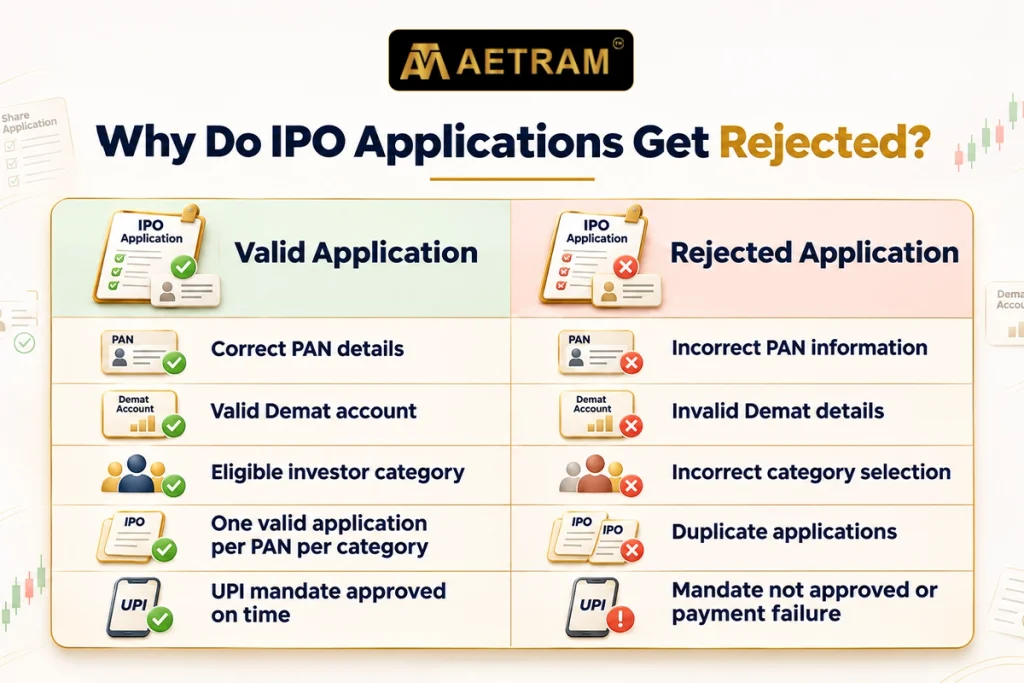
Checklist for Avoiding IPO Application Rejection
Before you apply for an IPO, ensure that the following things are in place:
- Correct PAN and demat account should be used.
- Only one IPO application should be made in each category using the same PAN.
- Only your eligible bank account and UPI ID must be used.
- Enough money should be there in your bank account.
- UPI mandate approval should be done on time.
- Correct investor category should be selected.
- Right bid price and quantity should be entered.
Exercise Care to Avoid Rejection of IPO Application
There are various reasons why an IPO application may be rejected. These include inaccurate personal information provided in the form, repeated application, failure in making payments and wrong choice of investor category. All of the above problems can be avoided through careful verification of the application details prior to its submission. One should also bear in mind that even if the application is successful, it does not ensure allotment of shares because the allotment of shares is based on the prevailing allocation procedure and subscription.
Know all about IPO updates and other investment related information with Aetram.
Frequently Asked Questions (FAQs)
1. What is the most common reason for IPO application rejection?
Multiple applications using the same PAN, incorrect application details, payment failures and unapproved UPI mandates are some common reasons for IPO application rejection.
2. Can an IPO application be rejected if the UPI mandate is not approved?
Yes. If the UPI mandate is not approved within the specified time, the application may not be considered valid.
3. Can I apply for an IPO using a family member’s bank account?
Generally, the bank account used for the IPO application must belong to the applicant. Using another person’s bank account or UPI ID can lead to rejection.
4. Will I get my money back if my IPO application is rejected?
Yes. The amount blocked through ASBA or UPI is generally released if the application is rejected or unsuccessful. The release may take some time depending on the bank.
5. Can I apply for the same IPO using two demat accounts?
An individual should not submit multiple applications for the same IPO using the same PAN. Multiple applications under one PAN may be rejected, even if different demat accounts are used.