What is SEBI’s intraday borrowing framework for mutual funds?
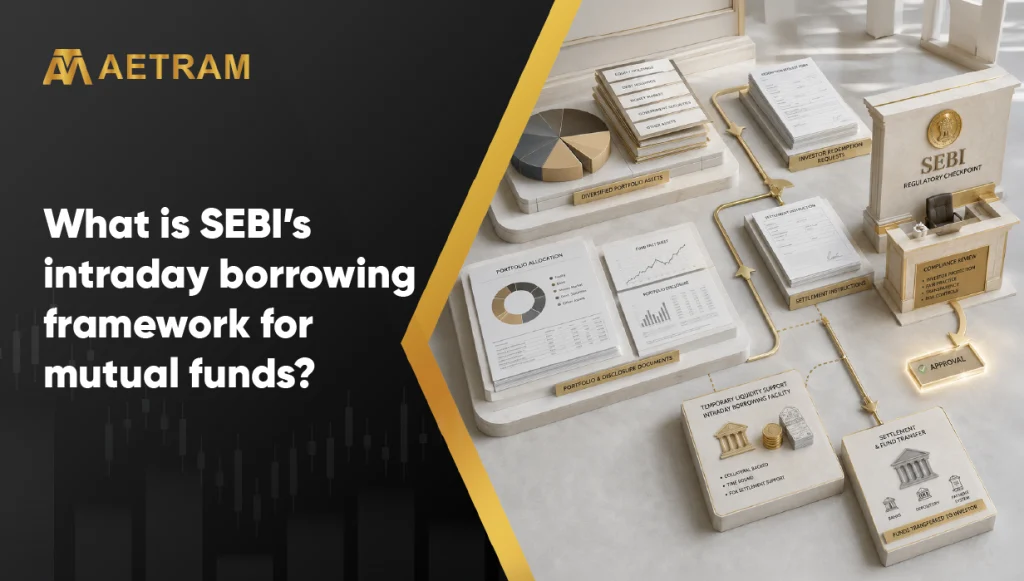
Mutual fund schemes regularly receive and pay money at different times during the day. For instance, if an investor is redeeming some units in a scheme, then the mutual fund has to pay redemption proceeds. It may also need to settle an investment purchase which has been made in the morning or evening. But they may not have enough funds in their account to make the payment because the proceeds from a security sale may arrive delayed.
To overcome this situation, the Securities and Exchange Board of India (SEBI) on July 10, 2026, issued a circular formalising an intraday borrowing framework for mutual funds. The framework became effective from September 1, 2026. This allows mutual fund houses to temporarily borrow money to manage this mismatch. The borrowing must generally be repaid on the same day and cannot be used to take investment leverage or speculate in the market. In this blog, we will take a look at this framework in detail.
Understanding the problem faced by mutual funds earlier
To understand why the market regulator felt it was necessary to step in, we have to first understand the operational constraints of mutual fund houses with respect to buying some units in various schemes or redeeming some units in various schemes. This includes equity schemes, debt schemes, hybrid schemes, liquid funds, overnight funds, etc.
When you want to withdraw money from your liquid fund, the fund house pays you back on a T+1 basis, which means the money gets credited to your account on the next working day. This is one of the big attractions of liquid funds, which promise easy liquidity.
But while the fund is paying out early on T+1, the money that the scheme is expecting to receive from Treasury Bills, Commercial Papers, Certificates of Deposit, TREPS (Tri-Party Repo) or reverse repo transactions, reaches in much later in the day.
As such, the fund house does not have enough cash for some time on the T+1 day and needs to pay out unitholders. Earlier, fund houses used to cover this intraday borrowing gap by way of informal arrangements, and there was not a uniform policy or SEBI-sanctioned guidelines, which specified the borrowing norms, limits or responsibilities in case of defaults. SEBI’s recent circular plugs this gap.
What is intraday borrowing in mutual funds?
Intraday borrowing is a short-term liquidity management tool that mutual fund schemes use on the span of a single day.
A scheme facing redemption payouts before anticipated inflows in the same day would otherwise have to sell securities at undesired prices or withhold payments due.
Instead, the mutual fund borrows funds temporarily from an authorized lender (usually a commercial bank) and liquidates the borrowed money as soon as the anticipated inflows arrive before the end of the day.
For example, an equity fund may want to buy assets worth Rs 100 crore in the morning but it also anticipates a redemption payout of Rs 100 crore later in the day from another sale transaction. During this situation, the fund would use intraday borrowing to manage the former settlement. And when it receives the proceeds, the fund paybacks the entire intraday credit.
In this way, such intraday borrowing is used to manage only operational mismatches of fund flows and not as an instrument to take leveraged positions in stocks. It helps distinguish between actual cash needs and a financing technique that would enable fund houses to take bigger leveraged exposure to the bourses.

What can mutual funds actually use intraday borrowing for?
SEBI has laid down specific rules, narrow limits on what mutual funds can use intraday borrowing for, stating clearly that it is a tool to address settlement-time liquidity mismatches, and not a lever to increase exposure:
Payments to unitholders (redemptions, IDCW payouts, interest payouts)
Investment pay-ins (funds for securities that the scheme has already committed to purchase)
MTM and forex obligations (particularly to hedge derivative positions or forex exposure)
Repayment of existing debts (enabling turnover of liabilities)
SEBI has made it clear that this facility is purely to bridge liquidity mismatches due to settlement cycles, and not to enable leveraged exposure.
How much can a mutual fund house borrow?
A particularly interesting feature of the new framework is how the regulator has set the borrowing limits based on receivables that the scheme expects to receive during the day:
Guaranteed receivables include subscription inflows that have already been booked in the scheme’s account and are due to be transferred to the scheme, as well as expected payments from RBI and clearing corporations. Borrowings against these are considered low-risk and should be prioritised where possible.
Non-guaranteed receivables include expected returns of maturity proceeds and settlements against NCDs, Commercial Papers, Certificates of Deposit, and OTC swaps, which are slightly more volatile (can sometimes default or have settlement delays).
For unitholder payouts, the SEBI has allowed AMCs to borrow beyond calculated receivables for meeting unitholder redemptions, to smooth out payout timelines.
Additionally, SEBI’s existing limit on borrowing (20% of scheme’s net assets) under Regulation 42 of the SEBI (Mutual Funds) Regulations does not apply to intraday borrowing which is why borrowing against receivables is governed under its own rules.
Repayment rule
Perhaps the most important restriction on intraday borrowing as a tool for market exposure is that it must be repaid by the end of the trading day. This acts as the key risk-control measure ensuring that it remains a tool to bridge settlement-time mismatches.
However, if, due to any reason, a scheme is unable to repay an intraday borrowing within the same day and has to roll it over as an overnight borrowing, such borrowings will be subject to the limits on borrowings by a scheme as laid down in regulation 42, and can only be used for the purposes laid down in regulation 42.
Governance and disclosure requirements for AMCs
SEBI has also laid down a number of governance and disclosure requirements for AMCs, including:
The boards of AMCs and trustees must approve a formal policy governing the use of intraday borrowing.
The policy must lay down monitoring procedures and be uploaded to the AMC’s website for disclosure.
AMCs must maintain scheme-wise records explaining the liquidity mismatch that caused each borrowing instance, as well as the expected source of repayment.
AMCs must comply with the requirements of clauses 6 and 7 of the Fourth Schedule to the SEBI (Mutual Funds) Regulations, 2026 which prohibit conflicts of interest and require unitholder interests to be paramount.
Cost and investor protection
Perhaps one of the most interesting points from the new framework is that it lays down that the cost of intraday borrowings must be borne by the AMC, not the scheme or its unitholders.
SEBI went a step further, stating that any loss or additional cost incurred by a scheme due to an unforeseen delay in receiving funds would also be borne by the AMC. So, if a scheme borrows intraday on the expectation that a certain set of settlements will occur on a given day, and it fails to, the cost of this borrowing will not be passed on to unitholders by the scheme in the form of a lower NAV.
What this means for mutual fund investors in India
For the average retail mutual fund investors who park money in liquid funds, overnight funds or ultra-short duration debt, this framework should be quite a relief. A few things that the new intraday borrowing rules mean for investors are:
- Faster & more reliable redemptions: Fund houses now have an established, well-regulated system for ensuring that they can meet their redemption requests even if their inflows are delayed.
- No cost passed on to you: Since AMCs will bear the borrowing cost and any losses incurred, your NAV and returns should not be impacted by this new framework.
- Greater transparency: With mandatory disclosure of policies and scheme-wise documentation, there is now a formal governance layer around this practice.
- Not a leverage loophole: The strict same-day repayment rule and restrictions on usage prevent misuse to boost scheme returns.
Conclusion
SEBI’s intraday borrowing framework gives mutual funds a regulated way to manage temporary mismatches between cash inflows and outflows. It permits borrowing for investor payouts, investment pay-ins, MTM obligations, forex settlements and other payment obligations, while requiring AMCs to monitor the facility and repay it by the end of the day.
The framework is particularly relevant in India’s market environment, where different instruments and settlement systems may generate cash inflows and outflows at different times. For investors, the most important safeguards are that the facility cannot be used as unrestricted investment leverage, the AMC must bear the borrowing cost and overnight borrowings must comply with normal regulatory limits.
Frequently Asked Questions
- What is intraday borrowing in mutual funds?
It’s a short-term borrowing facility that allows mutual fund schemes to bridge temporary same-day cash gaps caused by differences in settlement timing for instance, when redemption payouts go out before maturity proceeds from the scheme’s own investments are received. - When does SEBI’s new intraday borrowing framework take effect?
The final circular was issued on July 10, 2026, and the framework becomes effective from September 1, 2026, replacing the earlier March 2026 circular and previous master circular guidelines. - Does intraday borrowing affect the returns on my mutual fund investment?
No. SEBI has mandated that the cost of intraday borrowing, along with any losses from delayed receivables, must be borne by the AMC and not passed on to the scheme or its investors. - Is intraday borrowing the same as a loan taken by an investor?
No. It is a short-term institutional facility used by a mutual fund scheme to manage settlement-related cash flows.
Disclaimer: This blog is intended for informational and educational purposes only and should not be construed as financial, investment, or legal advice. Investments in mutual funds are subject to market risks. Please consult a qualified financial advisor before making any investment decisions. Aetram Trades Pvt. Ltd. is a SEBI-registered stock broker and an AMFI-registered Mutual Fund Distributor (ARN-281894).