Rising crude and snarled supply chains are squeezing India. Can India survive?
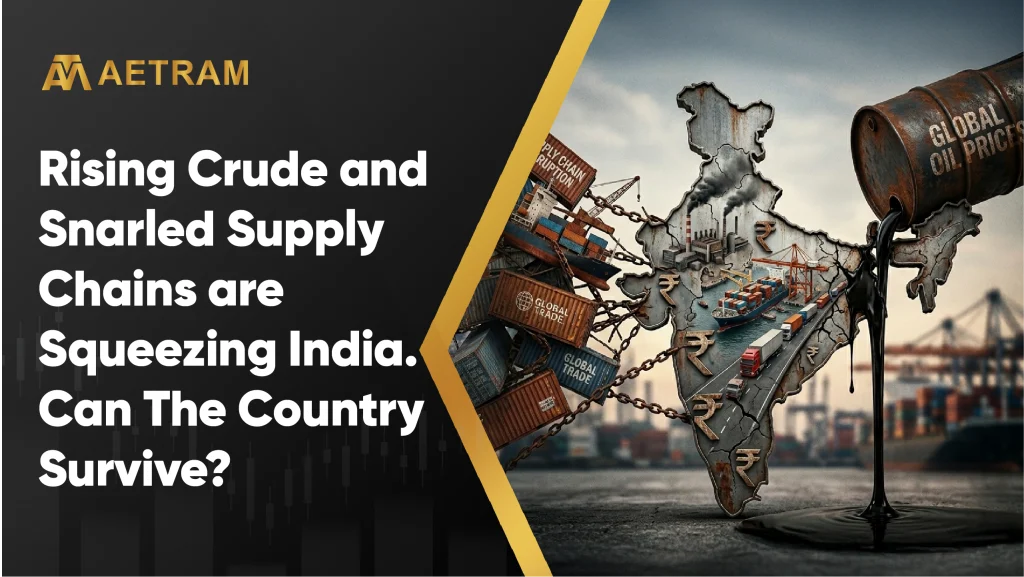
India has seen an increase in the amount of crude oil imports as its economy started to grow rapidly in the 21st century. So whenever the crude prices rise to $100 per barrel or crosses it, the Indian economy gets affected.
Though the Indian government has taken every effort to make sure the rise of crude oil prices does not increase domestic inflation, the ill effects of higher prices of the commodity does not completely vanish with respect to the Indian economy.
The crude prices crossed more than $130 per barrel when Russia attacked Ukraine and then the prices cooled down. However, it again breached $100 per barrel when Israel attacked Iran in March 2026 and then Iran retaliated by attacking the US bases in the Gulf and blocked the Strait of Hormuz. Though the prices in the international market are hovering around $80-90 per barrel in July 2026, it is still high for emerging markets like India which imports more than 80% of crude oil for its energy needs.
Shipping costs and other transportation costs have increased due to this kind of geopolitical tension. So the common man and the people in the boardroom are asking themselves if India can absorb this pressure without a real economic setback? Let us discuss the repercussions of crude oil price rise in this blog.
How Bad Is the Crude Oil Shock?
The Indian crude basket was $114.48 (average price) per barrel in April 2026 and it has fallen to $81.52 in July 2026. Even then it is high compared to the prices in 2025, given that India imports millions of metric tonnes in a year to meet its rising domestic demand.
The country also does not have any meaningful domestic production cushion to fall back on. So every dollar increase in global crude prices translates into additional pressure in India’s import bill. So the policymakers are cautious whenever crude oil prices increase and they closely watch the following metrics: the country’s current account deficit, the Indian rupee against the USD and the retail inflation.
According to rough calculations by some analysts, it is considered that a $10 per barrel rise in crude prices is expected to add somewhere between $13 and $18 billion to India’s annual import bill. At current elevated levels, that’s tens of billions of dollars in additional outflow compared to a year ago. Since the money to buy crude oil is paid in dollars, the government has to sell rupees to buy the USD first and then use the USD to buy the crude in million metric tonnes, resulting in downward pressure on the currency.
Why This Time Comes With a Supply Chain Twist
Previous oil shocks were mostly a pricing problem. This one comes bundled with a logistics problem too, and that combination is what makes 2026 feel different. Tensions in West Asia (Middle East) haven’t just pushed up the price of crude at the wellhead, but they have made moving it more expensive.
Shipping routes through the Gulf have seen war-risk insurance premiums spike sharply, in some reports by several hundred percent, as tanker operators price in the risk of operating near active conflict zones. This increase in transportation costs will get passed on to the buyers which are the refining companies in India and finally to the end users like you and me.
In addition, there is a lot of pressure on global freight operators due to uncertainty over container availability and longer transit times due to rerouting of shipping lanes just to avoid high-risk corridors. Indian importers and exporters are forced to shell out more money because of costlier raw material prices as well as slower logistics to move them. For industries that operate with slim profit margins and depend on timely inventory, such as energy companies, heavy industries, automotive parts, chemicals, fertilizers, pharma, etc. this situation is particularly detrimental.
Where the Pain Shows Up First
Inflation: Fuel costs feed into transportation, which feeds into the price of nearly everything else food, manufactured goods, services. Even when the government cushions retail petrol and diesel prices through tax adjustments, the underlying cost pressure doesn’t disappear; it just gets absorbed elsewhere, in the fiscal deficit or in corporate margins.
Current Account Deficit: A current account deficit happens when country has m ore imports than exports. So an increase in crude oil prices will increase the bill for India. Along with it the rising freight costs will push the current account deficit even higher. If the crude prices are hovering around $90-100 per barrel, India’s CAD could widen significantly.
Depreciating Indian Rupee: A wider current account deficit typically means more dollar demand relative to supply, and that shows up as rupee depreciation. A weaker rupee, in turn, makes the next barrel of imported crude even more expensive in rupee terms, a feedback loop that policymakers try hard to break through reserves management and, where needed, intervention.
Growth: This is the part that gets watched most closely by markets. Estimates on the growth hit vary depending on how long prices stay elevated and how much of the increase gets passed on to consumers, but the range being discussed by economists is roughly 20 to 40 basis points of GDP growth shaved off in a sustained $100-120 per barrel scenario. That’s not catastrophic on its own, but it comes at a time when India is trying to hold growth above 6.5% while much of the developed world slows.
Why India Is Better Placed to Absorb This Than It Was in 2013
It’s worth remembering the last time India faced a comparable oil and currency squeeze was during the 2013 “Taper Tantrum” period, when a wide current account deficit and capital flight sent the rupee into a sharp slide. The comparisons to that period are natural, but the structural picture today is meaningfully different in India’s favor.
First, India’s economy has become significantly less oil-intensive over the past decade. It now takes less crude to generate each unit of economic output than it did ten years ago, thanks to efficiency gains, a bigger services share of GDP, and the early but growing shift toward electric vehicles and alternative fuels. That doesn’t eliminate the impact of higher prices, but it dampens the pass-through.
Second, and perhaps more importantly, India’s foreign exchange earnings look nothing like they did in 2013. Software exports, business process outsourcing, and the rapid growth of global capability centers set up by multinationals in Indian cities have created a large, relatively stable stream of service export dollars. Add in steady remittance inflows from the Indian diaspora, and you get a foreign exchange cushion that isn’t as dependent on volatile foreign portfolio investment as it once was. That’s a structural buffer that simply didn’t exist at the same scale a decade ago.
Third, India’s forex reserves, while fluctuating with intervention activity, remain substantial by historical standards, giving the Reserve Bank of India room to smooth out sharp rupee moves rather than being forced into abrupt policy reactions.
What Policymakers Are Doing About It
On the demand side, India continues to push electric vehicle adoption, domestic oil and gas exploration, energy efficiency mandates, and coal gasification initiatives. These are all aimed at structurally reducing the economy’s oil dependence over time, even if none of these move the needle immediately.
Then, on the fiscal side, the government has traditionally adjusted excise duties to lessen the impact of rising crude oil prices on retail fuel costs, accepting some loss in revenue. Meanwhile, the Reserve Bank of India can control fluctuations in the rupee by using reserves, as long as inflation expectations remain stable and do not require drastic changes in interest rates.
Differences in Outlook
Not everyone agrees on how long this squeeze lasts. Some analysts expect the geopolitical risk premium embedded in oil prices to persist for years, arguing that the underlying supply and demand tightness in physical crude markets isn’t going away soon. Meanwhile, some in India’s petroleum ministry expect crude prices to ease, as production increases, global supply catches up and inventories are improved. This will help the prices to move back toward more moderate levels within the year. The International Energy Agency’s own outlook leans toward a downward trend as global stockpiles build through 2026.
The wide range of views matters because it shapes how seriously businesses and investors should treat this. It may either be a temporary situation or a multi-year structural cost increase, but the honest answer is that nobody knows with certainty. Geopolitical developments in the Middle East, OPEC decisions and how quickly the oil producing nations in the Gulf are going to bounce back will likely decide the outcome more than any purely economic factor.
Conclusion
India is heavily dependent on imports for crude oil but the value of import to the country’s GDP is relatively low. The country’s forex reserves are more diversified and stable. The policy decisions taken by the government from reserve management to fuel tax flexibility has made the country more resilient to such shocks.
But resilience is not the same as immunity. Growth will likely take a modest hit if crude stays elevated through the year. Retail Inflation will increase and it will dent consumption. The Indian rupee will depreciate further and the current account deficit will widen. For a country still trying to compound growth at over 6.5% while creating jobs for a young workforce, that’s a real problem economically and politically.
India may survive this squeeze but whether it can come out of the shock with a genuinely lower long-term oil dependence will depend on how seriously the structural shifts are already underway. The country should double down on creating an ecosystem to produce more renewable energy , EV adoption, domestic exploration and energy efficiency.
Frequently Asked Questions (FAQs)
Why does rising crude oil affect India’s economy so much?
India imports nearly 90% of the crude oil it consumes, so global price increases translate almost directly into a higher import bill, pressuring the rupee, inflation, and the current account deficit.
Will rising oil prices trigger a crisis like it happened earlier?
Unlikely. India’s strong and growing economy driven by stable service export earnings, growing manufacturing sector and remittances provide a stronger currency buffer.
How much could high crude prices slow India’s GDP growth?
Estimates vary, but sustained crude prices in the $100-120 range could shave roughly 20-40 basis points off India’s GDP growth, depending on how long prices stay elevated.
What is India doing to reduce its oil dependence long-term?
India is promoting the renewable energy sector, electric vehicle adoption, boosting domestic oil and gas exploration, expanding coal gasification, and pushing energy efficiency measures to structurally lower its reliance on imported crude.
Disclaimer: The information provided in this article is for educational and informational purposes only and should not be construed as investment, financial, or trading advice. Any financial figures, calculations, projections, examples, or scenarios are hypothetical, intended solely for illustrative purposes, and do not represent actual or future performance. The content is based on information obtained from credible and publicly available sources. While reasonable care has been taken in its preparation, no representation or warranty is made regarding its completeness, accuracy, or reliability. References to indices, securities, or other financial products are for illustrative purposes only. Actual investment outcomes may vary. Investors are advised to carefully read the relevant scheme, circular, or product offering documents and consult a certified and SEBI-registered financial advisor before making any investment decisions. Neither the author nor the publisher shall be liable for any loss, damage, or liability arising from the use of, or reliance on, the information contained in this article.