Microeconomics vs Macroeconomics: Explained

Understanding the forces that govern money, resources, and growth is called economics. Since economics is such a vast subject, economists have divided economics into microeconomics and macroeconomics. They represent the two fundamental divisions in economic theory, and understanding the difference between these two branches is crucial for anyone investing in the Indian market.
Without understanding economics, you will not be able to comprehend how an economy works at different levels and how it plays an important role for a country. If you are an Indian investor, it becomes imperative to understand the terms and definitions related to economics and have a broad understanding of the economy and in this blog, we will break down these concepts.
Understanding Microeconomics
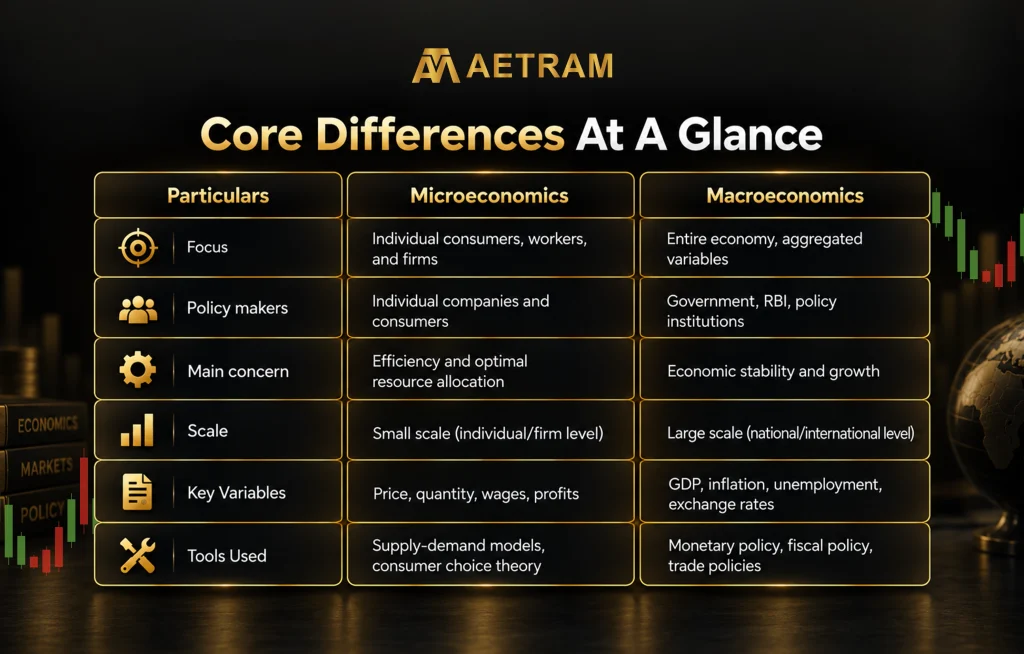
Microeconomics is the study of economic behavior at the individual level. It focuses on consumers, workers and specific businesses, and examines how individuals and firms make decisions related to production and consumption. It is also about evaluating pricing within the constraints of limited resources. Further, microeconomics is also about the study of how limited resources can be allocated and used to produce goods and services to maximize utility or profit.
The core of microeconomics revolves around the law of demand and supply. To understand better about this, let us consider the Indian gold market. Gold is not just a financial asset in India or used for investments. Indians are emotionally attached to the yellow metal and they buy gold for personal consumption.
A microeconomic analysis will examine how an individual household’s demand for gold increases during the wedding seasons or Akshaya Tritiya or during Dhanteras. If the price of gold increases significantly, some households might shift their preference toward silver. This shift in individual consumer behavior is a phenomenon in microeconomics.
Another critical aspect of microeconomics is the study of market structures. India possesses a unique mix of competitive markets, monopolies, and oligopolies.
For instance, the Indian Information Technology sector is a good example of competition in an industry, where thousands of companies exist and thrive.
On the other hand, the telecom sector in India has evolved into a duopoly, where only two large players dominate the market and consumers have a very little choice. Microeconomics helps us understand how these firms set prices, compete for subscribers, and react to the entry of a new competitor.
For a business owner in India, microeconomics will provide the necessary tools for evaluating different types of costs and pricing strategies. For instance, a small-scale manufacturer of an organic textile company in Coimbatore may calculate their marginal cost by determining the optimal price point which can increase profitability without affecting the behaviour of target customers. By analyzing the price elasticity of demand, the business can determine if a 10% price increase will lead to a slight dip in sales or a complete collapse in demand. It also helps the owner of the company to determine if any new investments in machinery or hiring more workers may result in any rise in profits or costs.
An Overview of Macroeconomics
Macroeconomics is the exact opposite of microeconomics and it takes a bigger view of the entire country or the world. It examines the economy as a whole by focusing on aggregate variables that affect the entire population. Macroeconomics is concerned with the overall performance of the national economic growth, inflation, interest rates, national income, current account, employment, etc.
The most important metric in macroeconomics is the Gross Domestic Product (GDP) which calculates the economic growth of a nation. When the government announces that India’s GDP grew by a certain percentage it means that the total value of all goods and services produced within the country’s borders have increased compared to the previous period. GDP is announced every quarter and for every financial year.
Macroeconomists analyze GDP to determine whether the economy is expanding or contracting. For India, which has been a developing economy, the focus is often on the composition of this economic growth, i.e., whether the economy is driven by the services sector, manufacturing (through initiatives like Make in India and Production Linked Incentive scheme, etc.), or agriculture.
Inflation is another crucial metric of macroeconomics which determines price rise of various goods and services. Since India imports a lot of crude and energy related products, any rise in them will impact the food prices and the entire economy.
So, India’s central bank, the Reserve Bank of India, will monitor the Wholesale Price Index (WPI) and the Consumer Price Index (CPI) to manage inflation.
When inflation rises too quickly, the purchasing power of the rupee falls. This means a consumer can buy fewer goods with the same amount of money.
So, the RBI uses monetary policy tools like the repo rate to control this rise of prices. Increasing the repo rate makes borrowing cost more expensive for consumers and businesses. This will decrease spending by consumers and businesses, and bring down the inflation under control.
Fiscal policy is also a major part of macroeconomics that is managed by the Government of India through the Union Budget. By making policies to increase the government’s revenue, adjusting government spending and changing taxation rules to increase the base as well as the numbers, the government can influence economic activity.
For example, increasing the spending for laying rural roads or improving them, spending on irrigation projects, etc. will create employment. This will boost the long-term productivity of the agrarian economy and also put money in the hands of the rural population.
Similarly, the implementation of the Goods and Services Tax (GST) has had a massive impact on the macroeconomy of India. The GST has created a “One Nation, One Tax” system, thereby, reducing the cascading effect of taxes and streamlining the movement of goods across various state borders.
How Microeconomics and Macroeconomics are Interconnected
Macroeconomics and microeconomics are interrelated because the aggregate economic indicators which are part of macroeconomics are simply the sum of millions of microeconomic decisions. They are two sides of the same coin.
Let us understand this with a scenario. Consider the Electric Vehicle (EV) market in India which was virtually non-existent a decade ago but has expanded in the past few years and is thriving in 2026.
From a microeconomic perspective, an individual consumer decides to buy an EV based on the cost of electricity versus petrol, maintenance, government subsidies, personal environmental concerns, etc.
When lakhs of individuals make this micro-decision, it creates a macro-trend. The government which is observing this shift may then implement macroeconomic policies like reducing import duties on lithium-ion cells or investing in a national network of charging stations to support the growing industry. It may also give incentives to the auto industry to improve the ecosystem. This is a bottom-up effect where a decision at a micro level impacts at a macro level.
Similarly, macroeconomic shifts can also directly influence microeconomic behavior. When the RBI raises interest rates which is considered a macro move, the cost of a home loan will increase.
The increase will affect homebuyers who have applied for a home loan or current home loan borrowers, let’s say, a middle-class family. This family may decide to postpone buying a new house and instead invest their savings in a fixed deposit. When millions of families make similar decisions, it leads to a slowdown in the real estate sector, which will reflect in the national GDP and can also cause unemployment for unskilled or semi-skilled workers.
This interplay was particularly evident during economic shocks like the Great Recession in 2008-09 and during the COVID-19 pandemic.
The macro-shock due to the lockdowns led to a sudden drop in national GDP across major economies. However, the recovery was driven by micro-level adaptations like small businesses pivoting to e-commerce, the rise of the gig economy, rise in freelancing, a surge in digital payments via UPI, etc. These micro-adjustments eventually added up and pulled the country’s economy back towards growth.
What Can Investors Do?
The ability to think at both micro and macro levels by an investor helps them to differentiate between a stagnant economy or expanding or contracting economy.
A trader who uses technical analysis would look at the chart of a stock to determine the levels of support and resistance which in a way represent the micro trends.
Meanwhile, the bigger picture is reflected in the big trends and it is usually defined by the macroeconomic factors. Even when a company is fundamentally sound or even if a company is growing at a fast pace at a micro level, a sudden change in geopolitical situation can impact the entire market and thus the price of stocks also.
It is therefore that many professional analysts adopt the so-called top-down approach while examining and assessing a stock. First, they analyze macro trends, then they take a closer look at the state of affairs within specific sectors and eventually assess specific stocks at the micro level.
In other words, they are concerned with fundamentals at the macro level, then they go on to analyze the fundamentals of the specific industry and finally evaluate the fundamentals of a particular company within the specific industry.
With the understanding of the difference between macro and micro levels it becomes possible to answer a few important questions like Why a particular stock is losing value? Is it stock specific or sector specific? or is it a broad market downtrend?
A few sectors like the AI, renewable energy, electric Vehicles may be considered sunrise sectors and companies in this sector may do well in the stock market. There will be more interest from anchor investors, institutional investors and retail investors.
Conclusion
The debate between microeconomics and macroeconomics is not about which is more important, but understanding how both complement each other.
If you are trying to optimize the operations of a startup, microeconomics is your playbook. If you are trying to understand the implications of the repo rate increase or Indian rupee depreciation or India’s widening current account deficit, macroeconomics is your guide.
For the average Indian, even if these concepts are not known, they are lived every day. Every time you bargain with a vegetable vendor, you are practicing microeconomics. Every time you worry about the inflation rate mentioned in the news, you are thinking macroeconomically.
By understanding both, we gain a clearer picture of how the economy works, enabling us to make better financial decisions and understand our place within the complex system.
Frequently Asked Questions
What is the main difference between micro and macroeconomics?
Microeconomics focuses on individuals, households or specific businesses. Macroeconomics analyzes the entire national economy, focusing on aggregates like GDP, inflation, current account, etc.
How does the RBI influence macroeconomics in India?
The RBI manages monetary policy by adjusting the repo rate to control inflation and stabilize the rupee and impacting borrowing costs.
Is the price of petrol a micro or macro issue?
It is both. A nationwide fuel inflation will affect the entire economy as people will cut consumption affecting demand.
Why should an Indian investor care about both?
Macro trends dictate market direction (e.g., GDP growth), while micro analysis identifies strong individual companies. Combining both helps investors make informed and balanced decisions.
Does GST fall under micro or macroeconomics?
GST is a macroeconomic tool. While it affects individual business pricing (micro), its primary purpose is tax streamlining at the national level, revenue collection and formalizing the entire Indian economy.