Key Highlights of Union Budget 2026
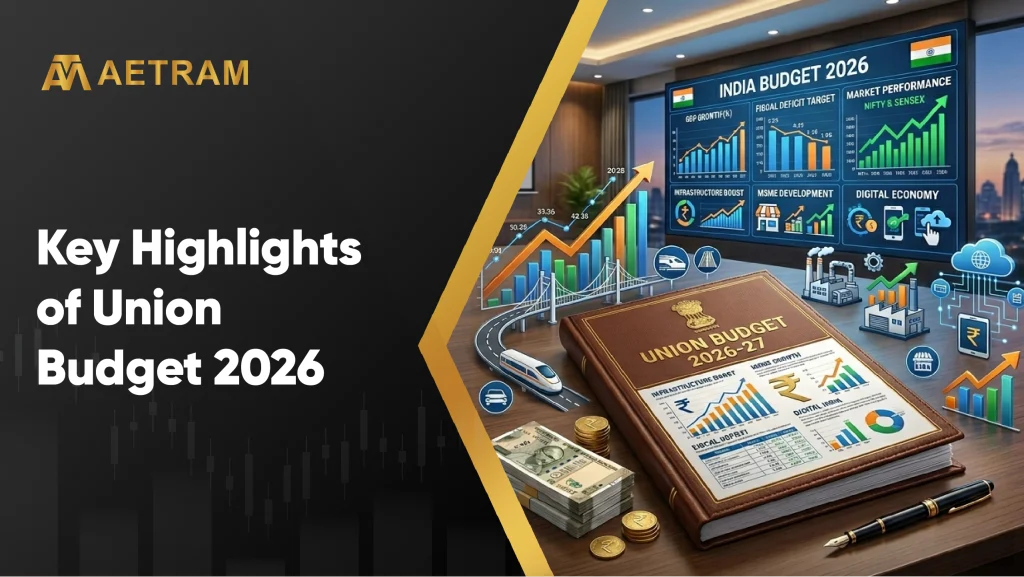
The Union Budget of India 2026 was presented by Finance Minister on February 1, 2026, that lasted for 85 minutes. The budget has outlined a comprehensive strategy for transforming the nation into a developed economy through fiscal discipline and structural reforms.
Finance Minister Nirmala Sitharaman said in the budget speech that the government plans to focus on the poor, underprivileged and the disadvantaged. Therefore, the government is inspired by 3 kartavya that is aimed at boosting the Indian economy, fulfilling citizen aspirations and access to resources, amenities as well as opportunities for meaningful participation.
The budget also proposed large scale public investment in manufacturing, continue infrastructure spending and focus on emerging technologies like artificial intelligence. Let us take a look at the key highlights of the budget 2026 in this blog.
Infrastructure
Public capital expenditure is set to rise to ₹12.2 lakh crore in FY2026-27, maintaining the strong momentum of the past decade.
Rail and Waterways
Seven high-speed rail corridors between cities will serve as growth connectors. They are Mumbai-Pune, Pune-Hyderabad, Hyderabad-Bengaluru, Hyderabad-Chennai, Chennai-Bengaluru, Delhi-Varanasi, Varanasi-Siliguri. To promote environmentally sustainable movement of cargo a new Dedicated Freight Corridors connecting Dankuni in the East to Surat in the West will be established.
With respect to waterways, 20 new National Waterways will be operationalized, starting with NW-5 in Odisha to connect mineral-rich regions like Talcher to major ports.
Green Energy
To align with net-zero roadmaps, ₹20,000 crore is allocated for Carbon Capture Utilization and Storage (CCUS) technologies across industries like power, steel, and cement.
City Economic Regions (CER)
The government aims to map CERs across tier-II, tier-III cities as well as temple towns, based on specific growth drivers, with an allocation of ₹5,000 crore per region to implement specialized development plans.
Information Technology and Data Centres
The safe harbor threshold for IT services has been raised from ₹300 crore to ₹2,000 crore, with a common safe harbor margin of 15.5%. Foreign companies providing global cloud services via Indian data centers will receive a tax holiday until 2047. Additionally, a safe harbor of 15% on cost is proposed for related entities providing these data center services.
Financial Services
Several key initiatives for India’s financial sector across banking, NBFC, stock market and bond market were announced in the budget.
Bank and NBFC
As part of strengthening the banking sector, a high level committee on banking for Viksit Bharat will be established to review the sector while ensuring consumer protection and financial stability.
To improve efficiency and scale in Public Sector NBFCs, the government proposes to restructure the Power Finance Corporation and Rural Electrification Corporation.
Additionally, the Foreign Exchange Management (Non-debt Instruments) Rules will undergo a comprehensive review to create a more contemporary and user-friendly framework for foreign investments.
Securities Transaction Tax (STT)
STT on Futures to 0.05 percent from present 0.02 percent. STT on Options premium and exercise of options are both proposed to be raised to 0.15 percent from the present rate of 0.1 percent and 0.125 percent respectively.
Corporate and Municipal Bond Markets
The budget proposes to introduce total return swaps and a market-making framework for corporate bonds, including access to derivatives on corporate bond indices. To support urban infrastructure, a ₹100 crore incentive is proposed for large cities that issue single municipal bonds exceeding ₹1,000 crore, while existing schemes for smaller towns will continue.
Portfolio Investment Scheme
Persons Resident Outside India (PROI) will be allowed to invest in listed Indian equity through the Portfolio Investment Scheme. The investment limits for individual PROIs will be increased from 5% to 10%, and the aggregate limit for all individual PROIs will rise from 10% to 24%.
Manufacturing
The government is doubling down on strategic sectors within the manufacturing sector to reduce dependency on imports and boost domestic capacity.
Biopharma SHAKTI
The government has earmarked ₹10,000 crore for the next five years to support the domestic production of biologics and biosimilars. This amount also includes three new NIPERs and over 1,000 clinical trial sites to combat the rising burden of non-communicable diseases in India.
Semiconductors and Electronics
Building on the momentum of India Semiconductor Mission (ISM), which was announced earlier, ISM 2.0 will focus on equipment, materials, design full-stack Indian IP, strengthen supply chains, industry-led research and training centres to develop technology and skilled workforce. The Electronics Components Manufacturing Scheme’s outlay has been nearly doubled to ₹40,000 crore.
New Rare Earth Corridors
The government aims to establish new rare earth corridors in mineral-rich states Odisha, Kerala, Andhra Pradesh, and Tamil Nadu. Additionally, three dedicated
Chemical Production
Chemical Parks will be developed using a cluster-based plug-and-play model to boost domestic chemical production and reduce import-dependency
Capital Goods and Logistics
The budget introduces “Hi-Tech Tool Rooms” as automated service bureaus to design high-precision components locally. Additionally, a ₹10,000 crore scheme for Container Manufacturing seeks to build a globally competitive ecosystem for logistics.
Reviving Textiles and Handicrafts
Textile sector is labour-intensive Textile Sector and the government has proposed the following:
- National Fibre Scheme for self-reliance in natural fibres such as silk, wool and jute, man-made fibres, and new-age fibres.
- Textile Expansion and Employment Scheme to modernise traditional clusters with capital support for machinery, technology upgradation, common testing and certification centres.
- A National Handloom and Handicraft programme to support weavers and artisans.
- Tex-Eco Initiative to promote globally competitive and sustainable textiles and apparels
- Samarth 2.0 to modernize and upgrade the textile skilling ecosystem through collaboration with industry and academic institutions.
- Setting up Mega Textile Parks in challenge mode focusing on value addition to technical textiles.
Mahatma Gandhi Gram Swaraj initiative to strengthen khadi, handloom and handicrafts industry. This will benefit our weavers, village industries and rural youth.
Transforming Sports through Khelo India Mission
The Mission will facilitate:
- An integrated talent development pathway supported by training centres
- Systematic development of coaches and support staff
- Integration of sports science and technology
- Competitions and leagues to promote sports culture and provide platforms
- Development of sports infrastructure for training and competition.
MSMEs
MSMEs are the vital engines of India’s economic growth and provide sunstantial employment opportunities to India. The budget adopts a three-pronged approach to empower them:
A ₹10,000 crore SME Growth Fund will provide risk capital to help small businesses scale into “Champions”.
The TReDS (Trade Receivables Discounting System) will be mandated for all purchases from MSMEs by Central Public Sector Enterprises (CPSEs). New credit guarantee mechanisms and the linkage of GeM (Government e-Marketplace) with TReDS will ensure cheaper and faster financing.
To help MSMEs in Tier-II and Tier-III towns manage compliance, a new cadre of accredited “Corporate Mitras” will be trained by professional institutions like ICAI and ICSI.
Orange Economy
India’s Animation, Visual Effects, Gaming and Comics (AVGC) sector is a growing industry, projected to require 2 million professionals by 2030.
The Indian Government aims to support the Indian Institute of Creative Technologies, Mumbai, in setting up AVGC Content Creator Labs in 15,000 secondary schools and 500 colleges.
Education
The Government will support States in creating 5 University Townships in the vicinity of major industrial and logistic corridors. Through capital support, one girls hostel will be established in every district.
To promote Astrophysics and Astronomy via immersive experiences, 4 Telescope Infrastructure facilities will be set up or upgraded. They are the National Large Solar Telescope, the National Large Optical-infrared Telescope, the Himalayan Chandra Telescope and the COSMOS-2 Planetarium.
Agriculture
The budget prioritizes increasing farmer incomes through high-value diversification and technology.
A multilingual AI tool, Bharat-VISTAAR, will integrate AgriStack and ICAR data to provide customized advisory support directly to farmers to reduce risks and boost productivity.
Targeted support is proposed for Coconut, Sandalwood, Cocoa and Cashew and the goal of the government is to transform Indian Cashew and Cocoa into premium global brands by 2030.
Building on the Lakhpati Didi success, SHE-Marts (Self-Help Entrepreneur Marts) will be established as community-owned retail outlets, helping women transition from credit-seekers to enterprise owners.
Healthcare
The government plans to expand healthcare by training 100,000 Allied Health Professionals (AHPs) over five years. Additionally, five regional medical hubs will be established to promote medical value tourism, integrating healthcare, research, and AYUSH centers.
To address mental health and the lack of facilities in North India, NIMHANS-2 will be established, alongside upgrades to institutes in Ranchi and Tezpur.
The Divyang Sahara Yojana will support ALIMCO to scale up R&D in assistive devices and establish Assistive Technology Marts where citizens can try and purchase products.
About 17 cancer drugs and medicines for 7 rare diseases are now exempt from basic customs duty.
Fiscal Consolidation
The government aims to balance ambition with fiscal responsibility as it has estimated the fiscal deficit for 2026-27 at 4.3% of GDP, down from 4.4% in the previous year.
The government’s long-term target is to reach a debt-to-GDP ratio of 50±1% by 2030-31. By reducing the debt-to-GDP ratio, the government aims to free up resources for priority expenditure by reducing interest outgo.
Taxation
Interest awarded by Motor Accident Claims Tribunals is now tax-exempt. The tariff on goods imported for personal use has been slashed from 20% to 10%.
The TCS rate for overseas tour packages as well as for education and medical purposes under Liberalized Remittance Scheme (LRS) has been reduced to 2%.
To encourage companies to shift to the new tax regime, the Minimum Alternate Tax (MAT) rate is reduced from 15% to 14%, and it will become a “final tax” with no further credit accumulation after April 2026.
To read more about taxes announced in Union Budget 2026, click here
Conclusion
The Union Budget 2026 is a comprehensive strategy for a Viksit Bharat as it focuses on high-tech manufacturing, empowering MSMEs, modernizing agriculture and creating a supportive ecosystem for every citizen to participate in India’s prosperity.
As the Finance Minister concluded, the government through this budget wants to ensure that the growth reaches every Indian.