How Will India Benefit From India-Oman CEPA?

Since the US started tariff war with many countries including India, we have been trying to diversify our trade with other countries by signing various bilateral trade agreements. India is one of the biggest economies in the world and the country has been signing trade deals with a number of nations which are likely to be strategic partners.
Recently, India signed a significant trade agreement with Oman in December 2025. Prime Minister Narendra Modi and Sultan Haitham bin Tarik Al Said signed the deal in the Omani capital Muscat. India-Oman Comprehensive Economic Partnership Agreement (CEPA) has formally come into force on June 1, 2026, a major milestone in bilateral trade.
This has come at a time when the Strait of Hormuz, one of the world’s most important energy chokepoints handling almost one-fifth of global oil consumption, came under great stress due to regional conflict.
That timing isn’t only a footnote. It is possibly the main reason this CEPA needs more notice than India’s other current trade agreements.
The trade deal with Oman is expected to help India as Oman could be a gateway to the bigger GCC and East African economies.
The deal is anticipated to open 127 service sub-sectors and also offer Indian exporters total duty-free access to a Gulf market. Here is a look at India’s potential advantages because of this deal.
What Exactly Is the India-Oman CEPA?
The Comprehensive Economic Partnership Agreement between India and Oman goes well beyond the normal Free Trade Agreement that was signed previously with other countries.
Normally an FTA will typically focus on tariff cuts for goods and services that are imported and exported from these two countries. But this CEPA will focus on easy access to import and export of goods, services liberalisation, investment protection, professional mobility, government procurement, intellectual property and regulatory cooperation into one coherent framework.
With this agreement, India has become only the second country in the world, only after the United States, to secure a comprehensive bilateral trade pact with Oman. As a result, this pact between the two countries shows how important the deal is for these two countries and how significant Muscat considers this relationship with India.
Near-Total Duty-Free Access
Before the CEPA was signed, only 15.33% of India’s exports entered Oman duty-free under the Most Favoured Nation (MFN) regime.
However, with the signing of CEPA, Oman has granted India 100% duty-free access on 98.08% of its tariff lines, covering 99.38% of India’s export value. This has been the most important statistic as part of this deal. The six-fold increase in duty-free market access and this has come into effect from June 1 and not in a phased manner over many years.
This is a boon for Indian exporters because they were previously paying tariffs up to 5% and in some product categories as high as 100%. Now, with the new trade agreement, it is a significant improvement in price competitiveness against rivals like China, Turkey, Italy and Thailand who do not enjoy similar preferential access.
Meanwhile, India has given tariff liberalisation on 77.79% of its tariff lines, covering 94.81% of imports by value from Oman. But India has made sure to protect sensitive domestic sectors like dairy, cereals, fruits, vegetables, edible oils, oilseeds, rubber, leather, and spices through an exclusion list. This calibrated approach and some sort of protectionist policies means Indian farmers and sensitive industries are shielded from competition in the domestic market even as exporters gain ground.
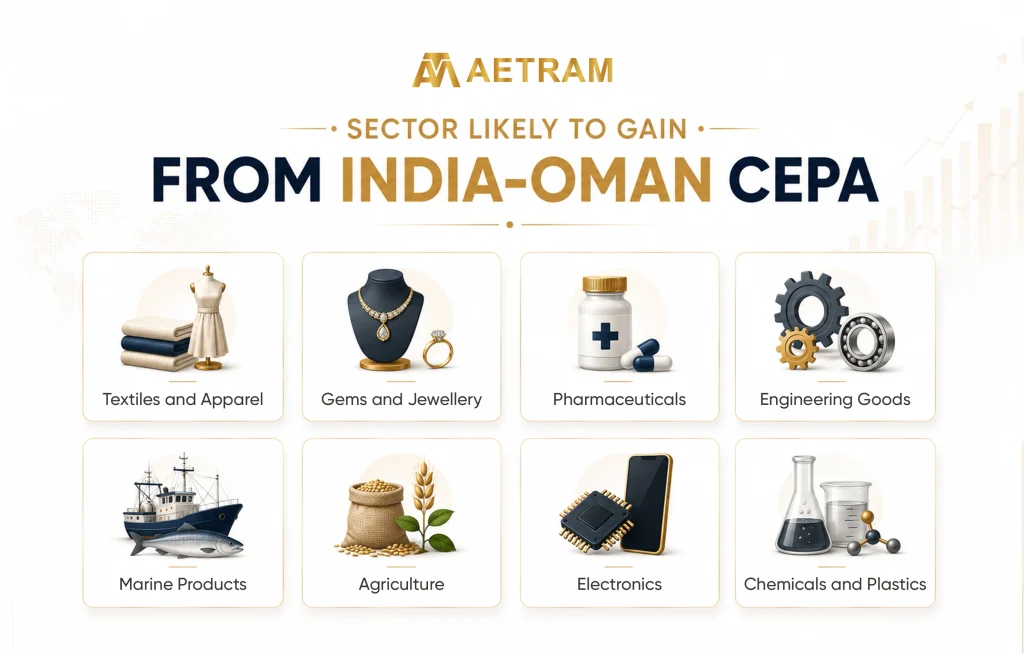
Which Sectors Are Likely To Gain
Textiles and Apparel
Textile and apparel is one of the important sectors for India and Oman has eliminated the existing 5% MFN duty across all 945 textile and apparel tariff lines.
India has an upper hand in this sector because roughly 43% share of Oman’s woven apparel imports and 31% of knitted apparel imports are from India. This duty-free access further strengthens India’s position against China, Bangladesh, and Turkiye.
Textile clusters in Tiruppur, Surat, Ludhiana, Panipat, Coimbatore, and Karur stand to gain. India’s textile exports to Oman have seen an increase from a 9.3% market share in 2023 to 22% in 2024.
Gems and Jewellery
There is a reason for the gems and jewellery industry to cheer because Oman has eliminated import duties of up to 5% for these products. There are a lot of opportunities for exporters in this sector because India’s exports in this category stood at around $35 million in 2024 against Oman’s total import market of $1.07 billion.
Industry estimates suggest that exports could climb to $150 million in the next couple of years and clusters like Surat, Jaipur, Mumbai, Kolkata and Chennai are expected to benefit.
Engineering Goods
Though Oman imports more than $3.7 billion worth of mechanical equipment India’s market share is only 5%. Oman also imports over $3.3 billion worth of cars yearly, but India’s market share is only 2%.
Engineering exports to Oman stood at about $875.83 million currently and this is expected to reach $1.3 – 1.6 billion by 2030 as Oman has replaced prior MFN levies of up to 5% with zero-duty access and this is expected to benefit iron, steel, industrial machinery, cars and copper products.
Pharmaceuticals
The actual victory here is regulatory quickness, not tariffs. Products accepted by strict worldwide authorities such the USFDA, EMA, UK MHRA, and TGA will now get Omani marketing permission inside 90 days without prior inspection; if inspections are needed, a 270-working-day target applies. Given that Oman’s pharmaceutical industry is expected to expand from about $303 million to $474 million by 2031, this regulatory fast-tracking eliminates one of the main non-tariff restrictions Indian pharmaceutical businesses usually experience overseas.
Here, the real win isn’t tariffs — it’s regulatory speed. Products approved by stringent global regulators like USFDA, EMA, UK MHRA, and TGA will now receive Omani marketing authorisation within 90 days without prior inspection, with a 270-working-day target where inspections are required. Given Oman’s pharmaceutical market is projected to grow from roughly $303 million to $474 million by 2031, this regulatory fast-tracking removes one of the biggest non-tariff barriers Indian pharma companies typically face abroad.
Marine Products and Agriculture
All marine products, including shrimp, fish, and cuttlefish, get immediate duty-free access, replacing duties of up to 5%. This should particularly benefit coastal states like Andhra Pradesh, Kerala, Tamil Nadu, and Gujarat. On the agricultural side, India already accounts for over 94% of Oman’s bovine meat imports and 98% of fresh egg imports — duty elimination locks in that dominance while opening further room in basmati rice, cashews, honey, butter, and sweet biscuits.
Electronics, Chemicals and Plastics
Oman’s electronics import market is worth around a couple of billions, but India’s exports stood at just around $140 million and this wide gap is expected to come down due to the new deal between New Delhi and Muscat.
In chemicals, India already supplies close to 39% of Oman’s inorganic chemical imports and the zero-duty access will most probably boost this number.
Exporters of plastic products, which is a largely MSME-driven export category worth $8.11 billion globally for India, also gets a clear price advantage of up to 5% over non-CEPA competitors.
Services and Professional Mobility Get a Real Boost
Trade in services under this CEPA deserves particular attention because it is the most comprehensive offer made to India by any GCC country. Oman has opened market access to 127 services sub-sectors covering IT, engineering, healthcare, education, accounting, construction and audiovisual services under GATS/Best FTA-plus commitments.
Concrete mobility gains include:
The ceiling for Intra-Corporate Transferees raised from 20% to 50%, letting Indian firms deploy more specialist and managerial staff in Oman
Business visitors permitted to stay up to 90 days, independent professionals up to 180 days, and Intra-Corporate Transferees up to 4 years
For the first time in any Indian FTA, Oman has made binding commitments for defined categories of professionals in accounting, engineering, medicine, IT, education, and construction
Future negotiations on a Social Security Agreement, which would eventually end dual social security contributions for Indian workers in Oman
With bilateral services trade at $863 million in 2024 and India holding just over 5% share of Oman’s $12.52 billion global services import market, the room to grow is substantial — particularly for India’s IT, healthcare, and professional services firms.
A Trade Route That Bypasses the Strait of Hormuz
This is where the India-Oman CEPA becomes really strategic rather than just commercial. Unlike most Gulf nations, much of Oman’s coastline lies outside the Strait of Hormuz, directly on the Arabian Sea and the Gulf of Oman. Its major ports like Salalah and Duqm remain accessible even when shipping traffic through Hormuz is disrupted by conflict.
This is a practical advantage because during the Hormuz crisis, while India’s imports from the wider Gulf region fell from around $15 billion in April 2025 to $9.8 billion in April 2026, and exports to the region dropped from $4.4 billion to $2.7 billion, India’s imports from Oman surged by 246.4%, from $430 million to nearly $1.5 billion, as energy purchases shifted away from riskier routes.
Oman has a lot of logistics hubs like Sohar, Duqm and Salalah which serve beyond the domestic market. It functions as a gateway to the wider GCC and East African markets. Cargo can even be transported overland from Omani ports to Saudi Arabia, the UAE and Yemen, an alternate route when maritime routes through Hormuz are congested or unsafe.
MSMEs, Employment, and Trade Facilitation
The agreement is built with labour-intensive, MSME-heavy sectors in mind. Trade facilitation measures including mandatory acceptance of certificates from India’s Export Inspection Council, recognition of India’s organic (NPOP) and halal certification systems, and a fully digitalised Certificate of Origin framework cut down the compliance burden that typically holds back smaller exporters.
That said, realistic expectations matter. On-ground reporting shows that engineering goods, processed food, and textiles are seeing the strongest MSME uptake, while chemicals and plastics face non-tariff hurdles like Oman’s separate drug registration process and stiff competition from Oman’s own subsidised petrochemical producers. Exporters who invest early in certifications and compliance infrastructure — as companies like Cera Sanitaryware and Parag Milk Foods have shown in other Gulf markets — are best placed to convert tariff access into actual sales.
Final Thoughts
The trade deal between India and Oman is comprehensive as almost all of India’s exports get instant duty-free access, a real services and mobility opening and also a concerted effort to keep sensitive domestic sectors safe and secure from foreign competition. More importantly a resilient trade corridor that keeps going even when the Strait of Hormuz is in turmoil. For Indian exporters, professionals, and MSMEs willing to navigate the compliance requirements, this agreement offers one of the clearest growth pathways into the Gulf region in years.
Frequently Asked Questions (FAQs)
1. When did the India-Oman CEPA come into force?
The agreement was signed on December 18, 2025, and came into force on June 1, 2026.
2. How much of India’s exports get duty-free access under the CEPA?
Oman offers 100% duty-free access on 98.08% of its tariff lines, covering 99.38% of India’s export value — up from just 15.33% under the earlier MFN regime.
3. Which sectors benefit the most from the India-Oman CEPA?
Textiles and apparel, gems and jewellery, marine products, agriculture and processed foods, engineering goods, and pharmaceuticals are among the biggest gainers.
4. Why is Oman strategically important for India beyond trade numbers?
Oman’s ports at Salalah and Duqm lie outside the Strait of Hormuz, making them a reliable alternative trade and energy route when Gulf shipping lanes face disruption.
5. How does the CEPA help India’s services sector?
Oman has opened 127 services sub-sectors to India, with expanded mobility for professionals in IT, engineering, healthcare, accounting, and education, plus a raised ceiling for intra-corporate transferees.