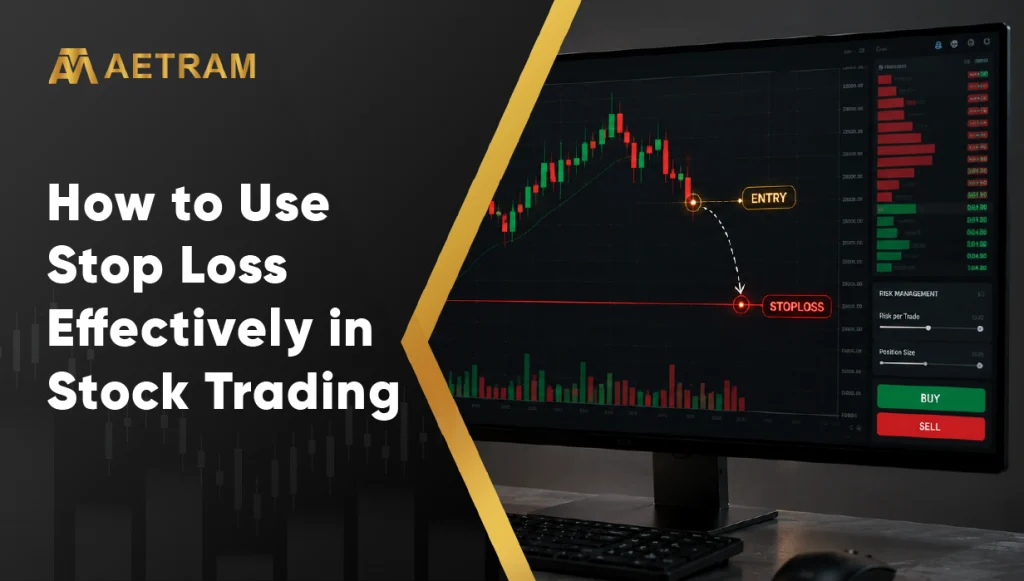
How to Use Stop Loss Effectively in Stock Trading
Consider a scenario where you purchase shares at ₹500 with the expectation of increasing value but instead see the value reduce from ₹500 to ₹450, then further down to ₹400. Each time, you think to yourself that “it will recover”. However, what happens if it does not? This is where the concept of a stop loss may play an important role in your risk management strategy. In place of waiting for losses to increase, you set the amount you would like to risk in any particular trade.
What is a Stop Loss?
A stop loss is an order intended to help limit your losses in a trade. This involves setting the point at which you want your position closed if the market works against you. For instance, if you enter a trade where you purchase stocks at ₹500 with a stop loss of ₹470, you risk ₹30 per share. This is not to predict where the stock will move, but rather control how much you may risk in the trade.
Why is a Stop-Loss Necessary?
It is common for investors to let small losses turn into large ones. Market fluctuations happen rapidly due to company news, economic news, international happenings or investor sentiments changing suddenly. The use of a stop-loss can help traders adhere to their preset risk tolerance instead of acting emotionally when prices fluctuate sharply. A stop-loss also prevents the temptation to hold on to a loss-making position in hopes that prices will bounce back.
How Should You Set a Stop-Loss?
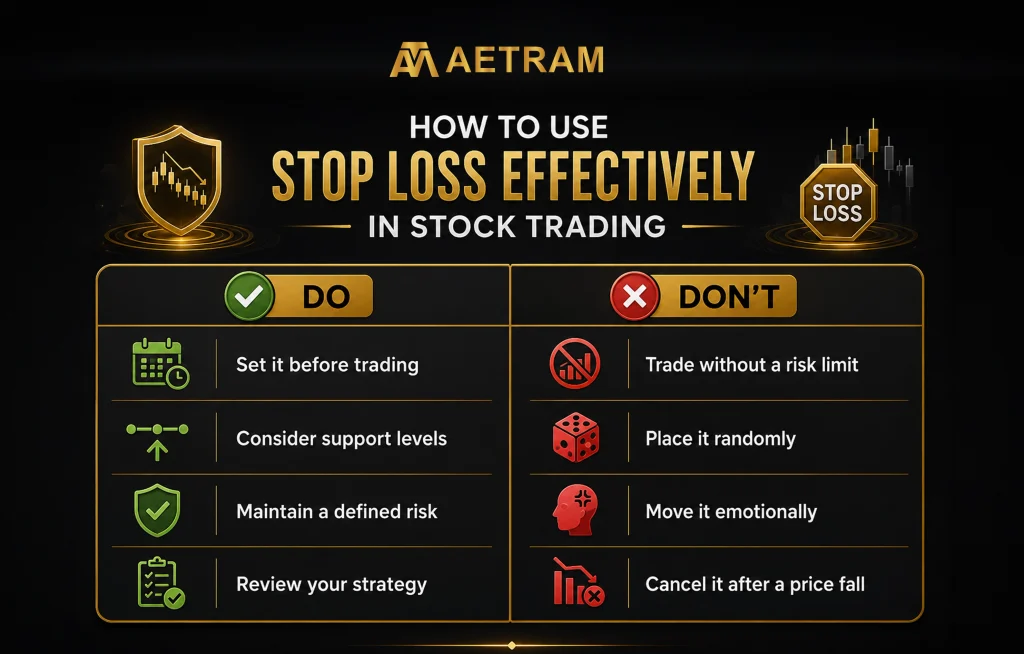
There is no particular stop-loss percentage that will apply across all stocks and strategies. Rather than setting your stop loss randomly, take into consideration the price behavior and your strategy for trading. A stop-loss, for instance, can be set below an important support level on a long trade provided that it fits your strategy. You should also base your position size on the risk you are willing to take.
In case you go long on 100 shares at ₹500 and have decided that the maximum loss for the trade is ₹3,000, a risk of ₹30 per share will be fitting.
Stop Loss vs No Stop Loss
Consider the scenario where both Arun and Karthik invest in a stock at ₹500. Arun uses a stop loss at ₹470 in line with his trading plan. When the stock dips to ₹470, he has to exit from the trade as per his risk limitation set at ₹30 per share. However, Karthik does not use a stop loss as he feels that the stock will bounce back to make profits. The prices dip from ₹500 to ₹470 to ₹450 and finally ₹400. As per his risk limitation, he holds the stock.
Considering that both have purchased 100 stocks, Arun’s risk would come to around ₹3,000 (excluding any charges), whereas Karthik at ₹400 stands to incur an unrealised loss of ₹10,000. The above example illustrates that a stop loss has nothing to do with guessing how far a stock can fall. It helps one determine the amount of risk involved before initiating the trade.
Do Not Set It Too Tight
One of the mistakes people tend to make is to set the stop loss at such a level close to the initial entry price that regular market oscillations activate it. Stock prices may oscillate during the trading period but not change the overall trend. If you have a tight stop loss, then you can be forced to exit the trade while it still has room to go.
Why Your Stop Loss May Not Execute at the Exact Price
The stop loss is a tool for risk management and not the means to exit the trade at the particular price you have set. Due to the volatility of the market, you may end up being stopped out at a price different from the one set as the stop loss. It is important to understand this beforehand.
What If a Stock Gaps Below Your Stop Loss?
A stop loss order does not ensure that your trade position would be closed out at the exact price point that you have set. In a case where the stock has gapped down below your stop level owing to an unexpected development or movement in the market, the price at which your order would be executed might not be exactly what you have specified. In a situation where you have put a stop loss of ₹470 and the stock gaps down at ₹450, your order would be executed at the price level prevailing in the market and not exactly at ₹470.
Do Not Move Your Stop Loss Based On Emotions
Assume that you bought shares in a company at ₹500 and had a stop loss at ₹470. The value of the shares fell to ₹472 and you think that they will bounce back. Therefore, you move the stop to ₹450 just so that your position is not closed. This makes the exercise of setting the risk limit futile. In case there are changes in your trading strategy, you should reconsider your position accordingly.
Stop Loss vs Target Price
A stop loss and a target serve different purposes.
| Stop Loss | Target Price |
| Helps limit potential losses | Defines a potential profit-taking level |
| Used when a trade moves against you | Used when a trade moves in your favour |
| Focuses on risk management | Focuses on potential returns |
| Should be based on your trading strategy | Should reflect your expected trade setup |
Using both can help create a more structured trading plan.
Stop-Loss Mistakes to Avoid
Many traders make a mistake by applying the same percentage for all stop-loss orders regardless of individual stock volatility. Position size should be taken into account as well. The wider the stop, the more monetary loss you should expect but it is possible to change the number of shares rather than the monetary loss itself. Above all, make sure that your trades are planned in advance and there are no stop losses because you are trading blindly.
Loss Planning before Profit Hunting
It is important to remember that successful stock trading consists not only in the ability to find the right stocks but also in knowing the amount of losses which are acceptable for each trade. Stop loss can introduce discipline into trading as an emotional procedure because it is a matter of defining the acceptable risk. Nevertheless, it is effective in the combination with a reasonable position sizing and volatility assessment. When entering a trade, you should not think about “how much I can earn?”. You should think about “how much am I ready to lose?”.
Connect with Aetram for more practical insights on stock markets, trading strategies and informed investing.
Frequently Asked Questions
- What is a stop-loss order?
A stop-loss order is an order designed to exit a trade when the price reaches a specified level, helping traders manage potential losses. - How do I decide where to place a stop loss?
The level should depend on your trading strategy, the stock’s volatility, support or resistance levels and the amount of risk you are willing to take. - Can a stop loss guarantee that I won’t lose more than the amount planned?
No. In rapidly moving markets, slippage can result in an execution price different from the stop price. - Should every trade have a stop loss?
Risk-management requirements vary by strategy, but traders should generally define their maximum acceptable risk before entering a trade. - What is the difference between a stop loss and a target?
A stop loss is designed to manage potential downside, while a target identifies a price level at which a trader may consider taking profits.