How Taiwan Became the World’s Fifth Largest Stock Market, Overtaking India
India’s stock market has seen a dream run since this century started and it became the fifth largest stock market in terms of market capitalization. India wore this milestone like a badge and took pride in becoming one of the top 5 biggest stock markets in the world. It was also a symbol of the country’s growing economic heft and a lot of FIIs preferring to invest in India among emerging markets.
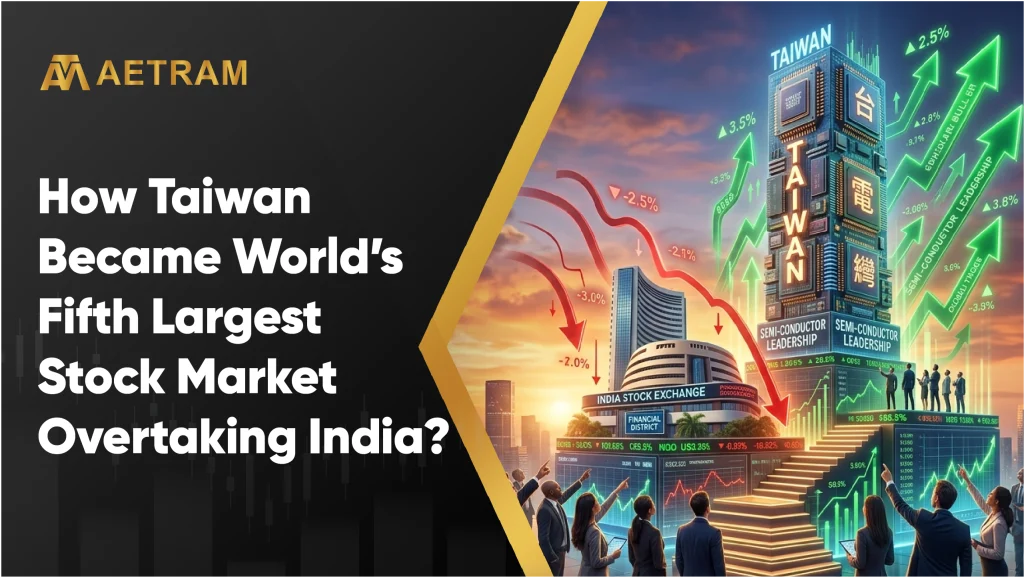
But this took a backseat in 2026 in the month of May when Taiwan’s stock market overtook India and it became the fifth largest stock market in terms of market capitalization. This wasn’t a gradual shift but it was a sudden and sharp rise in market capitalization. This was mostly due to the fortunes of a single company. For anyone tracking Indian markets or global capital flows, understanding how this happened and what it means going forward is worth a closer look.
The Numbers Behind the Shift
According to Bloomberg, Taiwan’s total stock market capitalization climbed to $4.95 trillion, nudging past India’s $4.92 trillion in the month of May 2026. It was only a narrow difference of about $30 billion but it was enough for the stock market to overtake India for the first time.
During that time (May 2026), the US led the world with a total market cap of $77.96 trillion, followed by mainland China at $15.57 trillion, Japan at $8.67 trillion and Hong Kong at $7.26 trillion. Taiwan then slots in at fifth, pushing India down to sixth.
To put this fall of India’s market cap in perspective, the country’s stock market had touched a peak valuation of $5.3 trillion back in January 2026. Since then, it had lost roughly $380 billion due to heavy selling by foreign institutional investors and a decline steep enough to hand Taiwan the title.
The Company Behind Taiwan’s Stock Markets Rise
Taiwan’s stock market rise and in the rankings table is in large part the story of one company: Taiwan Semiconductor Manufacturing Company, or TSMC. As the world’s largest contract chipmaker, TSMC now makes up nearly 40% or more of Taiwan’s benchmark TAIEX index and this is an extraordinary level of concentration for a national stock market.
TSMC’s share price had rallied close to 50% in a single year, fuelled by relentless demand for the semiconductors that sit at the heart of the global artificial intelligence boom. Over a slightly longer window, the stock has more than doubled. Given how much weight TSMC carries in the index, its rally has played a major role in lifting Taiwan’s entire market capitalization past India’s.
The “NVIDIA Proxy Effect” Explained
The share price of TSMC rose because of the shift in the global technology industry and due to one company it doesn’t even compete with directly and that is NVIDIA which is a US-based company.
NVIDIA designs some of the world’s most advanced AI chips but doesn’t manufacture them. That job falls to TSMC, which handles the fabrication, while Taiwan’s Foxconn assembles the physical servers and AI infrastructure that house these components. So whenever NVIDIA signs a large AI chip contract, that revenue eventually flows through to TSMC and Foxconn, sparking rallies in their stock prices.
People in the investing circles have started calling this the “NVIDIA proxy effect”. This is because Taiwan’s stock market has effectively become a way for global investors to bet on the AI boom, simply because so much of the physical hardware behind AI is built there.

Regulatory Tailwinds For Taiwan
Taiwan’s own regulators added fuel to this rally. Domestic mutual funds investing purely in Taiwanese equities were previously capped at holding a maximum of 10% of their assets in any single stock. That limit has now been raised to 25%, but only for companies whose weighting in the Taiwan Stock Exchange exceeds 10%.
At the moment, TSMC is the only company that clears that bar. The rule change effectively opened the door for far more domestic capital to flow directly into TSMC shares. Estimates suggest this alone could unlock several billion dollars of fresh inflows into the stock, adding further momentum to Taiwan’s market cap climb.
FII Outflows, Rupee and Crude Oil
India’s fall from the fifth spot wasn’t just a story of Taiwan surging ahead but it also reflects the pressure in the Indian stock market.
A combination of factors had weighed on investor sentiments through 2025 and 2026:
Record foreign outflows: Foreign institutional investors have sold stocks in droves and have pulled tens of billions of dollars out of Indian equities because they felt the valuation of Indian companies were stretched. They deployed this money into AI and semiconductor-linked markets like Taiwan and South Korea.
Rising crude oil prices: India is very much dependent on imports with respect to crude oil which is priced in USD. So, the Indian rupee is particularly sensitive to energy cost spikes which causes strain on the currency and corporate margins.
A weakening rupee: A depreciating Indian rupee will compound the negative impact of foreign selling because selling the currency will lead to erosion of dollar-denominated returns for foreign investors.
Benchmark declines: India’s two most important indices, the Nifty 50 and the BSE Sensex, dropped from earlier highs as FIIs who held large-cap stocks offloaded their stake in the components of these two indices.
So to put in simple words, Taiwan had a hardware and AI story to sell, but India lacked a comparable story and foreign investors rotated money into Taiwan stock market.
Is This a Structural Shift or a Temporary Dip?
There is always a tendency among people to get distracted when one country overtakes another country in any rankings. So as a serious investor or trader it is important not to get distracted by these rankings as they could always change.
In fact, India’s GDP remains several times larger than Taiwan’s and its long-term growth trajectory is still viewed favourably by many market participants, global investors, economists, analysts, etc.
Taiwan stock market’s rise in market capitalisation largely reflects its concentration in technology hardware, which happens to be at the centre of the current AI investment cycle and not a broader statement about economic strength. Markets without heavy exposure to AI-linked hardware like India are simply being overshadowed by markets like Taiwan and South Korea.
Some investors consider this as an overreaction amid the AI boom. India has been described as a market that’s been “ignored” for nearly two years, suggesting valuations may now look more attractive to contrarian, longer-term investors. According to various reports, there are also early signs that the global rush into AI and commodity trades may be losing some steam and the pace of foreign outflows from India has started to moderate.
What This Means for Indian Retail Investors?
For retail investors tracking Indian markets, a few takeaways stand out:
Rankings are not permanent and it can shift quickly. A difference as small as $30 billion was enough to flip a fifth-versus-sixth position which is a reminder that these rankings are more of a temporary snapshot rather than long-term view of the country’s economy.
Sector concentration matters. Taiwan’s rise shows how a single dominant sector — semiconductors, in this case, can move an entire market’s valuation. India’s more diversified market has both pros and cons in this context: less concentration risk, but also less of a singular “story” to attract a wave of thematic global capital.
Currency and commodity sensitivity is real. Oil prices and the rupee’s movement have an outsized influence on how foreign investors view Indian equities, and that’s unlikely to change soon.
Short-term pain doesn’t equal long-term weakness. India’s underlying economic fundamentals remain intact even as it has lost ground in near-term market capitalisation rankings.
Conclusion
Taiwan’s rise past India in the global stock market rankings is less a story about Taiwan’s economy overtaking India’s, and more a story about how concentrated the current AI investment boom is — and how disproportionately it rewards markets tied to semiconductor manufacturing. TSMC’s extraordinary rally, aided by regulatory changes at home, was powerful enough on its own to lift an entire national market past one nearly four times its economic size.
For India, the reshuffling is a reminder of how sensitive market capitalisation rankings are to global capital rotation, currency movements, and sector-specific themes. Whether this proves to be a temporary blip or a longer-lasting shift will depend on how the AI investment cycle evolves, and how quickly India can find its own catalysts to draw global capital back.
Frequently Asked Questions (FAQs)
How did Taiwan overtake India as the world’s fifth largest stock market?
Taiwan’s rise was driven almost entirely by a sharp rally in Taiwan Semiconductor Manufacturing Company (TSMC), which makes up nearly 40% or more of Taiwan’s benchmark index. TSMC’s stock surged on the back of massive global demand for AI chips, pushing Taiwan’s total market capitalisation past India’s.
What is the “NVIDIA proxy effect” mentioned in relation to Taiwan’s stock market?
It refers to how NVIDIA, which designs AI chips but doesn’t manufacture them, relies heavily on TSMC for chip fabrication and Foxconn for assembling AI hardware. As a result, every major AI chip order NVIDIA receives indirectly boosts TSMC and Foxconn’s revenues and stock prices, making Taiwan’s market a proxy for the global AI boom.
Why did India’s stock market value decline in 2026?
India’s decline was driven by a combination of record foreign institutional investor outflows, rising crude oil prices, a depreciating rupee and the absence of major AI-linked stocks to attract thematic global capital, unlike Taiwan and South Korea.
Does this mean Taiwan’s economy is now bigger than India’s?
No. India’s GDP remains significantly larger than Taiwan’s. This shift is specific to stock market capitalisation and reflects near-term sentiment and sector concentration rather than any change in the two countries’ underlying economic size.
Is India expected to reclaim its position as the fifth largest stock market?
India has already reclaimed its position as the fifth largest stock market in late June 2026. Some market participants believe the AI-driven rally may be losing momentum and that foreign outflows from India have started to moderate, though this remains to be confirmed by more recent market data.
Disclaimer: The information provided in this article is for educational and informational purposes only and should not be construed as investment, financial, or trading advice. Any financial figures, calculations, projections, examples, or scenarios are hypothetical, intended solely for illustrative purposes, and do not represent actual or future performance. The content is based on information obtained from credible and publicly available sources. While reasonable care has been taken in its preparation, no representation or warranty is made regarding its completeness, accuracy, or reliability. References to indices, securities, or other financial products are for illustrative purposes only. Actual investment outcomes may vary. Investors are advised to carefully read the relevant scheme, circular, or product offering documents and consult a certified and SEBI-registered financial advisor before making any investment decisions. Neither the author nor the publisher shall be liable for any loss, damage, or liability arising from the use of, or reliance on, the information contained in this article.